
Anti-corruption strategy presented
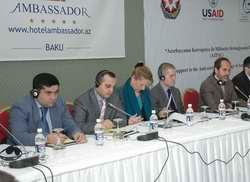
The new Anti-corruption Strategy and Action Plan of the Azerbaijani
government was introduced in Baku on Thursday with the support of
the US Agency for International Development (USAID) and the state
Commission on Combating Corruption.
The Council of Europe's first public awareness seminar, which is part of the Support to the Anticorruption Strategy of Azerbaijan Project (AZPAC), aimed to increase public awareness of issues and commitments undertaken by the government and its various agencies in combating corruption. The event brought together representatives from government bodies, the judiciary, international organizations, civil society and the media.
USAID Country Coordinator for Azerbaijan Scott Taylor said the agency was ready to cooperate with respective state bodies and other international organizations in implementing the anti-corruption strategy. He called on local media and civil society institutions to oversee the process.
Briefing the attendees on the project, CE consultant Quentin Reed said the organization not only conducts monitoring in its member states but also provides assistance in this area.
"AZPAC serves this purpose. Such projects are also being implemented in other South Caucasus republics and Baltic states," he said.
Reed said the key objective of the project was to counter corrupt practices and to promote democratic development and the rule of law in Azerbaijan by overseeing these efforts. The project will hold similar events in four different regions of the country in the upcoming months to support the anti-corruption measures being taken by relevant government agencies. During its implementation, international standards on fighting corruption will be studied and work done to improve respective national legislation in conjunction with partner institutions. Moreover, the project envisions supplying equipment to the Commission on Combating Corruption and its taskforce working to improve legislation.
A member of the commission, MP Bakhtiyar Aliyev said excellent legislative framework was in place to counter corruption in the country but certain problems with enforcing it remained. He said public opinion polls conducted by influential NGOs have revealed that citizens mostly confide in the head of state and the President's Office, while other government agencies are failing to gain full public confidence. Problems relating to anti-corruption combat remain in local executive authorities and some central executive bodies, Aliyev said.
He also maintained that some ministries are yet to comply with the anti-corruption laws passed so far. They restrict the work of local entrepreneurs by passing internal legal acts that are not in line with national laws.
"We should do away with such instances. The central government's authority should be gradually transferred to local executive authorities.
"Research by international organizations has already shown that Azerbaijan is pursuing a proper anti-corruption policy. We should simply speed up this process," Aliyev said.
Aliyev said that to achieve that goal, conducive environment should be provided to ensure transparency in state bodies, work continued to establish an advanced judiciary system, laws promoting fair competition in the domestic market passed and oversight over their enforcement stepped up.
"We won't be able to develop democracy without boosting small and medium enterprise. Without this fighting corruption will be challenging as well," the expert concluded.
Here we are to serve you with news right now. It does not cost much, but worth your attention.
Choose to support open, independent, quality journalism and subscribe on a monthly basis.
By subscribing to our online newspaper, you can have full digital access to all news, analysis, and much more.
Subscribe
You can also follow AzerNEWS on Twitter @AzerNewsAz or Facebook @AzerNewsNewspaper
Thank you!