
Obama-Erdogan talks focus on Turkey-Armenia ties, Garabagh
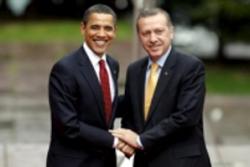
Turkey-Armenia relations and the Armenia-Azerbaijan
conflict over Upper (Nagorno) Garabagh topped the agenda of talks
between Turkish Prime Minister Recep Tayyip Erdogan and US
President Barack Obama at the White House Oval Office on
Tuesday.
Obama welcomed Erdogan’s steps toward a rapprochement in Turkish-Armenian relations, which have been strained for decades, calling on him to advance this process.
Erdogan said normalization of ties with Yerevan depends on the settlement of the Garabagh conflict.
"These issues are closely inter-linked. If one of them is not solved, solving the other one will be difficult. As the Turkish leadership, we are resolute on this," Erdogan said.
Erdogan told a news conference following talks with President Obama that he had brought to the White House leader’s attention the importance of finding solutions to all outstanding problems in the volatile region, including lingering conflicts. "If the Garabagh conflict is not settled, no hopes should be bound with sustainable peace in the region."
The Turkish premier said Ankara "has not lied to Armenia" and has delivered on its promises. He noted that Turkey had signed the protocols on mending ties with Armenia unconditionally, but parliament is demanding that progress be made in Garabagh settlement to ratify the documents.
"The government cannot influence this process by any means. Interfering with discussions ongoing in a parliamentary commission is beyond our powers. Political will does not suffice to solve this issue. The Turkish parliament approaches the Garabagh problem very sensitively," said Erdogan.
Turkey and Armenia have faced hostility for decades. In a bid to normalize ties, Turkey signed protocols to establish diplomatic relations and reopen its border with Armenia in Zurich on October 10, sparking concerns in Azerbaijan, Turkey’s ally. Ankara has ruled out a normalization of ties with Armenia before progress is made in Garabagh settlement. However, the Turkish government has already submitted the protocols to the Grand National Assembly.
Turkey closed its border with Armenia in 1993 due to Armenian occupation of Azerbaijani territory and claims on the alleged World War I-era genocide.
Erdogan said that, to accelerate the process of normalizing ties with Yerevan, the countries co-chairing the OSCE Minsk Group brokering Garabagh settlement – the United States, Russia and France – should step up their efforts. Views were exchanged on the matter during the meeting with the US president.
"The Minsk Group must fulfill its duties, speed the negotiating process and a result should be achieved swiftly. The support of this group of three to the meetings of the Azerbaijani and Armenian leaders should be increased. In that case the Armenia-Azerbaijan problem will be solved. Normalization of the Turkey-Armenia relations will also definitely be expedited and we will finalize this process fast."
The Garabagh conflict flared up in the late 1980s on Armenia's territorial claims. Armenia has been occupying over 20 percent of Azerbaijan's territory since the early 1990s, trampling on international law. The ceasefire accord was signed in 1994 after a lengthy war. Efforts by the international mediators have been largely fruitless but peace talks are underway. The negotiations are ongoing on the basis of the Madrid principles, the peace outline proposed by the intermediaries to Baku and Yerevan in late 2007.
President Obama and Prime Minister Erdogan also held discussions on the Nabucco project that aims to deliver Caspian and Central Asian gas to European markets. Erdogan noted that both Ankara and Washington support the project. He said, further, that talks on supplies are underway with resource-rich Azerbaijan, expressing confidence for their success.
Erdogan said many erroneously say that most of the gas for the Nabucco pipeline will come from Azerbaijan. "This is actually not so. For the time being, Azerbaijan is expected to supply 10 percent of the volume, and bringing the bulk to 25 percent is planned in the future."
Erdogan stressed that Turkey is located on the main transit route for Nabucco and is ready to provide the needed support for the project to be realized. He added that success of the project also hinges on the resolve of such energy majors as Statoil, Total and BP.
The Obama-Erdogan talks also focused on other pressing issues such as Iran’s nuclear program, the Israel-Palestine conflict, as well as the Iraq, Cyprus and Afghanistan issues.
Obama said Turkey could play an important role in resolving the problem surrounding Tehran’s nuclear activities. Erdogan, for his part, said Ankara was ready to make every effort to achieve a solution.
Regarding the situation in Afghanistan, Erdogan said his country has no plans, at this point, to increase its peacekeeping contingent in the war-torn nation.
Obama said in conclusion that Turkey was endeavoring toward world peace and stability, adding that both Ankara and Washington were firmly committed to fighting terror.
Erdogan, in turn, said the relations between Turkey, the first country visited by President Obama after taking office in January 2009, and the U.S. are based on the model of partnership, adding that Washington plays a major role in maintaining peace in the region and the entire world.
Here we are to serve you with news right now. It does not cost much, but worth your attention.
Choose to support open, independent, quality journalism and subscribe on a monthly basis.
By subscribing to our online newspaper, you can have full digital access to all news, analysis, and much more.
Subscribe
You can also follow AzerNEWS on Twitter @AzerNewsAz or Facebook @AzerNewsNewspaper
Thank you!