
Mediator sees favorable climate for Garabagh settlement
An unbiased environment has been created for
settling the Armenia-Azerbaijan Upper (Nagorno) Garabagh conflict,
an international mediator has said.
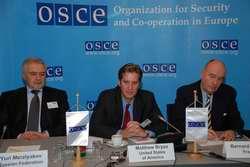
The statement by Yury Merzlyakov, the Russian co-chairman of the OSCE Minsk Group brokering a settlement to the long-standing dispute, came following a meeting with the leader of the self-proclaimed Upper Garabagh republic, Bako Saakian, on Sunday.
With regard to possible advances in the peace process in 2009, Merzlyakov said it was always challenging to make tentative projections and that he could not conclude what would exactly happen this year. He added that "under subjective conditions, the political will of the sides was necessary at times for the adoption of complicated but important decisions."
The mediator said the co-chairs had informed the leaders of the separatist regime that they saw new opportunities for moving the peace process forward after the latest meetings of the Azerbaijani and Armenian presidents.
"We shared our impressions and presumptions and are very pleased that they were heard and understood," he said.
Presidents Ilham Aliyev and Serzh Sarkisian last met in Zurich on January 28. The two held a one-on-one meeting, followed by talks attended by the foreign ministers and the Minsk Group co-chairs. The over two-hour meeting was described as constructive, but no comprehensive information was released.
The Russian Interfax news agency quoted a source from the office of the self-proclaimed republic`s leader as saying that Saakian had once again reiterated his position at the meeting regarding the participation of Upper Garabagh in peace talks as a party.
The co-chairmen had begun a visit to the region in Baku on Thursday. After holding talks with President Ilham Aliyev and Foreign Minister Elmar Mammadyarov, they headed to Yerevan, where they discussed Garabagh settlement with Armenian President Serzh Sarkisian and Foreign Minister Eduard Nalbandian, as well as Khankandi, an Azeri town turned by Armenians into the center of the self-proclaimed republic. They returned to Baku on Tuesday.
The co-chairs told reporters in the Azerbaijani capital that the meetings held with Armenian officials were very positive and significant. Bernard Fassier, the French co-chairman, said the intermediaries would table the outcomes of the talks held in Yerevan in Baku.
"We sensed good will from both sides. During our visit to Armenia, discussions were held on [arranging the next] meeting of the Azerbaijani and Armenian presidents. We now plan to discuss the results of the meetings we had in Yerevan with President Aliyev."
Fassier noted that whether or not the leaders` meeting would take place and its timing would be determined after discussions with President Aliyev later in the day.
US mediator Matthew Bryza said the talks were challenging but very important meetings had been held. "There used to be a threat to peace talks, but, luckily, the negotiating process continues."
Armenia and Azerbaijan waged a war in the early 1990s, which claimed some 30,000 lives and displaced about one million Azerbaijanis. Armenia has been occupying over 20% of Azerbaijan`s internationally-recognized territory since then. The ceasefire accord was signed in 1994, but Armenian armed forces have been persistently breaching the ceasefire on the frontline.
Here we are to serve you with news right now. It does not cost much, but worth your attention.
Choose to support open, independent, quality journalism and subscribe on a monthly basis.
By subscribing to our online newspaper, you can have full digital access to all news, analysis, and much more.
Subscribe
You can also follow AzerNEWS on Twitter @AzerNewsAz or Facebook @AzerNewsNewspaper
Thank you!