
Aliyev: Railway to turn host nations into Eurasian transport hub
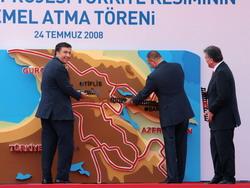
The major Baku-Tbilisi-Gars railway will turn Azerbaijan,
Georgia and Turkey into one of Eurasia's biggest transport hubs,
Azerbaijani President Ilham Aliyev has said.
Addressing the groundbreaking ceremony of the railway's Turkish
stretch in the eastern city of Gars on Thursday attended by the
three countries' leaders, Aliyev said regional cooperation will
further expand with the rail line's commissioning and the
protection of all three host countries' interests will be
strengthened.
"We will turn into an irreplaceable transport hub for Europe and
Asia. This will bring tremendous economic as well as political
dividends. We are already witnessing an increasing number of those
willing to join such large-scale projects launched by regional
states. The use of our infrastructure will certainly bring benefits
to each party involved, as this route is the most lucrative way to
transport energy resources. It is a project shortening a long
transportation route."
President Aliyev said materialization of the project once again
demonstrated the firm bonds of cooperation that link the three
countries hosting the railway. "Although many disbelieved the
realization of these projects [Baku-Tbilisi-Gars railway,
Baku-Tbilisi-Ceyhan and Baku-Tbilisi-Erzurum oil and gas
pipelines], our countries today play an important role in ensuring
the energy security of European states. We have managed to realize
our energy projects and are now linking the transport
infrastructure of the three countries. We have achieved these
results only thanks to the political will of our countries. The
Baku-Tbilisi-Gars project will share the fate of two other
large-scale projects - Baku-Tbilisi-Ceyhan and Baku-Tbilisi-Erzurum
- and our countries will become even closer," Aliyev said.
Turkish President Abdullah Gul, in his remarks, said the transport
corridor would revive the historic Silk Road. "Azerbaijan, Georgia
and Turkey are making history by creating this corridor, with the
Baku-Tbilisi-Gars railway being one of its pages. It is a railway
linking China, which lies at the heart of Asia, with the other end
- Great Britain in Europe."
Gul called on the Caucasus states to contribute to the project
implementation. "The railway project is open for all states in the
Caucasus region," he said.
Georgian President Mikheil Saakashvili said the project's
materialization showed close and solid cooperation among
Azerbaijan, Georgia and Turkey.
"The project eternally links all the three countries. We will sign
such large-scale projects in the future as well," he said.
After making their statements, the three presidents ascended to the
stage and placed symbolic rail models on the map of the region.
Construction of the 76-km rail line in Turkey's territory, which
stretches from the border with Georgia to Gars, will be carried out
by Turkish Ozgun Yapi and Celikler companies. According to the
latest estimates, the operations will cost Turkey $370 million to
be allocated by the country's government.
The railway that is considered the "Iron Silk Road" will create the
shortest route to transport cargo between Europe and Asia. The deal
on the project was reached on February 7, 2007 by Presidents Aliyev
and Saakashvili as well as Turkish Prime Minister Recep Tayyip
Erdogan. Construction work started in the Georgian territory in
November that year. The work will be done in two stages.
Construction of the 26-km Marabda-Kartsakhi rail line under the
first stage is currently under way. The railroad was initially to
be completed in 2009 but the deadline will not be met. During the
second stage, a 160-km section will be upgraded and a station built
on the Turkish-Georgian border for the replacement of railway
carriages.
The Baku-Tbilisi-Gars railway is to be commissioned by mid-2011. It
will allow to transport 5 million tons of mainly dry cargo a year,
with the volume to quadruple in the years to come. Passengers will
be transported directly from Baku to Turkey as well. The project
was initially estimated at $500 million but its cost may rise to
$700 million. Operations in the Georgian section of the railway are
being carried out on account of a $200 million loan disbursed from
Azerbaijan's State Oil Fund for 25 years. Tbilisi will pay the
advantageous interest rate of 1% under the credit.
Analysts commenting on the importance of the Baku-Tbilisi-Gars
railway say transportation via the corridor will be cheaper than by
other routes. The project stands out for relatively low expenses on
transportation, loading and unloading of consignments. The
Europe-Asia route will certainly draw the interest of other states.
The route will be 60 km shorter than other alternatives, which will
allow to save costs on transportation.
The rail line might be a lucrative corridor for Russia in the
future as well. Due to the lack of a rail link between Russia and
Turkey, Moscow should positively respond to the initiative.
The transport routes used during the Soviet times have ceased to
exist due to conflicts that flared up in the South Caucasus region,
and Russia therefore could gain from the commissioning of only the
Baku-Tbilisi-Gars railway. Thus, cargo will be transported from the
north to European and other markets through Turkey and vice
versa.
The Baku-Tbilisi-Gars project initially represented "a forbidden
fruit" for international financial institutions, and Western ones
in particular. US Congress once vetoed its financing by the
state-run EximBank. European institutions also noted that
implementation of the project would bolster Armenia's economic
blockade. However, neither the United States nor Europe put any
substantial pressure on the project participants to abandon its
realization.
Here we are to serve you with news right now. It does not cost much, but worth your attention.
Choose to support open, independent, quality journalism and subscribe on a monthly basis.
By subscribing to our online newspaper, you can have full digital access to all news, analysis, and much more.
You can also follow AzerNEWS on Twitter @AzerNewsAz or Facebook @AzerNewsNewspaper
Thank you!