
Azerbaijan eyes to produce new type of fuel for cars, vessels
By Kamila Aliyeva
The third SOCAR International Caspian and Central Asia Downstream Forum on Trading, Logistics, Refining and Petrochemicals continued its work in Baku on April 25.
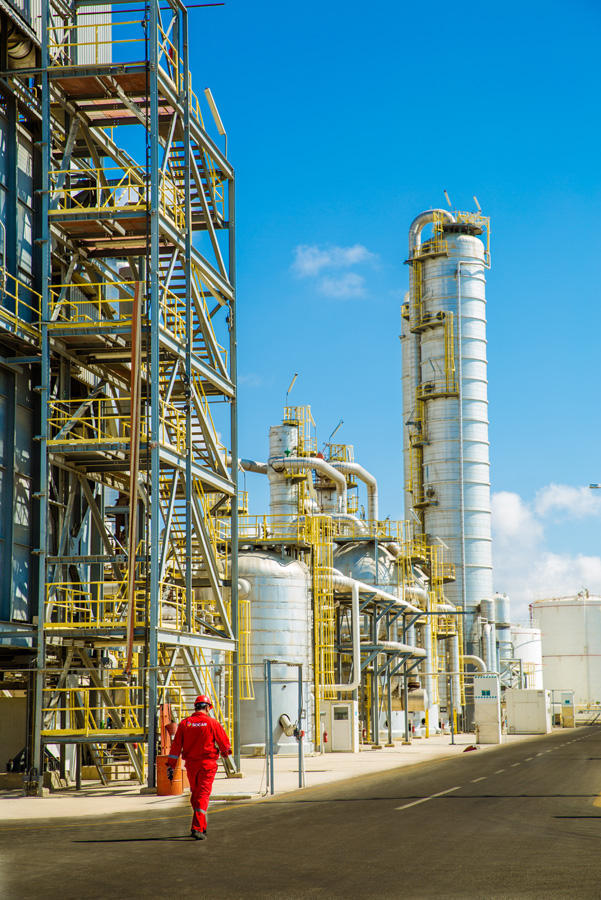
Addressing the forum, Khayal Jafarov, the director of SOCAR’s carbamide plant, informed that its construction has been completed by 99.2 percent.
The engineering work and equipment procurement are completed by 100 percent, construction work – by 97 percent, civil work – by 99.88 percent, while the equipment installation is completed by 96.7 percent, he noted.
“Some pumps and other elements have already been launched in the test mode, and the operation of some systems is being tested. The turn-key project’s completion is expected in the fourth quarter this year,” Jafarov said.
He added that the first auxiliary product, ammonia, will be obtained in August-September.
“After that, the urea production section will start its work, and the carbamide will be first produced under the 'Made in Azerbaijan' brand in October-November,” Jafarov said.
SOCAR spent 320 million euros from 500 million euro loan allocated by foreign banks for the construction, according to Jafarov.
He said that the total cost of construction of the plant is estimated at 770-780 million euros.
"The payback period of the plant is estimated at seven to eight years at current prices for carbimide," said Jafarov.
At first, financing of construction work was carried out from the Azerbaijani state budget and about 210 million manats were allocated from there before the beginning of 2015, another 60-65 million euros were allocated to SOCAR.
But later it was decided to switch to project finance and negotiations with banks were started. As a result, the Export–Import Bank of South Korea (EximBank) opened a line of credit worth 500 million euros under Azerbaijan’s state guarantee to complete the construction of the plant. EximBank will directly provide 251 million euros, while 249 million euros will be allocated by three commercial banks (Italy’s UniCredit S.p.A., France’s Societe Generale S.A. and Germany’s Deutsche Bank AG) with the support of EximBank.
The plant will produce 1,200 tons of ammonia and, subsequently, 2,000 tons of urea per day. It is planned to supply a quarter of production, that is, 150,000-200,000 tons of urea, to the Azerbaijani domestic market. The remaining part will be exported to Turkey, Georgia and the markets of the Black Sea and the Mediterranean Sea countries.
South Korea’s Samsung Engineering won the tender for the construction of the carbamide plant. Samsung Engineering acts as a general contractor of the plant’s construction, but it has no license for production of urea and ammonia, which will be by-product in the urea production process. Therefore, the relevant licensing agreements were signed with Haldor Topsoe company (Denmark) for production of ammonia and Stamicarbon B.V. company (the Netherlands) for production of urea. Production at the plant will be environmentally friendly. The plant will have an autonomous electricity system, and will consume 25-26 MW of electricity per hour.
Speaking at the event, General Director of SOCAR Methanol LLC Elnur Mustafayev noted that the methanol plant plans to produce 350,000 tons of methanol in 2018.
“Last year, we produced 265,000 tons of methanol, which exceeds the annual plan by 6 percent, and we plan to produce 350,000 tons in 2018, and 500,000 tons of methanol in 2019,” he said.
Mustafayev noted that the company's strategic goal is to increase production efficiency up to 90 percent, maintain price competitiveness, increase the share in the domestic market and expand warehouse capacities.
He went on to say that the plant intends to expand its product line.
“SOCAR Methanol produces technical and analytical methanol. We want to expand the product line in order to create additional added value in the short term. We plan to produce methanol that can be used as motor fuel and formaldehyde,” Mustafayev said.
He noted that methanol can be used by cars and vessels as motor fuel.
“In 2020, the rules regulating the reduction of emissions of harmful substances by vessels will come into force. These restrictions will affect vessels operating on diesel fuel. In this regard, transition to methanol as motor fuel is more appropriate, and it will require less money to adjust the engine to work using methanol rather than liquefied natural gas (LNG),” Mustafayev said.
He noted that the possibility of setting up transportable formaldehyde production at the SOCAR Methanol LLC is also being considered, and negotiations are underway to prepare the feasibility study of the project.
“We expect to get specific results during 2018,” Mustafayev added.
The plant also plans to increase the supply of methanol by sea, according to the director general .
“Presently, methanol is exported by the Marketing and Operations Department of SOCAR through the Kulevi Oil Terminal, the storage capacity of which allows storing 20,000 cubic meters of methanol with the possibility of expansion,” Mustafayev said.
The methanol from Azerbaijan is supplied to the countries of the Mediterranean region (Spain, Italy, Slovenia, Greece, Egypt, Israel), to Turkey, Georgia, Romania, Belgium, France, Kazakhstan, China and even Brazil, he noted.
He added that the company plans to increase supplies through the Caspian Sea via the Volga–Don Canal.
The director general noted that it is necessary to increase the storage capacities of the plant.
“This will make it possible to increase marginal profit, cut logistics costs, ensure sustainable development of the facility and guarantee fulfillment of contractual obligations, as well as reduce dependence on rail transport,” Mustafayev added.
Production of methanol at Azerbaijan’s methanol plant, the only plant of this kind in the South Caucasus and Central Asia, started in January 2014.The plant’s annual capacity is 650,000-700,000 tons. SOCAR acquired the plant from the Aqrarkredit non-bank credit organization. The plant cost was estimated at $520 million.
Later, advisor to vice-president on strategic development at SOCAR Teymur Aliyev, while speaking to reporters on the sidelines of the event, noted that the integration of filling station of liquefied petroleum gas (LPG) and bitumen plant in general infrastructure of the Baku oil refinery named after Heydar Aliyev was completed by 39 percent,
He said that this project is being realized within a separate part of the work.
“Contractors of Azerbaijan's state oil company- Foster Wheeler Engineering and Tekfen - have completed 98 of the detailed design. In general, the work on this package has been completed by 39 percent, while it is planned to complate the work in mid-September 2018,” Aliyev said.
He went on to say that SOCAR will sign an Engineering, Procurement and Construction (EPC) deal on transferring the primary oil processing unit together with atmospheric and vacuum distillation units (ELOU-AVT) with capacity of two million tons from the former Azneftyag oil refinery as part of the modernization of the Baku oil refinery.
He said that a part of the research conducted by the contractor, an alliance of SOCAR-Foster Wheeler Engineering and Tekfen Construction and Installation companies, has already been completed.
“Following the Front-End Engineering Design (FEED) phase, the EPC contract will be signed. The development of the project’s implementation strategy is almost completed. The FEED phase is to be completed in November 2018, and the entire project of the unit’s transfer - in late 2020-early 2021,” he said
In February 2018, SOCAR signed an Engineering, Procurement, and Construction (EPC) deal with the Italian Tecnimont on construction of new installations at the Baku oil refinery within the framework of its modernization project.
The Baku oil refinery’s modernization will be completed by 2022. The refinery’s processing capacity will be increased from 6 to 8 million tons of oil per year. The operational period will increase up to 2040.
Earlier, expert Gleb Gorodyankin said that the diversification policy of Azerbaijan’s state oil company SOCAR is an instrument of real support of commodity prices.
He noted that since January 2016, there has been an increase in the premiums for Azeri Light crude oil in relation to Brent Crude oil.
“At the same time, the demand for Urals oil fell in the European markets, and Russia cut the supply in the Western countries. The demand for oil from Iran, Iraq and the US increased in the Baltic countries. In January-April, oil supplies from the US to Europe increased almost fourfold from 1.8 million tons to 6.7 million tons, while the share of the European market in the structure of US exports increased from seven to 12 percent,” Gorodyankin said.
The expert added that the European market of oil products is in a difficult situation, because gasoline arbitrage to the US is almost closed.
“We observe more stable situation regarding diesel fuel, the supply of distillates from Russia and Kazakhstan may increase by the end of 2018. Against this backdrop, the arbitrage of oil varieties to Asia becomes particularly important, because in the medium term this will bring stability to the Caspian oil varieties. Own capacities, which allow companies to allocate raw materials for processing and give the opportunity to build their own logistics chain, also gain importance,” he said.
The third SOCAR International Caspian and Central Asia Downstream Forum is dedicated to the 95th anniversary of the birth of Azerbaijan's national leader Heydar Aliyev and is organized jointly by Baku Higher Oil School (BHOS) and Confidence Capital company (UK).
The number of its attendants has significantly increased since last year. Among experts and managers of state organizations and transnational companies, there are 72 participants from Azerbaijan, 49 representatives from Russia, 32 delegates from Kazakhstan, 53 participants from Austria, France, Germany, Great Britain, Italy, Poland, Spain, Switzerland and other European countries, 19 delegates from Iran, Singapore, Turkmenistan, UAE, Uzbekistan and other Asian countries, and a representative of Columbia.
The forum participants included managers and experts from state structures and enterprises, petroleum companies (traders, oil refinery and oil extraction), transport companies (ports, terminals, pipes and expeditors), banks, legislative and consulting companies, manufacturers, universities, and enterprises dealing with development of new technologies.
During the first three days of the forum, nearly 40 speakers from 30 countries made presentations and provided an overview of petrochemical industry in Azerbaijan and other Caspian countries, prices and target markets for oil and oil products, and gas production prospects and export routes. The delegates also focused on commercial positioning and prospects for development of refining facilities, analyze supply and demand for petrochemical products, and discuss current markets and potential export routes for them from the region. On April 26, they will make technical visits to the facilities of Heydar Aliyev refinery and Oil Gas Processing and Petrochemical Complex in Sumgayit.
---
Kamila Aliyeva is AzerNews’ staff journalist, follow her on Twitter: @Kami_Aliyeva
Follow us on Twitter @AzerNewsAz
Here we are to serve you with news right now. It does not cost much, but worth your attention.
Choose to support open, independent, quality journalism and subscribe on a monthly basis.
By subscribing to our online newspaper, you can have full digital access to all news, analysis, and much more.
You can also follow AzerNEWS on Twitter @AzerNewsAz or Facebook @AzerNewsNewspaper
Thank you!