
Kazakh ruler wins time for power transfer with election run
By Bloomberg
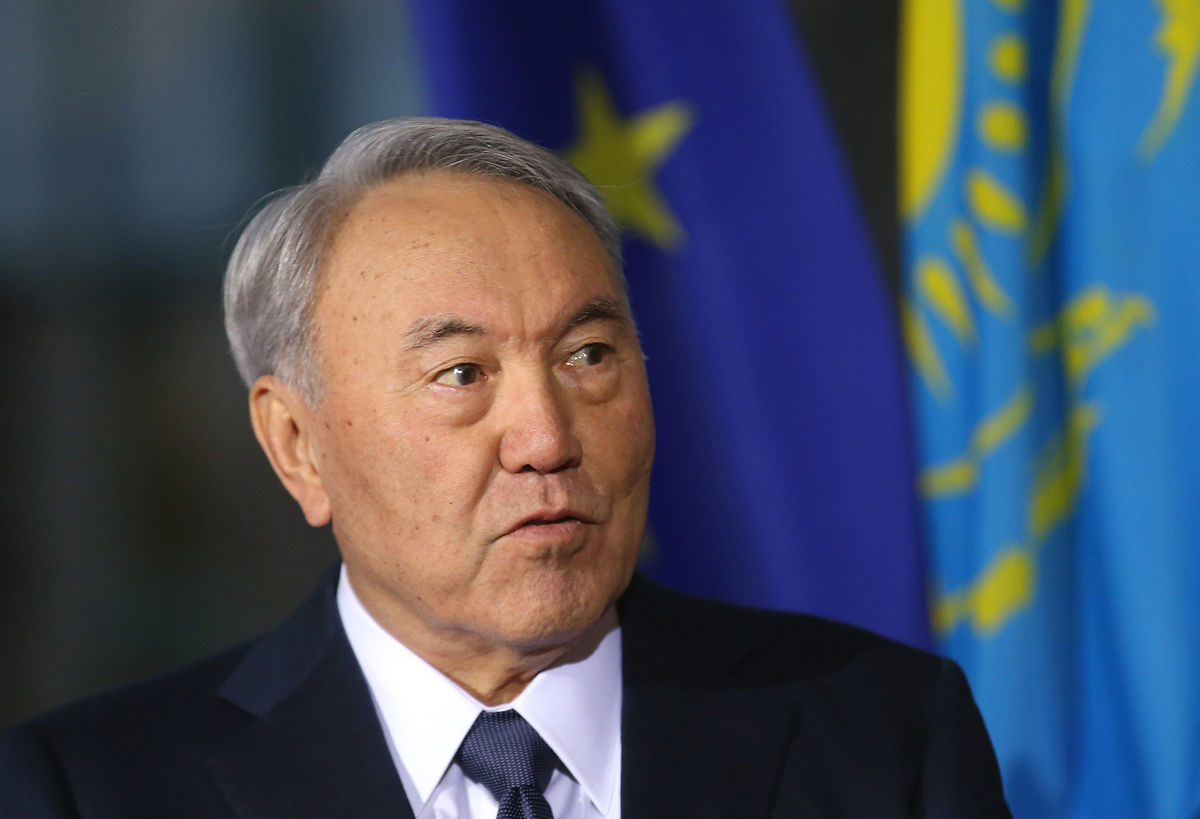
Kazakh President Nursultan Nazarbayev declared his intention to run in earlier-than-scheduled elections that will extend his 25-year rule, the longest of any leader in the former Soviet Union.
“All citizens should enjoy the same level of rights, carry the same burden of responsibility and have access to equal opportunities,” Nazarbayev, 74, told a meeting of his Nur Otan party in the capital Astana after announcing his candidacy in the snap elections scheduled for April 26.
He set out proposed reforms including strengthening the independence of the judiciary, creating a more “professional” bureaucracy with foreigners possibly appointed to state posts, and boosting the status and accountability of police. The former capital Almaty could be given a special status as a financial center, he said.
As first secretary of Kazakhstan’s Communist Party since 1989, Nazarbayev was the de-facto head of state at the time of the Soviet collapse in 1991. He has since won four presidential elections, most recently in April 2011 when he received 95.5 percent of the vote for a five-year term that would have expired in 2016. The lack of any clear succession plan heightens institutional risks for a country where policy making is “highly centralized,” Standard & Poor’s said on Feb. 9, when it cut Kazakhstan’s sovereign rating to BBB from BBB+.
‘Different Plans’
“To be honest, I had very different plans. I’ve led Kazakhstan for many years and stood at the beginning of its independence,” Nazarbayev told a gathering of female politicians, sports stars and pop celebrities on March 6, ahead of the March 8 International Women’s Day, according to the state-owned Kazinform news service. “Perhaps it’s time to change the scenery, as they say in the theater.”
Kazakhstan has attracted more than $150 billion of foreign investment since independence, mostly to exploit the abundant oil, gas and mineral reserves in a country whose land mass is the size of western Europe. The central Asian nation of 17 million people, which accounts for about 40 percent of the world’s uranium output, became a founding member of the Russian- led Eurasian Economic Union in January along with Belarus and Armenia.
Life Leader
“Nazarbayev understands that the system he built will collapse if he doesn’t make political reforms,” Dosym Satpayev, director of the Kazakhstan Risks Assessment Group said in an interview. Besides the personality of the president, “other guarantees of stability must be created in the form of political institutions” with parliament getting a real mandate from the population, he said.
“It’s very dangerous when shadow power groups play a key role in a political system, but not political parties,” Satpayev said. While a strong president can control the situation, “the departure of that person can turn those groups into destabilizing factors.”
In 2007, Nazarbayev signed into law a bill exempting his presidency from a constitutional two-term limit. Three years later, parliament voted unanimously to declare him “leader of the nation” for life and granted him powers to manage the country after his resignation. Nur Otan won more than 80 percent of the vote in a 2012 parliamentary election.
Currency Pressure
Kazakhstan has been under pressure to devalue the tenge and its companies have struggled to compete after Russia, the country’s biggest export market, saw the ruble drop by 46 percent against the dollar in 2014. Former Soviet republics including Belarus, Azerbaijan, Turkmenistan, Georgia and Moldova have devalued their currencies to try adjust to the ruble’s decline.
It’s costing Kazakh authorities $2 billion to $3 billion per month to maintain the tenge’s present exchange rate of about 185 per dollar as falling oil prices and capital flight put pressure on the currency, according to a March 5 research note by Moody’s Investors Service. A devaluation is unlikely before the election, Moody’s said.
Although its natural resources, including the world’s largest proven zinc deposits, have helped make Kazakhstan the second-largest economy among former Soviet republics, it remains hamstrung by corruption. The country ranked 126th out of 174 countries surveyed worldwide in Berlin-based Transparency International’s 2014 Corruption Perceptions Index, alongside Honduras and Pakistan.
Russia, China
Nazarbayev has maintained stability among Kazakhstan’s ethnic and religious groups, while keeping a balanced policy in relations with Russia and China, and developing a cadre of market-oriented managers with a western education, Satpayev said.
The conflict in eastern Ukraine between government troops and pro-Russian separatists has raised concerns about the future for Kazakhstan, where Russians make up a quarter of the population, once Nazarbayev leaves the presidency. Russian President Vladimir Putin jangled nerves in August when he told a pro-Kremlin youth camp that Nazarbayev had created a state “where there’s never been a state” and that the “vast majority of the citizens of Kazakhstan favor stronger ties with Russia.”
There isn’t any other option than for Nazarbayev to run again, as the opposition has been decimated under his rule and “no other viable candidate has emerged,” Kate Mallinson, a partner at London-based political risk advisory firm GPW & Co. who studies central Asia, said in e-mailed comments. “No other individual would be able to speak to Putin on roughly equal terms, and Kazakhstan would be more vulnerable to pressure from Russia,” without Nazarbayev, she said.
While Nazarbayev has championed the virtue of political stability during his tenure, the predominantly Muslim country has faced intermittent attacks by Islamic extremists.
In 2011, it suffered its worst violence in 20 years after a riot by oil workers in a region bordering the Caspian Sea left at least 14 people dead and more than 100 injured. The president moved to restore control, replacing top government officials and the head of state energy producer KazMunaiGaz National Co. and sending security forces to fight militants.
Compared to any potential successor, Nazarbayev will be able “to navigate better the social and ethnic tensions that will likely result from the deteriorating economic situation,” Mallinson said.
Here we are to serve you with news right now. It does not cost much, but worth your attention.
Choose to support open, independent, quality journalism and subscribe on a monthly basis.
By subscribing to our online newspaper, you can have full digital access to all news, analysis, and much more.
You can also follow AzerNEWS on Twitter @AzerNewsAz or Facebook @AzerNewsNewspaper
Thank you!