
Dollar risk at $115 billion looms over rate cycle: Turkey credit
By Bloomberg
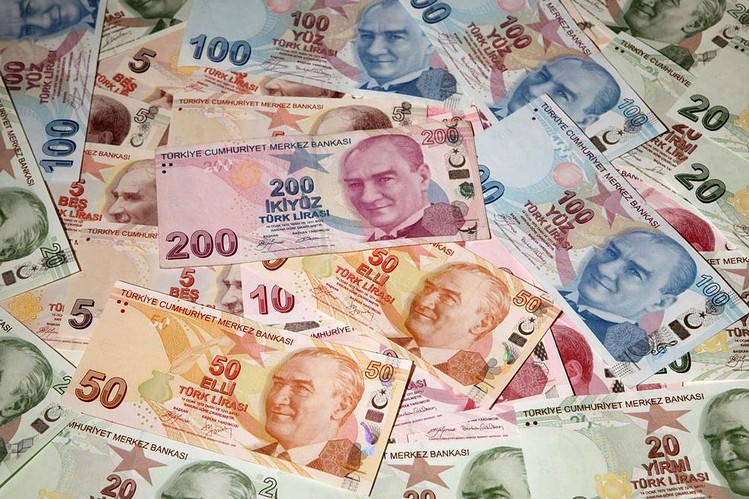
Turkish companies’ record exposure to foreign-currency debt is a growing risk to the central bank as policy makers weigh deeper interest-rate cuts to spur growth.
Corporate short-term foreign-exchange debt rose 2.5 percent to $115 billion last year, the highest year-end figure since the central bank began reporting the statistics in 2002, data released Monday showed. The threat to the lira is also building as the U.S. moves closer to its first rate increase since 2006, Fitch Ratings said.
With Turkey reliant on foreign cash, including to help finance the nation’s current-account gap, “any ill-thought rate cut” could deter inflows of short-term funds, according to Okan Akin, a fixed-income analyst at AllianceBernstein Ltd. in London. Ten-year government yields have jumped the second most among 22 emerging markets monitored by Bloomberg since central bank Governor Erdem Basci cut the benchmark to 7.75 percent on Jan. 20 amid political pressure to lower borrowing costs.
“The focus is on the central bank, particularly on interest rates,” Zsolt Papp, who helps oversee $43 billion of emerging-market fixed-income assets as a money manager at JPMorgan Chase & Co. in London, said by e-mail on Feb. 16. “Aggressive rate cuts could raise concerns about the lira and its potential impact on corporate foreign-exchange debt.”
Rates Test
While Turkey has narrowed its current-account gap, foreign liabilities remain a key risk, Paul Rawkins, a senior director at Fitch in London, said by e-mail Feb. 13. The deficit fell to $46 billion last year from $65 billion in 2013 on weaker consumer demand for imported goods and lower energy prices.
The cost to non-financial companies from the lira’s depreciation over the past month is equivalent to about a third of the current-account gap, according to Yeliz Karabulut, an analyst at ALB Menkul Degerler in Istanbul.
Turkish short-term corporate debt is more than five times the $20.6 billion owed by Polish companies, according to the latest data from the Polish central bank. Foreign-currency debt owed by lenders has increased to about 17 percent of Turkey’s gross domestic product, up from 7 percent in 2010, according to Fitch.
Looming interest-rate increases in the U.S. may test the Turkish economy’s resilience to changes in global investor sentiment, said Rawkins.
The lira has weakened 4.1 percent to 2.4472 per dollar since the central bank’s 50 basis-point cut to its main interest rate last month was followed by calls for further reductions from President Recep Tayyip Erdogan. The yield on Turkey’s 10- year lira notes has climbed 39 basis points in the period to 7.62 percent, the biggest increase after Brazil among emerging- market bonds tracked by Bloomberg.
Currency Cost
Even exporters with earnings in foreign currencies may be hurt by further interest-rate reductions weakening the lira, Karabulut said by phone Feb. 16.
“We expect the central bank to cut interest rates this month mainly due to political reasons,” she said. “Foreign debt is a huge risk to the Turkish economy.”
Here we are to serve you with news right now. It does not cost much, but worth your attention.
Choose to support open, independent, quality journalism and subscribe on a monthly basis.
By subscribing to our online newspaper, you can have full digital access to all news, analysis, and much more.
You can also follow AzerNEWS on Twitter @AzerNewsAz or Facebook @AzerNewsNewspaper
Thank you!