
Syria goes to parliamentary polls, talks in Geneva start
By Aynur Karimova
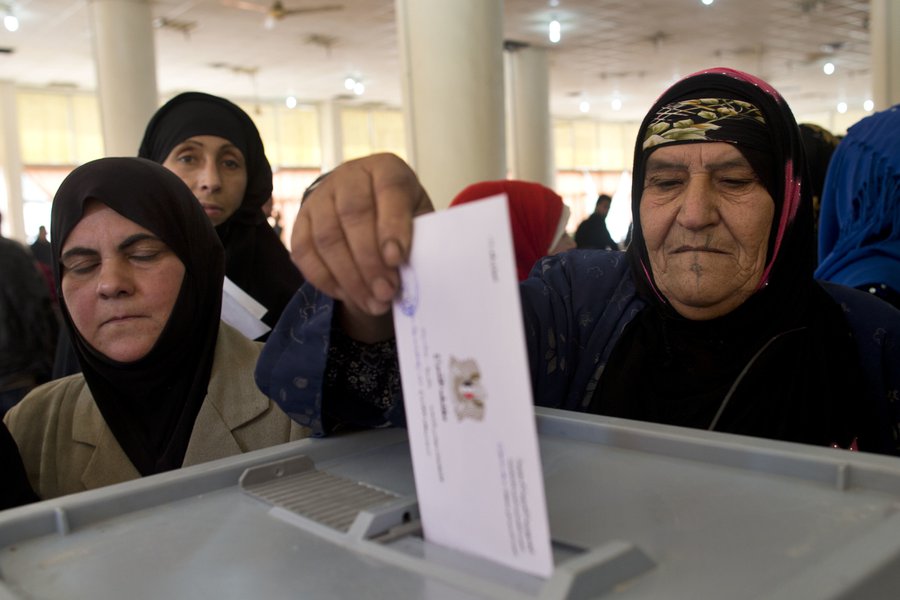
The population living in the territories controlled by the government of the war-torn Syria went to the parliamentary polls on April 13 to elect 250 MPs, on the same day when the second round of UN-backed peace talks kicked off in Geneva.
Only government-controlled areas took part in the elections, where the population has shrunk to around 8 million from the country's pre-war demography of 24.5 million.
This is the second parliamentary election held by the government in wartime.
The decision to hold the parliamentary elections on the same day with the start of peace talks is considered by several experts as a signal that President Bashar al-Assad has no plans to step aside, which is a key demand of the opposition delegation at the negotiations.
Deputy Foreign Minister Faisal Mekdad has already underscored Assad’s position, saying the opposition should abandon the “dream” of a transitional government. "Such a plan will never be acceptable," he said in his recent interview.
Meanwhile, the High Negotiations Committee, an umbrella group that represents the Syrian opposition in Geneva, believes that "the Assad regime will do whatever it can to undermine and derail the political process," and has called the April 13 election a "farce."
Now the opposition demands holding "free elections in Syria after the political transition," which is a main topic of Geneva talks.
Meanwhile, Bashar al-Jaafari, the government's head negotiator, has already announced that the government's delegation will visit Geneva and he will give a keynote speech in New Jersey to commemorate the 70th anniversary of Syria's full independence from French rule.
Thus, the message to the international community is clear: the Assad regime is the only legitimate government of Syria, and the recapture of Palmyra by the state army from the so-called Islamic State was a key point in voicing this message.
Assad regime sees Palmyra victory as a hope to rehabilitate him as national hero valiantly fighting IS terrorism. The restoration of Palmyra, the crown jewel in Syria's tourism industry, will now be the flagship project for rebuilding Syria.
Election slogans also echo the mantra "Together, hand in hand, we will rebuild Syria."
Both Russian and Iranian parliamentarians were in Damascus to support the elections and declare their readiness to be "a real partner to their Syrian counterparts in the post-crisis reconstruction stage".
Russian Foreign Minister Sergey Lavrov believes that Syria's parliamentary elections aim to avoid a legal vacuum before early elections are held under a new constitution.
"The Syrian sides will have to agree on a new constitution, on how they see the structures needed to ensure a steady transition to a new system," he said on April 13 in a news briefing. "There is an understanding already that a new constitution should emerge as a result of this political process, on the basis of which new, early elections are to be held."
He reiterated that a political transition, which includes drafting a new constitution and holding another round of elections, remains key elements of ending the five-year-long war.
The spokesperson of the Russian Foreign Ministry Maria Zakharova noted in her Facebook account that the Syrian parliamentary election is a “major factor of stabilization in the country.” She also mentioned that the polling is absent from EU media coverage.
However, no any country except Russia and Iran recognized these elections.
Western states denounced the poll as illegitimate. They said the election was out of line with a U.N. Security Council resolution that calls for elections at the end of an 18-month transition.
"The decision of the regime to hold elections is a measure of how divorced it is from reality. They cannot buy back legitimacy by putting up a flimsy facade of democracy," said a spokesperson for the British government.
France said the elections were a "sham" organized by "an oppressive regime".
French President Francois Hollande went as far as saying that "the idea that there could be elections is not just provocative but totally unrealistic. It would be proof that there are no negotiations or discussions [in Geneva]."
Germany, like France, has refused to give legitimacy to Syria's elections, saying in part that the current conflict there makes it impossible to hold "free and fair elections." German Foreign Ministry spokesman Martin Schaefer went on to say that the "German government will not recognize the results of these elections."
The U.S. State Department spokesperson, Mark Toner said that the U.S. “would view those elections as not legitimate in the sense that they don’t represent… the will of the Syrian people.
“So, to hold parliamentary elections now, given the current circumstances, given the current conditions in the country, we believe is at best premature and not representative of the Syrian people,” Toner noted.
Geneva talks starts with new hopes
The UN Syria envoy, Staffan de Mistura opened a new round of peace talks on April 13 to renew pledges for supporting a ceasefire that had been shaken by serious incidents but "not a bushfire".
The aim of de Mistura, who has called the peace talks "flexible," is to achieve UN-supervised elections within 18 months, where all Syrians can vote.
"In spite of the several and serious incidents, the cessation of hostilities is still holding, particularly when we compare to what used to be," de Mistura told reporters in Geneva.
He believes that the repeated "incidents" would damage confidence in the partial ceasefire, which began on February 27 and does not include the IS or al-Qaeda linked groups.
Since the first round of talks ended on March 24, de Mistura has traveled to Moscow, Damascus, Tehran and Amman.
He said officials in all four capitals had indicated support and interest in a discussion aiming at a political transition in Syria. "None of them actually expressed any doubt that is the priority and the agenda."
The opposition High Negotiations Committee Head, Asaad al-Zoubi believes that establishing a transitional governing body is the top priority this time around.
The delegation representing the Assad government is expected to arrive in Geneva on April 15 after vote-counting from parliamentary elections.
The conflict which started in 2011 has killed more than 250,000 people and created millions of refugees, dividing Syria into a several areas controlled by the government, an array of rebels, a powerful Kurdish militia, and the IS group.
The Damascus government controls around one third of Syria, including the main cities in the west, home to the bulk of Syrians who have not fled the country. The UN puts the number of Syrian refugees abroad at 5.8 million.
A partial truce, agreed in February 2016, had helped bring the fighting sides to Geneva. However, renewed fighting in south of Aleppo has violated the ceasefire to breaking point. The sides have blamed each other for ceasefire violations.
Meanwhile, experts are optimistic about the fruitfulness of the second round of Geneva talks that will focus on political transition and a stable political process in Syria.
They say if increased ceasefire violations have not disrupted the peace process until now, neither will the provocative offensives of Jabhat al-Nusra and its rebel groups achieve it.
--
Aynur Karimova is AzerNews’ staff journalist, follow her on Twitter @Aynur_Karimova
Follow us on Twitter @AzerNewsAz
Here we are to serve you with news right now. It does not cost much, but worth your attention.
Choose to support open, independent, quality journalism and subscribe on a monthly basis.
By subscribing to our online newspaper, you can have full digital access to all news, analysis, and much more.
You can also follow AzerNEWS on Twitter @AzerNewsAz or Facebook @AzerNewsNewspaper
Thank you!