
Preliminary Iran deal: Will it lead to resolution of nuclear dispute?
By Sara Rajabova
Forgotten a while ago, a peaceful solution to the disputes is once again on the international community's agenda now following a diplomatic breakthrough was formulated in between Iran and the P5+1.
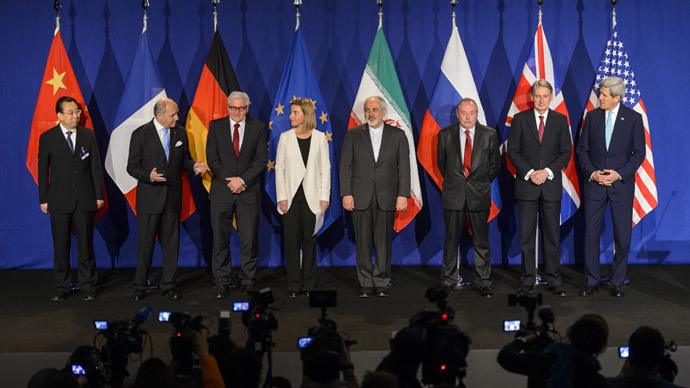
The world powers and Iran have finally reached a “historic breakthrough”, as appreciated by the negotiating sides, in the marathon talks in Lausanne, Switzerland, that lasted over a week, in view of resolving a decade-old nuclear dispute with the Islamic Republic.
Iran and the P5+1 group of world powers adopted on April 2 a joint statement that envisages considerable cuts to Tehran’s nuclear program in return for the lifting of international sanctions.
With the recent progress, nuclear dispute on Iran’s uranium enrichment program entered a resolution stage.
The main point in this issue is that the sides, which previously supported irreconcilable positions, now managed to iron out all major differences and reached a common consensus.
This can be viewed as a diplomatic victory of the world powers in a time when conflicts and wars have considerably broken hopes for any peaceful solution over disputed questions.
Reaching such a breakthrough when the Middle East is grappling with civil wars, conflicts and terror activities, was especially important in view of preventing another hotbed for war in this region.
The complete failure of the nuclear negotiations could have led to unprecedented results not only for Iran, but for region as a whole.
Though a final deal on Iran’s nuclear issue has not been inked yet, the recent framework agreement brought much needed relief to international tensions and proved that even issues that seem impossible to resolve can be settled through negotiations.
Iranians celebrated in the streets after negotiators reached a framework for a nuclear deal. Under the deal international sanctions should get lifted and Iran will be able to resume all activities, no longer a pariah of the world community. Iranians are hopeful that the deal will end years of international isolation and avert the threat of war.
Foreign companies awaiting financial sanctions removal
The lifting of restrictions will considerably improve the economic situation of the Islamic Republic. Analysts have predicted the country’s national currency rial, which dramatically dropped against the dollar after EU and U.S. bans in 2012, will strengthen following recent progress.
Moreover, foreign businesses, especially energy companies are set to rush to enter the Iranian market after the framework agreement.
“Consulting companies are reviving old contacts, lots of signs that companies are pre-positioning themselves. One sign of the degree of interest is that it’s impossible to get a hotel room these days in Tehran,” The Guardian quoted Bijan Khajepour, an Iranian businessman, who is managing partner of the Vienna-based Atieh International consultancy.
Western companies, such as Airbus, Boeing, as well as auto companies Peugeot, Renault, General Motors stand now in line to return to the Iranian market. They are waiting for the removal of all financial sanctions on Iran.
Also, the oil companies were reported to have been in talks with Iran to return to the country. Bijan Namdar Zanganeh, the Iranian oil minister, has met executives from BP, Shell, Total of France and Lukoil of Russia before a meeting of the Organization of Petroleum Exporting Countries last November.
Meanwhile, following the announcement on the preliminary agreement, oil prices started to fall as Iran will be able to export more crude after the removal of sanctions. Currently, the prices for Brent oil stands at $54.95 per barrel, showing 3.77 percent fall.
Sanctions have cut Iran's oil exports to about 1.1 million barrels per day from 2.5 million bpd in 2012. The OPEC nation is keeping about 30 million barrels of crude on a fleet of tankers ready to be shipped when allowed, into a market already flooded with supply, according to Reuters.
Countries hail preliminary accord
The majority of countries, as well as negotiating sides of the nuclear talks have hailed the framework agreement as a “decisive step” after more than a decade of work, however, noting that there “many technical details” still which must be ironed out for a future deal.
Obama described the agreement as a "historic understanding with Iran". He compared it to the nuclear arms control deals struck by his predecessors with the Soviet Union that "made our world safer" during the Cold War, Reuters reported.
The other members of the P5+1 group, as well as the world countries hailed the agreement.
However, there are also countries that are not happy and to some extent frustrated by the deal with Iran.
One of these countries is Israel, which sees such a deal as a threat to its security. Following an announcement about the progress on the nuclear issue, Israeli Prime Minister Benjamin Netanyahu said it could lead to nuclear proliferation and war in the Middle East.
In a statement released after the conversation with Obama on April 2, Netanyahu said a deal based on the framework announced in Lausanne "would threaten the survival of Israel", according to Reuters.
Moreover, the Sunni Arab States are also not satisfied with the nuclear arrangement with Shiite Iran. Saudi Arabia, which sees Iran as a regional rival, along with some of the Arab states have yet to issue statements.
U.S. President Obama reportedly called Netanyahu and Saudi Arabia’s King Salman bin Abdulaziz al-Saud to comfort them on the deal international negotiators reached with Iran on its nuclear program.
A long way ahead
Though world powers and Iran reached a preliminary agreement, the most difficult work to do remains ahead. The negotiating teams from Iran and the U.S. are expected to present the details of the deal in their respective legislative bodies.
The major hurdle for them is convincing hardliners back home. The Republicans in the U.S. Congress have said not to be in favor of any deal with Iran and threatened to impose new sanctions on the Islamic Republic. Also, hardliners in the Iranian parliament are skeptical of the West’s true intentions when it comes to an agreement with Iran.
Moreover, a final deal is still not reached. World powers and Iran negotiators should start drafting the Joint Comprehensive Plan of Action to meet the June 30 deadline. Also, many details still need to be worked out.
Reuters reported diplomats close to the negotiations as saying that the preliminary deal was fragile and the understandings reached could still collapse between now and June 30.
Experts believe it will be much harder to reach a final deal than it was to agree the framework agreement.
--
Sara Rajabova is AzerNews’ staff journalist, follow her on
Twitter: @SaraRajabova
Follow us on Twitter @AzerNewsAz
Here we are to serve you with news right now. It does not cost much, but worth your attention.
Choose to support open, independent, quality journalism and subscribe on a monthly basis.
By subscribing to our online newspaper, you can have full digital access to all news, analysis, and much more.
You can also follow AzerNEWS on Twitter @AzerNewsAz or Facebook @AzerNewsNewspaper
Thank you!