
The zero-emissions imperative
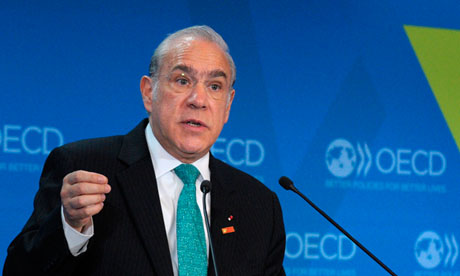
By Angel Gurría
Secretary-General of the OECD
Our planet is warming dangerously. And, as the 2013 report by
the Intergovernmental Panel on Climate Change makes clear, our
carbon-dioxide emissions over the past half-century are extremely
likely to be to blame. A more robust approach to global warming is
needed if we are to avoid catastrophe. Unlike the recent financial
crisis, there is no bailout option for the earth's climate.
Three years ago, at the United Nations COP 16 climate-change
meeting in Cancún, countries agreed to reduce their emissions by
2020 to a point that would prevent the average global temperature
from rising more than 2°C above pre-industrial levels. However, UN
estimates show that current trends would bring the world only
25-50% of the way to this target.
This is why I am calling on all governments to be more ambitious -
to aim for zero net emissions from fossil fuels by the second half
of this century. Nothing short of a wholesale transformation of the
energy economy will suffice.
Just this week, the European Commission unveiled new energy and
climate targets for 2030 - calling for a 40% reduction in the
bloc's greenhouse-gas emissions from 1990 levels, with 27% of
energy to come from renewable sources. This is an extremely
important step, and more countries should follow suit.
To be sure, we will encounter huge obstacles. Two-thirds of
electricity generation, and nearly 95% of the energy consumed by
the world's transport systems, comes from fossil fuels. Our energy
security is increasingly tied to the exploitation of unconventional
fossil-fuel deposits like shale gas, especially in the United
States. Carbon-intensive technologies remain more profitable than
low-carbon alternatives in many cases. And cash-strapped
governments continue to encourage oil and gas exploration, in part
because the rents received by some account for a large part of
their revenues.
But change is possible. There is a yawning gap between what
governments promise to do about climate change and their
often-inconsistent (if not incoherent) policies. Even when
appearing to support greener technologies, governments are prone to
sudden policy changes, sometimes retroactively, leaving businesses
reluctant to commit to significant investments, or even take
official statements seriously at all.
I believe we can make substantial and rapid progress by setting a
clear direction on three issues:
Put a price on carbon. By pricing the cost of carbon, we can manage
its use (or disuse). More than 40 countries have already
implemented some form of carbon tax or emissions-trading scheme.
Trading schemes are often politically more attractive, because they
can be flexible (although their design and implementation could be
improved in many cases). But we can be bolder. Several governments
have successfully introduced carbon taxes without adversely
affecting growth, and we should encourage more countries to follow
their example.
Cut fossil-fuel subsidies. The OECD estimates that fossil-fuel
subsidies in member countries amounted to $55-90 billion annually
from 2005 to 2011. And the International Energy Agency estimates
that in 2012 fossil-fuel subsidies worldwide grew to $544 billion.
Most of these subsidies should be scrapped; the energy industry
does not need more state aid to burn fossil fuels (and, in
developing and emerging economies, subsidies are a grossly
inefficient and probably unnecessary way to help the poor).
Clarify policies. Governments must address inconsistencies in their
energy strategies, consider the links with broader economic
policies, and stop sending mixed signals to consumers, producers,
and investors. In particular, they must assess whether the right
regulatory arrangements are in place to allow clean-energy
investments to compete on a risk-return basis. This will be
essential if investors are to redirect investment toward
climate-friendly alternatives.
The OECD will play its part. In order to understand and compare
countries' performances more accurately, OECD Economic Surveys will
now include data and analysis of climate policies. By mid-2015, we
expect to have a clear picture of the progress being made and the
challenges that remain in OECD countries and all major emerging
economies - and to have advised these countries how they can
realistically increase the ambition and cost-effectiveness of their
policies.
These steps will signal that the price of emissions must rise
substantially if we are to reach our goal of zero net emissions.
The transformation will not be costless, and governments must be
frank with their electorates about its social and economic impact.
But a low-carbon, climate-resilient world will also offer new
economic opportunities.
More important, the alternative - inaction, or too little action -
would be far more expensive in the long run. Hurricane Sandy, for
example, cost the US the equivalent of 0.5% of its GDP. The annual
bill for flood protection in coastal cities worldwide is likely to
rise above $50 billion by 2050. The consequences for developing
countries are more dire: Typhoon Haiyan, which hit the Philippines
in 2013, was a stark reminder of how vulnerable poor countries can
be to climate change.
If the world is to avoid a collision with nature - one that
humanity surely cannot win - we must act boldly on every front,
particularly with respect to carbon pricing and the coherence of
our economic and energy policies. And we must do so now.
Here we are to serve you with news right now. It does not cost much, but worth your attention.
Choose to support open, independent, quality journalism and subscribe on a monthly basis.
By subscribing to our online newspaper, you can have full digital access to all news, analysis, and much more.
You can also follow AzerNEWS on Twitter @AzerNewsAz or Facebook @AzerNewsNewspaper
Thank you!