
Turkey's tripartite initiative to be effective: expert
By Aynur Jafarova
The establishment of a tripartite relationship between Turkey, Azerbaijan, and Turkmenistan can be an effective move to bring Turkmen gas to Europe.
Turkish Foreign Minister Ahmet Davutoglu recently said Turkey, Azerbaijan, and Turkmenistan intend to create a tripartite format of relationship.
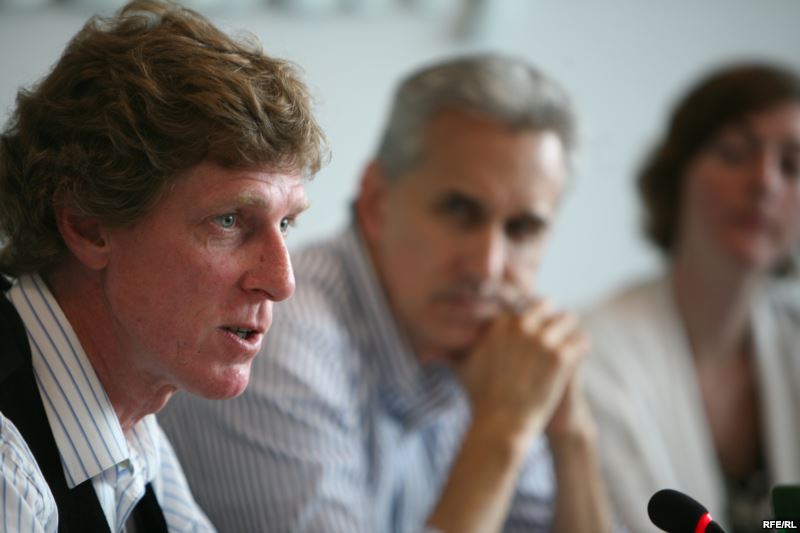
If created, this tripartite format will be beneficial to Turkey, Azerbaijan, and Turkmenistan, Expert on Central Asia and Senior Correspondent at Radio Free Europe/Radio Liberty Bruce Pannier told Azernews.
Being part of the Trans-Anatolian Pipeline (TANAP), which will bring the Azerbaijani gas to Europe, Turkey would like to purchase Turkmen gas and be part of an export route from the Caspian Basin to Europe, Pannier said.
In this regard, Turkey will act as a customer and transit country.
As to Azerbaijan, being the supplier of oil and gas, it has also regularly highlighted its potential as a transit country for the oil and gas that comes from Kazakhstan and Turkmenistan.
Turkmenistan has always been interested in the diversification of gas export routes and selling as much gas as possible. The country has indicated many times that Europe would prove an ideal market, the expert said.
However, Turkmenistan's problem is its lack of export routes.
Close cooperation to lead to TCP construction
Pannier said the closer the cooperation between Azerbaijan, Turkey, and Turkmenistan is, the more likely the construction of the Trans-Caspian pipeline will be.
With a length of around 300 kilometers, t he Trans-Caspian Gas Pipeline will be laid from the Turkmen coast of the Caspian Sea to Azerbaijan, where it will be linked to the Southern Gas Corridor. The pipeline's capacity is 30-40 billion cubic meters of gas per year.
Talks on the construction of the Trans-Caspian Gas Pipeline between Turkmenistan, the EU, and other countries started in late1990s. Negotiation process intensified after the EU issued a mandate to start negotiations on preparing an agreement between the EU, Azerbaijan, and Turkmenistan on the Trans-Caspian project in September 2011.
Ashgabat believes the agreement between Turkmenistan and Azerbaijan, the territories of which are covered by the project, is sufficient for laying a pipe under the Caspian Sea.
"Europe's need for gas is growing. Russia has nearly finished building Nord Stream and has started the construction of South Stream. Now the Trans-Adriatic Pipeline (TAP) has been approved, and there are older pipeline systems to Europe that originate in Russia.
"But all that will be still not sufficient if the projections of Europe's gas needs in the coming decades prove true. So other pipelines need to be built and new sources of gas must be found," he said.
Technically, it wouldn't be difficult to construct the pipeline, t he expert said. It just requires cooperation between Turkmenistan and Azerbaijan.
Iran, Russia not positive
Iran and Russia have expressed their skepticism towards the project, believing that the construction of the pipeline may damage the Caspian Sea's ecology.
"That leaves the biggest obstacles - Russia and Iran," Pannier said. "Both countries have publicly opposed the construction of a Trans-Caspian pipeline on environmental grounds, but the fact is Russia would rather not see Turkmen gas reach Europe via a route that does not go through Russia."
The expert said Iran is still calling on all Caspian states to refrain from developing gas and oil fields in the sea until the status of the Caspian Sea - sea or lake - is agreed upon.
"Iran is hoping the Caspian could be officially recognized as a lake, in which case all five Caspian countries would have to share the wealth of the Caspian equally - the so-called 'condominium' arrangement," Pannier noted.
Azerbaijan, Russia, and Kazakhstan have all moved ahead with developing their sectors of the Caspian Sea. Turkmenistan is behind them, but is developing its sector as well. They already view the Caspian as a sea and have therefore established their maritime borders, he said.
Two problems prevent TCP construction
Pannier also mentioned two obstacles that prevent the construction of the pipeline.
"The first one is, who is going to start constructing the pipeline?" he said. "Failure to start construction was Nabucco's biggest problem, since no gas suppliers wanted to sign contracts to pump gas into a pipeline that did not have even one segment in place."
Pannier believes there would have to be a clear commitment; "Better yet - a visible evidence of work being started on a pipeline, especially to convince Turkmenistan, that it would be worth risking Russia's immediate anger for the promise of making money several years in the future."
The other big variable is Iran, the expert says.
"Relations with the West are experiencing a slight improvement and many are waiting to see if this thaw in ties will continue," he said. "If Europe's relations with Iran improve significantly, there will no longer be a need to build a pipeline across the Caspian Sea bed. It can be built much easier across northern Iran, into Turkey, and on to Europe."
Pannier believes considerable progress will be achieved on the Trans-Caspian pipeline if it becomes obvious that relations between Iran and the West will not improve anytime soon.
The expert concluded that Turkey's support could help convince Azerbaijan and Turkmenistan to construct the pipeline, although financing remains a key issue.
Touching on the Caspian legal status, Pannier said "there is no way Kazakhstan, for example, will agree to hand over 20 percent of the profits from the Kashagan oil field in the northern Caspian to Iran or any of the other three Caspian countries. That is true of Azerbaijan and the gas produced at Shah Deniz."
"Iran can hold up a legal agreement on the Caspian's status, but it cannot stop the other four countries from continuing to extract oil and gas from what they consider to be their sectors of the Caspian," Pannier concluded.
Here we are to serve you with news right now. It does not cost much, but worth your attention.
Choose to support open, independent, quality journalism and subscribe on a monthly basis.
By subscribing to our online newspaper, you can have full digital access to all news, analysis, and much more.
You can also follow AzerNEWS on Twitter @AzerNewsAz or Facebook @AzerNewsNewspaper
Thank you!