
Iran's Rouhani hails deal signed with French Total
By Kamila Aliyeva
The multibillion-dollar gas deal concluded with France’s Total for investment in Phase 11 of South Pars – the world's largest gas field – will facilitate the "transfer of technological, scientific and managerial experience" between the two countries.
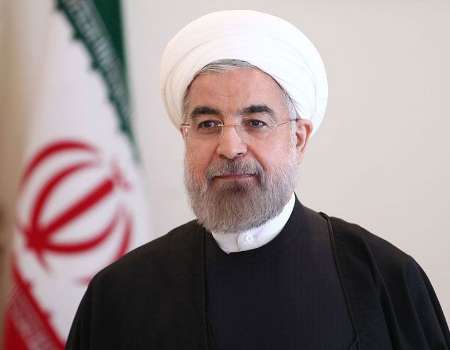
Iran’s President Hassan Rouhani announced about this on July 4 ahead of his meeting with French energy giant CEO Patrick Pouyanne in Tehran.
Rouhani noted that his administration was striving to sign a landmark nuclear agreement known as the Joint Comprehensive Plan of Action (JCPOA) with the P5 + 1 group to lay the foundation for strengthening Iran's economic cooperation with giant companies.
Iran has signed a $4.8 billion deal with a consortium led by French oil company Total, with 50.1 percent stake, to develop the phase 11 of its giant South Pars gas field on July 3.
This deal is the Islamic republic's first one with a European oil company in more than a decade.
Rouhani also invited big foreign companies to invest in projects in Iran’s oil and gas sectors valued at around $200 billion. “We must make efforts toward economic growth of the Middle East to establish peace and stability in the region,” he said at the meeting.
CNPC and Iran’s Petro Pars have 30 percent and 19.9 percent stakes as well.
The long-anticipated agreement, based on newly designed contract model, called Iran Petroleum Contract (IPC), can be extended for 5 years further, and would become operational in two stages.
Under the terms of the deal, Total will invest $1 billion in the first phase, the total cost of which amounts to $2 billion. The project includes construction of two 32-inch pipelines with length 270 km total, as well as drilling 30 wells (including 28 production wells), construction of two 1,500 tons platforms as well as construction of 4.5-inch pipeline (136 km) to transit ethylene glycol from land to offshore project for dehydration of gas and another 4.5 km 36-inch pipeline and a mooring buoy to transit gas condensate there for loading to tankers.
Pouyanne, in turn, deemed the contract of high importance to Total, expressing hope that its implementation would open doors to the presence of other European companies in Iran.
He also hailed the Iran’s nuclear deal for having created ample opportunities for developing Iran-EU relations, saying Total is optimistic about its cooperation with Iranian firms.
Total is familiar with the South Pars field that it will work on, as the company had experience there before sanctions made work in Iran impossible for big international companies.
Pouyanné argues that by being the first of the western oil companies to sign a major deal with a post-sanctions Iran, his company was able to shape much better terms than had been offered in the past.
However, Total’s deal has certain risks as well. In particular, Trump’s administration, which is reviewing its policy towards Iran, could take a harder line against Tehran, discouraging international companies from investing there.
Nevertheless, from Total’s point of view, the advantages seem to outweigh the drawbacks.
The Phases 11 development project of the South Pars field is set to produce 56 mcmd of soar gas.
Within a 20-year period, 335 billion cubic meters of soar gas will be extracted from the phase. Once processed, 315 billion cubic meters of sweet gas, 290 million cubic meters of gas condensate, 2 million tons of sulfur, 14 million tons of liquefied petroleum gas and 12 million tons of ethane will be produced.
The Phase 11 is expected to bring $84 billion worth of revenues for Iran, based on the current price of crude oil.
On the sidelines of the signing ceremony Zanganeh said that the contract, which is the first IPC contract, will amount to $5 billion worth of investment.
South Pars, located in southern region, is divided into 24 development phases, and contains 40 trillion cubic meters of natural gas.
It covers an area of 9,700 square kilometers, 3,700 square kilometers of which are in Iran's territorial waters in the Persian Gulf. The remaining 6,000 square kilometers are in Qatar's territorial waters.
Iran has vast energy resources — the world’s largest proven natural gas reserves and the second-largest trove of oil in the Persian Gulf, according to BP.
---
Kamila Aliyeva is AzerNews’ staff journalist, follow her on Twitter: @Kami_Aliyeva
Follow us on Twitter @AzerNewsAz
Here we are to serve you with news right now. It does not cost much, but worth your attention.
Choose to support open, independent, quality journalism and subscribe on a monthly basis.
By subscribing to our online newspaper, you can have full digital access to all news, analysis, and much more.
You can also follow AzerNEWS on Twitter @AzerNewsAz or Facebook @AzerNewsNewspaper
Thank you!