
Azerbaijan says ready for transit of Central Asian gas
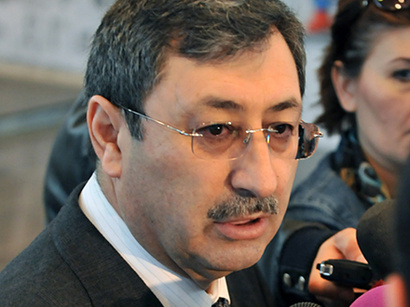
Azerbaijan has a powerful infrastructure system today, thanks to which it plays an important role in ensuring Europe's energy security and acts as a reliable partner for it, Deputy Foreign Minister Khalaf Khalafov said during his speech at the Caspian Forum in Istanbul on Thursday, Trend news agency reported.
"The "Contract of the Century" signed in 1994 served to opening of a new page in oil and gas sphere in Azerbaijan. Since 1995, investments worth over $120 billion have been made in Azerbaijan's economy," Khalafov said.
Building of friendly relations and establishment of cooperation with neighboring countries is the basis of Azerbaijan's foreign policy, he said.
According to Khalafov, ensuring peace and security, as well as sustainable economic development in the Caspian region should be the key goal.
He said a progress has been observed in convergence of positions on the status of the Caspian Sea in recent time.
"Azerbaijan, Kazakhstan and Russia have reached an agreement, and we hope that there will be an agreement with Iran and Turkmenistan. Azerbaijan attaches great attention to the ecology of the Caspian Sea," Khalafov said.
Khalafov said that Azerbaijan is ready to contribute to the implementation of the Trans-Caspian gas pipeline.
"Azerbaijan is ready to provide its territory for transit of the Central Asian gas," he said.
Trans-Caspian gas pipeline with length of about 300 kilometres will be laid from the Turkmen coast of the Caspian Sea to Azerbaijani, where it will be linked to the Southern Gas Corridor.
The negotiations between Turkmenistan and the EU and other
countries on the construction of the Trans-Caspian gas pipeline
have been held since late 1990s.
In September 2011 the EU Council gave a mandate for the
negotiations between the EU, Azerbaijan and Turkmenistan to build
the Trans-Caspian gas pipeline.
During his speech Khalafov also touched upon the
Nagorno-Karabakh conflict.
"For over 20 years, Azerbaijan has suffered from occupation of 20
percent of its territories by Armenia, as a result of which one
million Azerbaijanis became refugees and IDPs. Armenia does not
observe decisions taken by international organizations. If, we want
to see the Eurasia stable, then it is necessary to end the
occupation, in accordance with international norms," Khalafov
said.
The conflict between the two South Caucasus countries began in 1988 when Armenia made territorial claims against Azerbaijan. Armenian armed forces have occupied 20 per cent of Azerbaijan since 1992, including the Nagorno-Karabakh region and seven surrounding districts.
Azerbaijan and Armenia signed a ceasefire agreement in 1994. The co-chairs of the OSCE Minsk Group - Russia, France and the U.S. - are currently holding peace negotiations.
Armenia has not yet implemented the U.N. Security Council's four
resolutions on the liberation of the Nagorno-Karabakh and the
surrounding regions.
The role and importance of the Caspian region are discussed in the
Caspian forum, which was organized by Caspian Strategy
Institute.
Here we are to serve you with news right now. It does not cost much, but worth your attention.
Choose to support open, independent, quality journalism and subscribe on a monthly basis.
By subscribing to our online newspaper, you can have full digital access to all news, analysis, and much more.
You can also follow AzerNEWS on Twitter @AzerNewsAz or Facebook @AzerNewsNewspaper
Thank you!