
Russia opens key natural gas pipeline
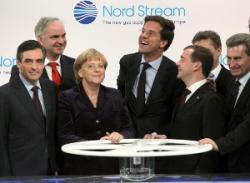
Line links Siberia reserves to Western Europe
(Newswires, November 9) – European leaders and Russia's president yesterday opened a ¤7.4 billion (Dh37.4 billion) natural gas pipeline that links western Europe directly with Siberia's vast gas reserves in a bid to make the region's energy supply more secure.
German Chancellor Angela Merkel, French Prime Minister Francois Fillon and Dutch counterpart Mark Rutte joined Russian President Dmitry Medvedev in symbolically turning a wheel to open the pipeline in Lubmin, on the Baltic Sea coast in Germany's northeastern corner.
"We are going to put into operation the first stage of a new partnership between Russia and the European Union," Medvedev said.
The 1,200km Nord Stream underwater pipeline ferries the gas from Vyborg, near St Petersburg in northern Russia, under the Baltic to Lubmin.
That creates a direct link between the Russian and western European networks — circumventing traditional and sometimes troublesome overland transit routes through Ukraine, Belarus and Poland.
Merkel called the pipeline a "strategic project that is exemplary for the cooperation between the European Union and Russia," and stressed that both sides benefit from the link — Europe by ensuring steady gas supply and Russia with direct access to its biggest market.
"We will be closely linked for decades," Merkel said.
Once the project is complete, gas will flow to Europe through two pipelines. The first line, inaugurated yesterday, has an annual capacity of 27.5 billion cubic metres.
That volume will double once the second line is completed — expected next year. Nord Stream officials say it's the world's longest underwater pipeline.
The total annual capacity of 55 billion cubic metres is equivalent to more than ten per cent of the EU's current gas needs, EU Energy Commissioner Guenther Oettinger said.
Russia's Gazprom holds 51 per cent of Nord Stream, while German energy companies E.ON Ruhrgas AG and Wintershall AG each hold 15.5 per cent. Dutch company Nederlandse Gasunie and France's GDF Suez hold nine per cent each.
Lukewarm welcome
Europe gets about 25 per cent of its natural gas from Russia, which
has the world's largest reserves. Until now, the gas was mostly
ferried through Soviet-era pipelines crossing the Baltic states,
Poland and Ukraine.
The new pipeline received high-level political backing in Germany, and former Chancellor Gerhard Schroeder went on to work for the consortium building the pipeline after he left office in 2005. But officials in Poland and Ukraine, bypassed by the pipeline, have given the project at best a lukewarm welcome.
The new pipeline will undercut Ukraine's leverage in a long-running dispute about Russia's gas and transit fees. When the dispute between Moscow and Kiev escalated in 2009, Western Europe was surprised as Ukraine shut off the pipelines, causing supply interruptions in the middle of winter.
Here we are to serve you with news right now. It does not cost much, but worth your attention.
Choose to support open, independent, quality journalism and subscribe on a monthly basis.
By subscribing to our online newspaper, you can have full digital access to all news, analysis, and much more.
You can also follow AzerNEWS on Twitter @AzerNewsAz or Facebook @AzerNewsNewspaper
Thank you!