
President Aliyev: Joining NABUCCO hinges on price
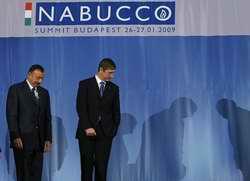
Azerbaijani President Ilham Aliyev on Tuesday
pledged further backing for the NABUCCO gas pipeline, but hinted
the country`s joining the West-backed project depended on the most
lucrative price for its fuel.
As European leaders held talks on the supplies of Caspian and Central Asian gas in Budapest, Aliyev said Baku was ready to cooperate with all parties involved in the project.
"I am confident that good partnership relations will be forged as part of this project. It is possible to succeed in getting all the work done as a result of cooperation."
Although the Azerbaijani leader made it clear that his country generally supported the NABUCCO project, he had told Hungarian media prior to the summit that this was not a political, but rather a commercial issue for the resource-rich South Caucasus republic.
In his address, Aliyev brought to the attention of participants the prospects of Azerbaijan`s acting not only as a transit state but also as an exporter. In other words, the country intends to sell its gas to the parties that will offer the most commercially viable prices and conditions.
"Azerbaijan supports the project, however, as before, what role it will play in the project - that of a transit state or a supplier of gas - remains an outstanding issue," the president said.
While a proposal on the price for Azerbaijani gas to be pumped into the NABUCCO pipeline is yet to be made, Russia, which is bypassed by the conduit, has offered to buy it for $250 per 1,000 cubic meters.
The NABUCCO pipeline will deliver about 30 billion cubic meters of Azerbaijani and Turkmen gas a year to European markets through a 3,300-kilometer pipeline traveling via the territories of Azerbaijan and Turkey to Romania, Bulgaria, Hungary and Austria.
The goal of the two-day summit held in the Hungarian capital was to rally support for the West-backed project and speed up its implementation. The project aims to help European countries diversify supplies of energy and ease reliance on Russian gas. It requires about 8 billion euros, but it is still unclear which countries will provide the needed funds and gas for the pipeline.
The summit was attended by representatives of Georgia, Austria, Romania, Egypt, Turkey, Turkmenistan, Germany, Iraq, the United States, as well as those of the European Union, the European Investment Bank (EIB), and the European Bank for Reconstruction and Development (EBRD).
The EU Energy Commissioner Andris Piebalgs said NABUCCO was "a test for European unity." He emphasized that if the countries involved fail to reach an agreement on the project, it will not be supported by the EIB and EBRD either.
"Amid the current financial crisis, no bank will assume the risk of allotting a loan just for the sake of a very good idea," Piebalgs said.
The EIB Chairman Philippe Maystadt said his institution was ready to finance 25 per cent of the NABUCCO project, which will benefit European energy security.
EBRD President Thomas Mirow also pledged financial aid for the project. However, both banks require guarantees and a respective intergovernmental agreement.
Indeed, reaching an agreement among the governments of the interested countries appears more likely than before.
As per US Deputy Assistant Secretary of State Matthew Bryza, the Russia-Ukraine dispute over gas supplies in the past weeks that threatened Europe`s supplies has drastically altered the view of the summit host Hungary, which saw NABUCCO as merely a dream just a year ago. The country`s Prime Minister, Ferenc Gyurcsany, stopped short of calling the project a symbol of independence and urged European financial institutions to allocate 300 million euros to start realizing the project.
Mirek Topolanek, Prime Minister of the Czech Republic that chairs the EU, said the North Stream and South Stream pipelines that Russia plans to build to export its gas to Europe bypassing Ukraine were a threat to NABUCCO.
"NABUCCO is a project that will ensure our [energy] independence, as it will allow the EU to buy gas from a third, alternate source - along with Russia and Norway. And, I didn`t mention these two countries together in vain -- I am trying to make it clear that NABUCCO is not aimed against Russia."
If we set aside statements by European politicians and bankers, the main question remains to be answered, i.e. whose gas will be pumped into the pipeline? It is indicative that although the officials of Azerbaijan, Turkmenistan and Kazakhstan, which are potential suppliers of gas for NABUCCO, attended the summit in Budapest, they stated merely generally-worded support for the project.
Russia`s envoy to the EU, Vladimir Chizhov, has said Moscow offers Europe an alternative to NABUCCO - the South Stream pipeline passing through Turkey.
"The conduit already exists, and, after expansion, it will be able to transport 30bn cubic meters of gas annually. Moreover, Russia has gas available for the pipeline, while that for NABUCCO is not even there yet," Chizhov maintained.
Transporting first gas via the NABUCCO pipeline, which will be an extension of the existing Baku-Tbilisi-Erzurum conduit, is expected in 2013 at the earliest. Deliveries of gas from Kazakhstan, Iran and Iraq are possible in the future as well. Six shareholders - German RWЕ, Turkish Botas company, Romanian Transgas, Bulgarian Bulgargas, Austrian OMV, and Hungarian MOL - hold equal stakes in the project consortium.
Turkish Prime Minister Recep Tayyip Erdogan has refused, at the last moment, to attend a summit on the NABUCCO gas pipeline project held in Budapest early this week. Instead, the country was represented at the event by Energy Minister Hilmi Guler, local media reported.
The Turkish premier warned earlier that if talks on Turkey`s admission to the European Union did not resume, Ankara might reconsider its support of the Western-backed project.
Talks on Turkey`s EU admission were launched in 2005 but were suspended later over tension caused by the Cyprus issue.
The NABUCCO pipeline is a new route for transporting gas from the resource-rich Caspian and Central Asia regions to Europe. It will deliver about 30 billion cubic meters of Azerbaijani and Turkmen gas a year to European markets through a 3,300-kilometer pipeline traveling via the territories of Azerbaijan and Turkey to Romania, Bulgaria, Hungary and Austria, while by-passing Russia. The project is valued at about 8 billion euros. Transporting the first gas via the pipeline is expected in 2013 at the earliest.
Sinan Ogan of the Ankara-based think-tank Turksam has said that following the Russia-Ukraine dispute over gas supplies in the past weeks that threatened Europe`s supplies, Turkey witnessed how important energy resources are for the EU. Thus, by using this leverage, Ankara is now trying to bolster its influence and to speed its admission to the 27-member bloc.
"Turkey, itself, is in need of gas. But, if need be, Turkey doesn`t have to participate in this project, and, instead, it will lay a pipeline from Azerbaijan and Turkmenistan, and then sell gas to Europe on its own. The EU needs the NABUCCO project more."
According to the analyst, the EU has, so far, sought a limited role for Turkey as a transit state in the project, but Ankara will now demand that it become one of the pipeline`s owners.
Azerbaijani former state adviser, analyst Vafa Guluzada, has said Turkey has fallen under Russia`s clout, as Ankara and Moscow have drawn very close of late both in the trade and tourism sectors.
Nonetheless, Guluzada believes the NABUCCO pipeline will be built. "America will step in, hold consultations with Ankara and the EU, and bring Turkey on board," he concluded.
Here we are to serve you with news right now. It does not cost much, but worth your attention.
Choose to support open, independent, quality journalism and subscribe on a monthly basis.
By subscribing to our online newspaper, you can have full digital access to all news, analysis, and much more.
Subscribe
You can also follow AzerNEWS on Twitter @AzerNewsAz or Facebook @AzerNewsNewspaper
Thank you!