
Baku, Yerevan agree to step up talks
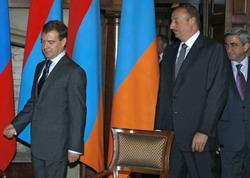
Azerbaijani and Armenian leaders agreed Sunday to intensify talks
on settling the 20-year conflict over Upper (Nagorno) Garabagh.
This consensus was reached in a joint declaration signed following
a Russia-brokered meeting.
The document, containing five provisions, was signed following a meeting between Presidents Ilham Aliyev and Serzh Sarkisian held at the Meiendorf Castle near Moscow along with Russian President Dmitry Medvedev. The document calls for a further OSCE-brokered dialog between the two sides and marks the first time in nearly 15 years that such a paper has been inked.
Armenia and Azerbaijan waged a war over the mountainous region of Upper (Nagorno) Garabagh in the early 1990s which claimed some 30,000 lives and displaced about one million Azerbaijanis. Since then, Armenia has occupied over 20% of Azerbaijan`s internationally-recognized territory. The ceasefire accord was signed in 1994, but peace talks have been fruitless so far. Also, sporadic clashes along the frontline have continued.
The first provision in the newly signed document calls for facilitating the improvement of the situation in the South Caucasus and the establishment of stability and security in the region through a political settlement of the conflict. Both sides agreed that these efforts would provide an impetus to economic and multi-lateral cooperation in the region.
Second, the parties agreed to continue negotiating within the OSCE Minsk Group (MG), a team of Russian, US and French diplomats brokering the peace process, and to hold further meetings to resolve the conflict.
Third, Baku, Yerevan and Moscow agreed that "the achievement of a peaceful settlement must be accompanied by legally binding international guarantees of all aspects and stages."
Furthermore, the declaration said Azerbaijani and Armenian leaders would continue maintaining contacts on the highest level and continue working to resolve the Garabagh conflict in peace.
Presidents Aliyev and Sarkisian agreed to instruct their foreign ministers to "activate further steps in the negotiating process."
Finally, the document said all efforts being made in the peace process to create mutual confidences should be welcomed.
The MG co-chairs - Matthew Bryza of the United States, Yuri Merzlyakov of Russia, and Bernard Fassier of France - attended the signing, although the presidential talks proceeded without their participation.
President Medvedev said, after hosting his Azerbaijani and Armenian counterparts, that the three leaders had held broad discussions on the prospects for a negotiated Garabagh settlement. He said the parties also pointed out the importance of further efforts by the mediators, while taking into account the earlier talks with Baku and Yerevan held in Madrid in November 2007 along with later discussions.
US co-chair Matthew Bryza said the Moscow declaration would allow the group to continue holding Garabagh talks more efficiently and successfully. He said its signing was a constructive step along the path to a settlement, emphasizing that the document envisages a strictly political and peaceful solution to the conflict within the MG.
Bryza went on to describe the declaration as "a green light" for the MG co-chairmen.
"Azerbaijani and Armenian presidents are now embarking on substantial talks, as neither leader has been ready to make major decisions so far. They did not know each other well," the diplomat said.
Russian co-chair Yuri Merzlyakov termed the joint declaration "as a very important document." In an interview with the BBC, he noted that no documents had been signed by the parties to the conflict since 1994, referring to the ceasefire accord. He added that the signing could give an incentive to a peaceful resolution of the Garabagh conflict.
Additionally, Armenian Foreign Minister Eduard Nalbandian said the Garabagh settlement was "a quite serious and important issue," stressing that negotiations will intensify after the signing of the Moscow declaration. "We hope that Russian President Dmitry Medvedev`s initiative would create a stimulus in the negotiating process and open up a new way for stepping up peace talks."
Baku has expressed its content with the Moscow talks, saying the declaration has advanced Azerbaijan`s interests. Further, the Foreign Ministry said the document reflected Baku`s demands and contained no provisions that are inconsistent with them.
The ministry spokesman, Khazar Ibrahim, told journalists that the Azerbaijani government considered the joint declaration to be a document reflecting all issues to resolve the conflict. The declaration opens up broad opportunities for finding a political settlement to the dispute, Ibrahim said.
He underlined that the protection of territorial integrity remained the key principle of the peace process.
"Azerbaijan`s territorial integrity is a key condition in the conflict settlement, and this has been reflected in all documents. The Helsinki Final Act contains a provision on the ability of self-determination for all nations, and Azerbaijan accepts this.
However, this provision also lays out territorial integrity as a key condition. We are not denying any international principles," Ibrahim said, but added that the integrity principle is held above the self-determination principle within international law.
Novruz Mammadov, head of the Azerbaijan President`s Office international relations department, said in an exclusive interview with AzerNEWS that the signing of the joint declaration "had laid the groundwork for an important stage" in Garabagh talks. The document signed by the presidents is a start of a new stage in negotiations, which have been ongoing for 14 years, and clears up a number of issues including the tasks facing the conflicting sides.
The declaration has drawn conflicting responses in Azerbaijan.
Political analyst Rasim Musabayov maintained that the document is pointless. "I think this declaration will bear no historical importance either. A number of issues are simply repeated in this document."
Musabayov claimed the only issue of substance is that the document urges significant guarantees be put in place during all stages of the conflict settlement, which implies the stage-by-stage process which is rejected by Armenia. He noted that Yerevan has always backed down from this plan, claiming that if it withdraws its troops from the occupied land, Azerbaijan could pose a threat to Armenians.
Musabayov added that the extent to which international guarantees cited in the document comply with Azerbaijan`s sovereignty should be put on discussion in the country.
Former Azerbaijani state adviser, analyst Vafa Guluzada, also believes the declaration is "pointless and useless to anyone."
"Nothing has changed - the situation remains the same. There is nothing new in this declaration.
"Russia is thus trying to show its being a guarantor of peace with regards to the Garabagh conflict [by brokering talks in Moscow]," the analyst said.
Guluzada said that hypothetically, the only shortfall in the document for Azerbaijan could be the assertion that the Garabagh conflict could be settled strictly in peace.
Guluzada believes that its signing was necessary "to demonstrate that the presidential meeting did not conclude without a result."
"The statement does not impose any responsibility on anyone," the former state adviser asserted.
But another analyst, Arif Yunus, noted that till now there has been no document on the negotiating table. But, a declaration has now been signed which envisions a negotiated solution of the problem and urges leaders to work to eliminate the lack of trust between the Azerbaijani and Armenian societies.
"The sides have, for the first time, agreed to continue talks, and did so based upon the Madrid principles. This is certainly a very important document."
Yunus said the gist of these principles envisions a stage-by-stage resolution to the conflict. First, Armenian armed forces are to be withdrawn from the occupied territories of Azerbaijan, to be followed by the clearing of mines and beginning of rehabilitation work in the occupied territories, and the return of over 700,000 Azerbaijanis displaced by the armed conflict to their homes. Further, communications between Azerbaijan and Armenia are to be established and international peacekeepers stationed in some areas.
Yunus said the declaration brings certain advantages to Armenia as well. "After this, they can be assured that war will not erupt," the analyst concluded.
The Russian media has described Sunday`s talks as "a turning point" in Garabagh talks. The country`s analysts explain their optimism saying that with the signing of the declaration, Russia has taken the lead in moving forward the peace talks. Further, by playing a key role in reaching a solution to the Garabagh problem, Moscow is striving to restore its image on the world stage. Russian commentators said they were confident that the hostilities similar to the Georgian-Abkhaz conflict will not occur between Azerbaijan and Armenia.
Analysts say the brief Russia-Georgia war in August has given a new momentum to international efforts to resolve disputes in the Caucasus, a region where Moscow is seeking to assert its clout.
Here we are to serve you with news right now. It does not cost much, but worth your attention.
Choose to support open, independent, quality journalism and subscribe on a monthly basis.
By subscribing to our online newspaper, you can have full digital access to all news, analysis, and much more.
Subscribe
You can also follow AzerNEWS on Twitter @AzerNewsAz or Facebook @AzerNewsNewspaper
Thank you!