
Obama’s “genocide” speech sparks mixed responses
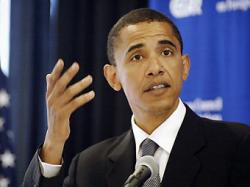
US President Barack Obama’s avoiding a mention of "genocide" in
his Saturday’s speech on the World War One-era developments in
Ottoman Turkey has sparked mixed responses from the Turks and
Armenians. In his annual address, Obama reiterated that the 1915
events were "one of the worst atrocities of the 20th century", but
also spoke of those Turks who rescued Armenians.
Turkey dismisses claims that the 1915 events amounted to
"genocide". Turkish Prime Minister Recep Tayyip Erdogan said
Obama's remarks took into account "the sensitivities" of his
country, while a U.S.-based Armenian group lashed out at Obama’s
statement issued by the White House.
"On this solemn day of remembrance, we pause to recall that 95
years ago one of the worst atrocities of the 20th century began. In
that dark moment of history, 1.5 million Armenians were massacred
or marched to their death in the final days of the Ottoman Empire,"
Obama said in a speech that came as Armenians marked the 95th
anniversary of the alleged WWI killings.
Obama used the term genocide while on the campaign trail, but not
since becoming president in January 2009. However, both in his
latest speech and the 2009 address, he did not use the term,
considering the tremendous importance the United States attaches to
Turkey, a NATO ally.
The Armenian National Committee of America expressed disappointment
that Obama did not call the events "genocide".
"Sadly, for the U.S. and worldwide efforts to end the cycle of
genocide, he made the wrong choice, allowing Turkey to tighten its
gag-rule on American genocide policy," ANCA Chairman Ken Hachikian
claimed in a statement, according to Reuters.
According to historians, from 1915 to 1923, Armenians had begun an
uprising. They had taken up arms against Turkey and assisted
Russia, one of Turkey’s enemies in WWI. To counter these actions,
the Ottoman Empire decided to resettle the Armenians. However, the
latter claim that their predecessors were subjected to genocide in
the process, while Ankara rejects the allegations and has offered
to research the events through a joint commission of historians.
Armenians have achieved recognition of the alleged genocide in
several countries’ parliaments. The Foreign Relations Committee of
the US House of Representatives adopted a resolution in March that
supported the Armenian allegations, drawing ire from Turkey.
However, the full House has not voted on the non-binding resolution
and it is not clear whether it could pass.
Turkey welcomed President Obama’s not using the term "genocide". In
a statement, Prime Minister Erdogan said, "President Obama made a
speech taking into consideration the sensitivities of Turkey. ...
The speech by Obama shows the sensitivity of the current U.S.
administration about this issue."
But Turkey's Foreign Ministry in a separate statement said, "We are
sorry to see such a statement, which has a one-sided political
view, and which contains mistakes. The biggest enemy of historical
facts is the revision of memory. No country should impose on others
its views of history."
The ministry objected to the fact President Obama is carrying on
the overall practice of US presidents to address Armenians on April
24 every year.
Turkish Foreign Minister Ahmet Davutoglu pointed out that assessing
historical events while politicizing them was wrong.
"We believe that history is to be reviewed strictly by historians
and that such events could be negotiated among the countries and
societies directly involved in those historical developments,"
Davutoglu said. He added that Obama’s speech was unacceptable in
that respect.
Prime Minister Erdogan noted that the protests staged in the
Armenian capital Yerevan on Saturday will hamper the process of
normalizing Turkey-Armenia relations, which have been hostile for
decades. During the protests, demonstrators burnt Turkey’s flag,
the photos of the Turkish president, prime minister and foreign
minister.
Erdogan also affirmed Ankara’s stance on the reconciliation
process, saying the Turkish-Armenian normalization could not move
forward until peace is reached between Armenia and Azerbaijan.
Armenia and Turkey signed protocols in October 2009 in Switzerland
to establish diplomatic relations and reopen their sealed borders,
in a bid to normalize ties, marred by decades of hostility due to
Armenian occupation of Azerbaijani territory and Yerevan’s
"genocide" claims. However, Turkish officials have assured
Azerbaijan, Turkey’s ally, that the protocols will not pass in the
country’s parliament until progress is made in resolving the
long-standing Armenia-Azerbaijan conflict over Upper (Nagorno)
Garabagh. On Thursday, Armenian President Serzh Sarkisian announced
Yerevan’s decision to halt approval of the protocols but said his
country "had decided not to exit the process for the time being,
but rather, to suspend the procedure of ratifying the
protocols."
Analysts say Obama’s statement affirmed Washington’s support for
the Turkish-Armenian reconciliation. The White House initially
believed Turkey was to blame for the deadlock in enforcing the 2009
accords, but Armenia’s suspending ratification of the documents
last week indicates that Ankara is committed to the fence-mending
process.
Mark Katz, a professor at U.S.-based George Mason University, has
told Azerbaijan’s APA news agency that the White House leader had
sought to appease both Turkey and Armenia, by both avoiding the
term "genocide" and saying "Metz Yegern" in the Armenian
language.
"Securing mutual benefits by pressing ahead with the
Turkish-Armenian rapprochement or arguing about the past is up to
the Turkish and Armenian governments," Katz added.*
Here we are to serve you with news right now. It does not cost much, but worth your attention.
Choose to support open, independent, quality journalism and subscribe on a monthly basis.
By subscribing to our online newspaper, you can have full digital access to all news, analysis, and much more.
You can also follow AzerNEWS on Twitter @AzerNewsAz or Facebook @AzerNewsNewspaper
Thank you!