
OSCE mediators cautiously optimistic after talks
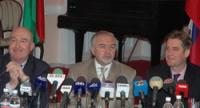
The OSCE mediators brokering settlement to the
Armenia-Azerbaijan conflict issued an optimistic statement at a
meeting with the leader of the self-proclaimed Upper (Nagorno)
Garabagh republic on Wednesday.
French co-chair of the Minsk Group Bernard Fassier said after
meeting Bako Saakian in Khankandi, the center of the self-styled
entity, that 2008 will be crucial for the Garabagh settlement.
"There is goodwill between the conflicting sides, which gives a
hope for a final decision on the conflict resolution this year," he
said.
Russian co-chair Yuri Merzlyakov agreed with his counterpart but
argued that the parties have not yet succeeded in reaching mutual
understanding on basic principles of the peace process. The
intermediaries have not been able to foster an option fully
accepted by the sides either. Merzlyakov added, however, that the
co-chairs continue working to accomplish that goal.
"The 2008 should indeed be a crucial year for the resolution of the
Garabagh conflict," he said.
The Minsk Group co-chairs from France, Russia and the United States
arrived in the Azerbaijani capital Sunday evening as part of a
visit to the region that aims to inquire about the positions of the
two countries' governments on the written proposals submitted by
the MG in Madrid late in November. After holding discussions in
Baku they headed to Yerevan late on Monday. The intermediaries met
with President Robert Kocharian and Prime Minister Serzh Sarkisian.
The co-chairs further arrived in Khankandi. On Friday, they are
tentatively scheduled to return to Baku.
The separatist leader maintained that 2008 could see a turning
point in the conflict settlement only if the self-proclaimed
republic "joins the negotiating process as a full-fledged
party".
"We also stressed that we are interested in Armenia's further
participation in talks, as this could help to preserve current
peace," Saakian said.
"The co-chairs laid out common views expressed by the leadership of
Armenia and Azerbaijan, and based on that one can conclude that
there are certain provisions that do not meet the interests of
Upper Garabagh's people," he said.
Speaking of the benefit of talks, Saakian said "the situation will
improve only when the problem finds a final solution". The
separatist leader linked this with the "independence" of what he
called "his country" that should be allegedly recognized by the
world community.
US MG co-chairman Matthew Bryza expressed cautious optimism about
the conflict settlement. "Based on the outcomes of meetings with
the presidents I sense a positive shift in the negotiating
process," he told an international conference in Armenia Tuesday.
Bryza emphasized that the peace process is currently at an
important stage as the two countries' leaders are thoroughly
studying the new document on the conflict resolution.
"It is difficult to cite a specific timing for an agreement on
basic principles, but the sides are demonstrating a new approach to
the issue," he said.
Bryza noted that neither party to the conflict was trying to block
the peace process or delay it. "Both sides are conducting a sincere
exchange of views and informing each other as to what is required
for reaching agreement.
"Presidents Ilham Aliyev and Robert Kocharian have their own views
that are quite firm, but at the same time, they appear to be ready
to strike a common ground," Bryza said.
The US co-chair said the timing for the next presidential meeting
depended on the outcomes of the elections in both countries but the
2008 votes would not affect the peace process.
He stressed that all presidential hopefuls in both countries
support the Minsk Group's mediating activity.
Presidents Aliyev and Kocharian last met on the sidelines of a CIS
summit in St. Petersburg, Russia June 9.
The presidential ballot in Armenia is due in February 2008, while
in Azerbaijan it will take place in October that year.
The conflict between the two South Caucasus republics reared up in
the late 1980s due to Armenia's territorial claims. Armenia has
been occupying over 20% of Azerbaijan's internationally-recognized
territory since the early 1990s in defiance of international law.
The ceasefire accord was signed in 1994, but peace talks have been
fruitless so far and refugees remain stranded.
Baku awaits outcome
Azerbaijani Deputy Foreign Minister Araz Azimov said Tuesday that
it was unclear whether or not the OSCE mediators who headed to
Yerevan late on Monday after holding talks in Baku would return to
the Azerbaijani capital after meeting with the Armenian
leadership.
He said that if the MG co-chairs fail to bring clarity to Yerevan's
stance on key principles of the conflict resolution, their return
to Azerbaijan at the weekend for further discussions was under a
question mark.
"We are awaiting the outcomes of their consultations in Yerevan. If
no need or reason arises for their repeated visit, they will not
return to Baku, and we will have to wait for their next visit," the
deputy minister said.
Azimov noted that despite some progress in negotiations, the
advances were not enough to bring about cardinal changes in the
peace process.
"We don't want to hold dialog just for the sake of holding it. If
the other side merely cherishes the thought of gaining time, we
will not accept this," he added.
Here we are to serve you with news right now. It does not cost much, but worth your attention.
Choose to support open, independent, quality journalism and subscribe on a monthly basis.
By subscribing to our online newspaper, you can have full digital access to all news, analysis, and much more.
You can also follow AzerNEWS on Twitter @AzerNewsAz or Facebook @AzerNewsNewspaper
Thank you!