
Crisis-hit Russia and three South Caucasus musketeers
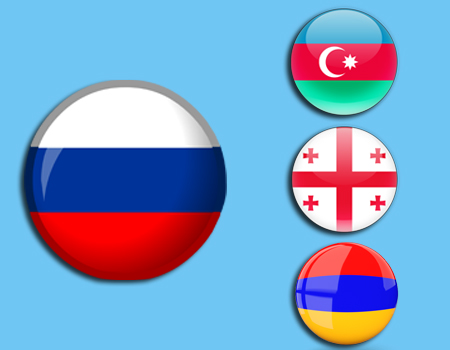
By Mushvig Mehdiyev
Relations between Russia and three South Caucasus countries – Azerbaijan, Georgia and Armenia – have always had their ups and downs, as politics tends to do, resulting in uneasiness in the region.
Russia is going through a tough period as a result of Western-applied sanctions, that along with the falling price of oil and the depreciating ruble, risks seeing Russia’s woes travel south into the Caucasus.
If that were to occur one might well ask what impact will Russia’s failing economy have on Azerbaijan, Georgia and Armenia ? How will it further take its toll on the South Caucasus countries to the point where they would start reconsidering their relations with the northern giant?
Let’s first take a brief tour to the root of the challenge facing the world’s largest country. The Ukrainian crisis made Russia discern the first glimpses of the trouble waiting ahead when the Western forces – Europe and U.S. – blamed it for escalating tensions in Ukraine during the Maidan unrest. Russian authorities then rebuffed all accusations, saying it was just trying to help Russians living in Ukraine.
Further actions by Russia revealed its active involvement in the events in Ukraine as it annexed the Crimea peninsula in March, 2014, prompting accusations from the West and the introduction of sanctions.
Given that a large number of Ukrainians aspire to integrate Europe politically, Russia’s intervention was labeled as an act of aggression and Western forces vowed to back Ukraine. This does not seem to have influenced Russia who is still reportedly involved in military hostilities in eastern Ukraine, where it is backing the separatist forces, according to the West’s allegations. More than 1.7 million children in conflict-torn areas of eastern Ukraine face an extremely serious situation amid conflict and winter cold, according to UNICEF.
Although Russian President Vladimir Putin called the ongoing hardship in his country an “unfavorable scenario” rather than accepting it as a crisis, Moscow is trying to prevent the ruble turmoil from turning into an economic catastrophe, and finds itself more isolated than at any period over last 25 years.
The most recent exchange rate of the ruble against the US dollar is 57 rubles for one dollar. In addition to Western sanctions, the ruble’s overwhelming depreciation is reportedly linked to the global depreciation in oil prices, which is a serious blow on Russia’s oil-oriented economy.
What should Azerbaijan expect from the Russian crisis? Azerbaijan’s relations with Russia has always cordial and at a relatively constant and at a high-level.
Azerbaijan
Azerbaijan refused to join the Russia-lead Collective Security Treaty Organization (CSTO) and Eurasian Economic Union (EEU), explaining it with its preference to an independent course in political and economic policies in the region, rather than bearing certain compulsory responsibilities within a union. Positive feedback of that decision by the Azerbaijani authorities was reflected in the International Monetary Fund report about the impact of the Russian crisis on its neighboring countries. The IMF claimed that Azerbaijan’s economy will be among those to have less and even intangible consequences of the crisis in Russia.
“Both Europe and Russia are our good partners and neighbors, and we cooperate with either side based on our national interests,” said Ali Hasanov, Head of Public and Political Department of the Presidential Administration.
Hasanov noted that Azerbaijan sees Russia as a great player in the region. He said Azerbaijan was not making a choice between Russia and Europe.
Last August Russia announced it was closing its markets to European products in retaliation to the “punishing” sanctions from the West. Preventing Western food products from entering its markets, Russia started to trust on more active involvement of its eastern partners by increasing their export to Russian markets.
Azerbaijan is seen as one of the main exporters who can fill part of the void in the Russian market after Moscow in a retaliatory move banned European products. Foreign Minister Sergey Lavrov has even said the fruits imported from Azerbaijan were much more tasty and high-quality than the fruits brought from Europe.
Meanwhile, Azerbaijani officials are confident that the Russian slowdown will not affect their economy given the stability of the national currency, the manat. Indeed, President Aliyev has recently said the fall in oil prices would not affect the country’s economy, due to stable rate of the national currency the manat based on strong economic basis and well-thought economic policy.
In a nutshell, Azerbaijan’s political and economic skills were not seriously affected by the deepening crisis in Russia, so far. Moreover, the “evil days” in the northern giant could not threaten Azerbaijan to turn away from its neighbor and leave it alone in the region.
Georgia
But if relations between Baku and Moscow are cordial the same cannot be said about Moscow and Tbilisi, who fought a brief , but bloody war in August 2008, when Russia recognized the independence of Georgia’s breakaway South Ossetia and Abkhazia regions, causing a serious uproar among Georgian authorities to cut diplomatic ties with Moscow.
Economic relations between the countries worsened in 2006, when Russia banned the importation of Georgian wines, mineral water and agricultural products, claiming low quality of such goods. The measure, which Georgia described as politically motivated, came as ties between the two former Soviet nations soured with the rise to power of pro-Western Georgian leader Mikheil Saakashvili.
Russian-Georgian relations improved after the Georgian Dream Team took power in 2012. This was characterized by Moscow’s conciliatory gestures towards Georgia, including the opening of the Russian market to Georgian goods in 2013, resumption of direct flights, Tbilisi’s great willingness to contacts with Russia and its consideration of Russia’s some interests. This did not affect Russia’s overall priority for Georgia. Russia signed a versatile treaty with the breakaway Abkhazia region in November to provide a multi-sided assistance to the separatist regime, once more deteriorating the relented relations of the two countries. Grigory Karasin, Russia’s Special Envoy for Georgian Issues, said the agreement with Abkhazia was Russia’s respond to Georgia’s strong aspiration for European integration.
Political negotiations between Russia and Georgia are being held by special representatives Grigory Karasin and Zurab Abashidze under the Geneva Format of Talks, a coordinated negotiation framework to soften the Russia-Georgia relations escalated after August 2008 war.
Georgia as a neighbor of Russia also has some predictions in regard to the economic slowdown in Russia. First of all, as a small country, it expects a smaller impact caused by Russia’s troubling economy compared to Germany, France and Italy, whose trade balance with Russia amounts to tens of billions of dollars. Russia is the fourth major trade partner of Georgia and the third main export market, particularly for wine and mineral water.
If the Russian economy suffers from a sharp decline, the solvency of Russian population will simultaneously drop to affect Georgia’s export potential, Georgian economic analysts worry. Moreover, there are hundreds of Georgian citizens who work in Russia and send money to their families. Soso Archvadze, an economic analyst, claims that the deepening economic crisis in Russia threatens Georgian migrants with a possible loss of jobs. Reduction in their income will seriously affect money transfers to Georgia, which make up almost 60 percent of overall remittances to the post Soviet country.
“Money transfers share one third of the Georgian residents’ revenues and roughly 14-15 percent of GDP. Nearly 60 percent of the total money inflow comes from Russia. Therefore, Georgia should make a very serious analysis and shift its focus to Asian markets. China, for example, is a very attractive wine market due to its huge population,” Archvadze said.
Georgia’s national currency the lari faced a decline in its value in recent days, which is reportedly linked to the Russian ruble’s devaluation. Nevertheless, Georgia is not threatened by financial hassle given the sustainable support from the Western forces. Now, the government is developing fundamental plans to build firm relations with the European Union and NATO, accepting the west as a best roof over its head amid aggressive Russian policy in the region. The European Union ratified the Association Agreement with Georgia on December 18, 2014, to push the post Soviet nation a step closer inside Europe.
Armenia
Armenia is most likely the main country to feel the fallout of the Russian crisis.
It is a member of the Russia-lead Collective Security Treaty Organization and the Eurasian Economic Union, having irreversible obligations under the common rules of the alliances. Russian Foreign Minister Sergey Lavrov said Armenia should resist the Western sanctions along with Russia in any necessary circumstance.
Russian-Armenian political relations date back to very old times, as Russia has always been accepted as the main strategic ally and “big brother” of Armenia, reviewing South Caucasus nation's each step in regional and even international policy.
In return to Armenia’s long-lasting loyalty, Russia, as a chief protector, pledges to ensure the South Caucasus country’s security (under the CSTO membership terms) and welfare (under the EEU membership terms) in the region.
Russia is also an important regional player for Armenia in regard to the Nagorno-Karabakh conflict. Amid its regular decentralization on the peaceful resolution to the protracted conflict, Russia is a key power to urge the South Caucasus country to stay committed to the peaceful negotiations, since any turmoil in the region is a threat to the northern giant’s interests. Also, Russia is playing a dual role in the region to keep the balance in military skills of Armenia and Azerbaijan by selling weapons to the belligerents. But, anyway, a peaceful end to the conflict is one of the key issues in regional policy of Russia, a co-chair country of the OSCE Minsk Group, and Armenia obeys Russia’s instructions in regard to the Karabakh knot.
Any tremor in Russia’s economy means an earthquake in the economy of Armenia – this may be the best saying to express the mutual economic ties of the two former Soviet nations. Russia is the top destination for Armenian-made products, since nearly 85 percent of the overall exportations are directed to Russia. Dependence on Russian markets paralyzes Armenia’s economy on the background of the modern crisis hitting the northern giant. Weakening purchasing power in Russia, which is a clear result of the crisis, inflicts painful blows on the Armenian export.
"An unpleasant causal chain started in the Russian markets simultaneously with the ruble's fall. Drop in purchasing power in Russia decreased orders from Armenia," said Vaahn Mkrtchyan, Co-owner of the Armenian Wine Company, while Avag Harutunyan , Head of Armenian Winemakers Union, revealed a $86,000 daily loss of the Armenian winemakers in Russia given the financial tussle.
Over 2.2 million Armenians live in Russia today, according to the Armenian Diaspora's data. Many of them are labor migrants, who left Armenia to earn their life and provide for their family living in the native land. The money transfers from migrant workers in Russia take a considerable share in the South Caucasus country's income, making up nearly 84 percent of the overall private remittances and 15.4 percent or $1.6 billion of Armenia's Gross Domestic Product, the Central Bank revealed.
The bank announced that the total transfers made by Armenian migrant workers in Russia was nearly $146 million this year, which testifies to a sharp fall by $11 million compared to the last year. Just in October, the remittances from Russia has dropped by 20 percent.
Current dethronement of the Armenian dram started all while the Russian ruble began to slide to an all-time low following the isolating sanctions by the Western forces. Experts claim that Armenia's tightening relations with Russia, amid the partnership within the Eurasian Economic Union, show green light for future challenges in its economy if Russia fails to tackle the deepening economic hassle facing it. Economic experts believe that the prices in the Armenian markets have taken a sharp rise this year ahead of the New Year holiday season compared to the previous years, linking it to the dram and ruble devaluation, as well as the dollar’s significant appreciation in the global market.
President Vladimir Putin promised to overcome the "unfavorable scenario" in two years, maybe less. Amid the ongoing developments the three South Caucasus nations will have to take the best stand not to sink their ships in a battle of big powers.
The article was first published at Eurasiareview.com.
Here we are to serve you with news right now. It does not cost much, but worth your attention.
Choose to support open, independent, quality journalism and subscribe on a monthly basis.
By subscribing to our online newspaper, you can have full digital access to all news, analysis, and much more.
You can also follow AzerNEWS on Twitter @AzerNewsAz or Facebook @AzerNewsNewspaper
Thank you!