
Top Armenian court approves Turkey accord, sparks protests
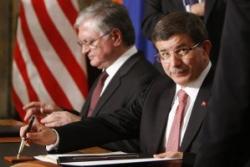
A top Armenian court on Tuesday approved the
agreement signed with Turkey in 2009 in a bid to end decades of
hostility between the two neighbors.
Gagik Arutunyan, chairman of Armenia’s Constitutional Court, said after the closed-door hearing that the decision to declare the October 2009 accord constitutional was final and cannot be challenged, local media reported.
Tensions mounted in the courtroom after the ruling was announced, with opponents shouting "Traitors" and "You are not Armenians".
Under Armenia’s laws, the president is required to send the signed international agreements to the Constitutional Court, which determines whether or not the documents are legitimate. Once approved, the agreements are sent to parliament for ratification.
The Armenian and Turkish governments signed two protocols to establish diplomatic relations and reopen the two countries’ shared border on October 10 in Zurich, in a bid to normalize ties. The documents also envision setting up a commission of historians to research the alleged World War I-era mass killings of Armenians in the Ottoman Empire.
The signing of the protocols with Ankara has been met with a great deal of public resentment in Armenia. The ultra-nationalist Dashnaktsutyun party protested outside the Constitutional Court building as the protocols were being reviewed. The protesters demanded revoking the agreement, which they deem as detrimental to Armenia.
Armen Rustamian, a Dashnaksutyun executive, said the Armenian opposition would continue opposing the reconciliation accord and voice protests in parliament.
In Turkey, no work is apparently underway to approve the agreement signed with Armenia. Onur Oymen of the opposition Republican People’s Party, who sits on the parliamentary foreign affairs commission, said the protocols were sent to the Grand National Assembly on October 21, 2009, and further to the commission, and no steps have since been taken. According to the lawmaker, the protocols have not even been submitted to the commission members.
"No indications are currently seen of the protocols being discussed in the Grand National Assembly," Oymen said. "The core position here is that they cannot be endorsed before progress is made in resolving the Armenia-Azerbaijan Upper (Nagorno) Garabagh conflict. We won’t even put the issue on discussion."
Turkey and Armenia do not have diplomatic relations and the border between the two countries has been closed since 1993. Armenia's occupation of the territories of Azerbaijan, Turkey’s ally, and Yerevan’s claims on the 1915 genocide have been obstacles to normal relations between the two countries.
Oymen said a concern is mounting in Turkey that as the month of April approaches, when Armenians mark the anniversary of the alleged genocide, the Turkish government is likely to come under pressure to approve the agreement signed with Yerevan.
"I can’t say how much of that pressure the government can withstand. But, to my mind, the authorities will not dare to put those protocols on discussion," the MP opined.
The approval of the protocols on mending ties by the Armenian court overlapped with Turkish Prime Minister Recep Tayyip Erdogan’s visit to Russia. Vladimir Yevseyev, a Russian analyst, believes this is not accidental. According to him, Turkish-Armenian normalization is stalling, and such visits represent an attempt to revitalize the process.
"In my view, the Turkish-Armenian [normalization] process is deadlocked, and a new round of one-of-the-kind negotiations is being started to revive it. It is clear to everyone that agreeing upon something with Armenia necessitates Russia’s getting involved. Presently, the sides are facing a peculiar impasse: in order not to lose Azerbaijan and uphold its political image, Turkey is seeking Armenian concessions on the Upper Garabagh issue, while the Armenian leadership is not undertaking concessions due to the challenging situation at home, and, as a result, the border remains shut."
Yevseyev believes that Moscow is interested in the opening of the Turkey-Armenia border. Russia has a lot of property in Armenia which could yield hefty profits if the frontier opens up. The analyst said that overall, Moscow would like to persuade Armenia to make concessions on Garabagh settlement, but it is rather unclear how much this country may concede.
But other analysts say the border opening does not promise considerable benefits for Russia and it is useless to expect Moscow to put pressure on
Yerevan.
Vafa Guluzada, an Azerbaijani former state adviser and political analyst, says the United States is behind the process of reopening the Turkey-Armenia border. Therefore, Washington is doing everything in its power to achieve approval of the normalization agreement in both countries’ parliaments.
Guluzada said he had expected the signing and parliamentary approval of the protocols from the beginning.
"Now, different ways will be explored to substantiate Turkey’s taking this step. Turkey is keen on Moscow’s making concessions and for at least one of the occupied Azerbaijani districts to be freed. But I don’t believe Moscow will agree to this, as this occupation is a building erected by Russia. If one of its bricks is taken out, the whole building will collapse. So, Turkey shouldn’t hope that having achieved liberation of just one district, it will be able to open its border with Armenia without remorse.
"Turkey will be prompted to open the border under these very conditions. I had said from the very outset that the border opening has no bearing on the Garabagh problem, because the U.S. knows all too well that Russia will never allow liberation of Upper Garabagh and the adjacent regions."
The Garabagh conflict flared up in the late 1980s on Armenia's territorial claims. Armenia has been occupying over 20 percent of Azerbaijan's territory since the early 1990s, trampling on international law. The ceasefire accord was signed in 1994 after a lengthy war. Efforts by the US, Russian and French mediators have been largely fruitless but peace talks are underway.
Regarding protests by the Armenian opposition and diaspora at the Constitutional Court’s endorsing the accord with Turkey, Guluzada called them "a show."
Rasim Musabayov, another Azerbaijani analyst, believes the protocols’ approval will benefit Armenia. He said that if the decision had not been passed, Armenia "would have exposed itself before the world community."
"As for parliamentary approval of the protocols, this may take time. Armenia will be trying to carry out this process in parallel with Turkey. The Armenian opposition and diaspora may stage protests over this. But in any case, the Armenians are trying to show that "we have made major concessions, look how difficult it was to do that."*
Here we are to serve you with news right now. It does not cost much, but worth your attention.
Choose to support open, independent, quality journalism and subscribe on a monthly basis.
By subscribing to our online newspaper, you can have full digital access to all news, analysis, and much more.
Subscribe
You can also follow AzerNEWS on Twitter @AzerNewsAz or Facebook @AzerNewsNewspaper
Thank you!