
World powers demand settlement of Nagorno-Karabakh conflict
By Sara Rajabova
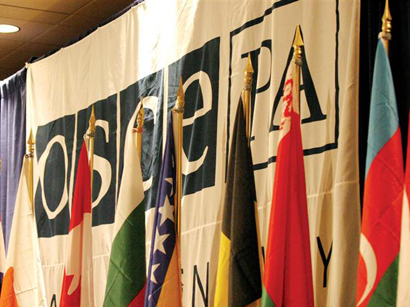
The ways of resolving the long-standing Armenian-Azerbaijani Nagorno-Karabakh conflict was one of the main issues of discussion at a meeting of the OSCE Ministerial Council in Belgrade, Serbia.
Despite the negotiations led by OSCE Minsk Group co-chairs to reach a peaceful settlement to the conflict, the efforts of the international mediators have become largely fruitless so far.
During the OSCE ministerial held on December 3, the OSCE Minsk Group co-chairing countries’ foreign ministers welcomed the upcoming meeting between the presidents Ilham Aliyev, of Azerbaijan, and Serzh Sargsyan, of Armenia.
The presidents last met and discussed the ways of settling the long-standing conflict in France last October.
Though the officials from both countries said the presidents could meet this month, the exact date and place of the meeting is yet to be discussed.
During the OSCE ministerial, the world powers have drew attention to the fact that the conflict, which hinders the development of the South Caucasus region and a major source of the instability in these part of the continent.
The United States, which is one of the co-chairing countries of the OSCE Minsk Group, urged the OSCE to take decisive steps in settlement of the Armenian-Azerbaijani dispute.
U.S. Secretary of State John Kerry said the OSCE should move decisively in resolving the Nagorno-Karabakh conflict.
“Protracted conflicts in Moldova, Georgia, Armenia, and Azerbaijan are still unresolved, great frozen conflicts. We need move decisively to rebuild military transparency in Europe and increase information sharing among our forces,” Kerry said.
In the meantime, the European Union voiced concern about rising tensions related to the Nagorno-Karabakh conflict.
The situation on the contact line of Armenian-Azerbaijani troops has escalated in recent days, as Armenian armed forces intensified the ceasefire violation. In a recent sabotage on the frontline, the Armenian armed forces killed two and wounded one Azerbaijani servicemen.
EU High Representative for Foreign Affairs and Security Policy Federica Mogherini stressed at the ministerial that the EU urges all parties involved in the conflicts to work in good faith towards political solutions that respect OSCE principles and commitments.
Mogherini added that the EU remains committed to be actively involved in the process of settling the conflicts.
The EU supports the restoration of Azerbaijan’s territorial integrity and liberation of the occupied territories. However, the organization is not involved in the settlement process of the Nagorno-Karabakh conflict.
Another OSCE Minsk Group co-chairing country – Russia voiced support to a comprehensive settlement of the Nagorno-Karabakh conflict based on the principles of mutual activity and mediation.
Russian Foreign Minister Sergei Lavrov said Moscow is guided by the principles of solidarity action and finding a mutually acceptable solution in the resolution of the Nagorno-Karabakh conflict.
Earlier, Azerbaijan’s Foreign Minister Elmar Mammadyarov said Russia has made proposals on settling the Nagorno-Karabakh conflict during his visit to Azerbaijan in September.
Harlem Désir, French secretary of state for European affairs, also voiced Paris’ commitment to contribute to resolution of the dispute.
He said France, along with other co-chairs of the OSCE Minsk Group is committed to continuing efforts to settle the Nagorno-Karabakh conflict.
Addressing the ministerial, Mammadyarov demanded a complete withdrawal of Armenian troops from the occupied Azerbaijani lands.
He noted that the recent proposal by Lavrov, supported by other co-chairs can provide a very good impetus to reach a breakthrough in peace talks.
Mammadyarov said with regret that no substantive progress has been achieved in the settlement of the conflict since the last ministerial council meeting in Basel, as Armenia continues to disregard the calls of the international community.
“The Armenian leadership imitates the engagement with a view to consolidating the volatile status-quo created through the unlawful use of force and ethnic cleansing,” he said. “So-called “balanced” or undifferentiated attitude to the aggressor and the victim will never produce a desired outcome. The policy of appeasement only emboldens the aggressor.”
Mammadyarov stressed that the unlawful presence of the Armenian armed forces in the occupied territories is the major destabilizing factor with the potential to escalate at any time with unpredictable consequences.
Therefore settlement of the conflict must began with unconditional withdrawal of Armenian forces from the Azerbaijani territory, as demanded by the UN Security Council resolutions and as implied by the mandate of the co-chairmen of the OSCE Minsk Group, according to the minister.
He further added that the settlement of the Nagorno-Karabakh conflict will give impetus to development of the region.
The minister also met with the OSCE Minsk Group co-chairs as part of the 22nd OSCE Ministerial Council, the Azerbaijani foreign ministry reported.
Mammadyarov and the co-chairs discussed the current status of the negotiation process on the conflict, the action plan of the OSCE Minsk Group for the upcoming period, as well as the issues related to organizing a meeting between Azerbaijani and Armenian presidents.
--
Sara Rajabova is AzerNews’ staff journalist, follow her on
Twitter: @SaraRajabova
Follow us on Twitter @AzerNewsAz
Here we are to serve you with news right now. It does not cost much, but worth your attention.
Choose to support open, independent, quality journalism and subscribe on a monthly basis.
By subscribing to our online newspaper, you can have full digital access to all news, analysis, and much more.
You can also follow AzerNEWS on Twitter @AzerNewsAz or Facebook @AzerNewsNewspaper
Thank you!