
Baku unruffled by Turkish-Armenian talks
A senior Azerbaijani official has said there was no need for
Baku's harsh protests against the recently-started dialog between
Turkey and Armenia that is closely followed by the world
community.
"The talks currently under way between the two countries serve to
determining the nature of bilateral relations, their history and
current state," the head of the President's Office international
relations department, Novruz Mammadov, said, adding that Ankara was
securing its own interests in its relations with the neighboring
country.
The statement comes just days after Ankara confirmed that Turkish
senior officials had held a secret meeting with Armenian diplomats
in Switzerland. Turkey's confirmation followed a report carried by
local Huriyyet newspaper saying the two countries' diplomats had
met in Bern on July 8 for talks that lasted several days. The
Turkish delegation was headed by a high-ranking Foreign Ministry
official.
As for the relations between Azerbaijan and Turkey, Mammadov said
the two states are enjoying close ties and have always acted as
fraternal nations and strategic partners, and this affected the
mentioned developments.
"Overall, even without our insistence, Turkey has attached great
importance since the very beginning to the Armenia-Azerbaijan Upper
(Nagorno) Garabagh conflict in its relations with Armenia and
stated that these ties depend on the resolution of this
dispute."
Mammadov said Armenia was striving to achieve opening of the border
between the two countries by all means but was unwilling to
eliminate the well-known obstacles that stand in the way. He cited
such examples as territorial claims against Turkey reflected in the
Armenian Constitution and Yerevan's frequent attempts to use the
"genocide" claims as tools of pressure on Ankara.
"I believe that Turkey aspires to strike understanding with Armenia
and to fairly resolve the situation that has emerged. In some
sense, this is a test for Turkey with regard to the promises it has
made. But I don't think Turkey will take any steps counter to
Azerbaijan's interests," the presidential administration official
concluded.
Armenia and Turkey have been at odds and the border between the two
countries has been closed since 1993. Ankara has repeatedly made it
clear that discussions on forging ties with Yerevan could begin
only after Armenia relinquishes its policy of occupation against
Azerbaijan and the "Armenian genocide" claims.
Armenia has been occupying over 20% of Azerbaijani territory since
the early 1990s in defiance of international law.
Armenians term the 1915 developments in the Ottoman Empire as
genocide, a claim strenuously denied by the modern Turkish
state.
The Azerbaijan Foreign Ministry spokesman Khazar Ibrahim said his
country took Ankara's statements and position as a basis in
treating the issue of Turkish-Armenian dialog. "If Turkish
officials state that the country's stance remains unchanged, we
hope that Ankara's future steps will be based on that policy," he
told a news conference Monday.
Ibrahim said that unlike Turkey, the issue concerning the
Armenia-Azerbaijan border is very complex as it depends not only on
Azerbaijan's will.
"It is common knowledge that most of Azerbaijan's territories
bordering on Armenia are under occupation. From this standpoint,
even if we seek to open up the border, we can't do it in these
conditions. Therefore, the key issue is that Armenia must withdraw
its armed forces from our occupied land."
Armenia and Azerbaijan waged a war over the mountainous region of
Upper Garabagh in the early 1990s, which claimed some 30,000 lives
and displaced about a million Azerbaijanis. The ceasefire accord
was signed in 1994, but the OSCE-brokered peace talks have been
fruitless so far.
Washington praises dialog
US Deputy Assistant Secretary of State Matthew Bryza has said the
United States welcomed the start of dialog between Turkey and
Armenia.
Bryza told Radio Liberty that he had lately visited the two
countries to discuss ways of normalizing Turkish-Armenian relations
with their top leaders.
"I can say with confidence that in both Ankara and Yerevan, sincere
efforts are being made to normalize ties," Bryza said.
He emphasized that this entails raising bilateral diplomatic,
economic and cultural relations to an acceptable level.
"This is a [long] process, and the talks held by Turkish and
Armenian diplomats in Bern are the beginning," Bryza said.
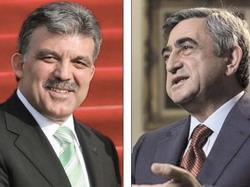
He voiced hope that Turkish President Abdullah Gul would accept the
Armenian leader Serzh Sarkisian's invitation to attend a World Cup
qualifying football match between the two countries' teams coming
up in Yerevan. "We hope that President Gul will capitalize on this
golden opportunity to move the process forward."
Bryza said Sarkisian had taken "a very courageous step" by
extending the invitation and by citing the possibility of setting
up a joint commission of historians to research the 1915
developments in Ottoman Turkey.
Sarkisian's invitation is seen as the latest attempt to forge his
country's relations with Turkey.
Turkish Foreign Minister Ali Babacan said whether or not the
invitation will be accepted depended on the situation that will
emerge.
Here we are to serve you with news right now. It does not cost much, but worth your attention.
Choose to support open, independent, quality journalism and subscribe on a monthly basis.
By subscribing to our online newspaper, you can have full digital access to all news, analysis, and much more.
You can also follow AzerNEWS on Twitter @AzerNewsAz or Facebook @AzerNewsNewspaper
Thank you!