
Sargsyan claims ‘anti-Armenian racism’ in Azerbaijan
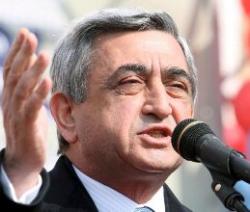
YEREVAN – Serzh Sargsyan, the president of Armenia, which occupies part of Azerbaijani territory, has claimed "anti-Armenian racism is reigning in Azerbaijan" and cited Baku's regular threats to regain its land by force.
Speaking ahead of Friday’s talks on the Nagorno Karabakh conflict with the Azerbaijani leader, he called for resolving the long-standing dispute through compromise.
"But in our case it turns out that we have to compromise with the one who is looking for a good chance to shoot at us," Sargsyan claimed at a sitting of the Council of Europe parliamentary assembly in Strasbourg on Wednesday. "In this situation, anyone would have hard time convincing the public in Armenia, in Nagorno Karabakh, the indigenous Armenian people who have lived there for centuries, that it is necessary to make any concessions to a country where there are hostility to the Armenians and racist moods."
The Karabakh conflict flared up in the late 1980s due to Armenia's territorial claims. Armenian armed forces have occupied over 20 percent of Azerbaijan's territory, including Nagorno Karabakh, since the two countries signed a precarious cease-fire in 1994 following a lengthy war. OSCE mediators have led negotiations on Karabakh settlement but little progress has been made so far.
The Azerbaijani and Armenian presidents will discuss in the Russian city of Kazan the basic principles of the conflict's resolution drafted by the United States, Russia, and France.
Sargsyan said a final accord to resolve the Karabakh conflict and its full enforcement will be possible only when the alleged anti-Armenian phobia and racism have been eliminated and "an environment of confidence" created in Azerbaijan. "The right of Nagorno Karabakh’s people to live freely and safely and decide their fate on their soil cannot be questioned."
He said further that a peaceful and fair solution of the Karabakh dispute remains a priority for Armenia.
"It is pivotal that the presidents of the [OSCE Minsk Group’s] co-chairing countries are personally dealing with the conflict resolution. This, undoubtedly, gives us hope."
US, French and Russian Presidents Barack Obama, Nicolas Sarkozy and Dmitry Medvedev issued a statement on May 26 calling on the Azerbaijani and Armenian leaders to finalize the basic principles of a peace agreement during Friday’s summit due in Kazan. The principles, dubbed the Madrid Document, are a peace outline proposed by the Minsk Group co-chairs that includes the return of the territories surrounding Nagorno Karabakh to Azerbaijani control; determining the status of Nagorno Karabakh; a corridor linking Armenia to the region; and the right of the displaced persons and refugees to return home.
The Armenian president said the conflict parties have different approaches to the basic conflict settlement principles. "The problem is that we interpret the Madrid principles one way, while Azerbaijan the other."
According to Sargsyan, as early as in 2007, when the peace outline was initially floated by the OSCE mediators, Yerevan said the outlined principles -- non-use of force, territorial integrity of states and self-determination of nations -- allow to achieve a fair settlement of the conflict.
"In recent years, the Azerbaijanis -- from officials to the president -- have stated that they are ready to resolve the problem militarily," he said, terming this as a violation of the first principle.
"Regarding the second principle, we have no questions. The Armenian state has never leveled territorial claims against either Azerbaijan or any other country. Therefore, Armenia has not recognized the independence of Nagorno Karabakh to date.
"The right of nations to self-determination is clear and appropriate for us. This [the enforcement of this right] has led to the establishment of several states in past years. But the Azerbaijanis have a different opinion."
But Azerbaijani President Ilham Aliyev rejected Sargsyan's criticism a few hours later when he appeared at a press conference in Brussels with European Commission President Jose Manuel Barroso.
President Aliyev said he had never heard of the so-called anti-Armenian phobia in Azerbaijan.
"This is disappointing. Someone who spearheaded military action against Azerbaijani civilians in Khojaly [a massacre committed by Armenians against Azerbaijanis during the Karabakh war in 1992] is talking about ‘anti-Armenian phobia’, this is outrageous."
Aliyev said it was the Azerbaijanis that were victims of aggression.
"Our lands are under occupation. The Armenians carried out ethnic cleansing against the Azerbaijanis, and several hundred thousand Azerbaijanis were ousted from their native lands. Naturally, these people want to go home, this is their fundamental right."
The president said Azerbaijan’s territorial integrity is not being questioned by any other country and reminded that the UN Security Council has passed four resolutions urging an unconditional pullout of Armenian armed forces from the occupied territories.
"Naturally, Armenia and Azerbaijan’s approaches to the conflict are different," Aliyev said. "Azerbaijan has not occupied an inch of Armenian territory, but Armenia has invaded 20 percent of Azerbaijan. We are the victims of this aggression, and therefore the moods in our society are different from the moods of the society in Armenia. So, when we hear from European Commission President Barroso and world leaders that the status quo has to change, this is encouraging. And a change in the status quo means changing the current situation, altering the fact of occupation."
Aliyev said that Azerbaijan accepted the Madrid Principles as a basis for negotiations and said he hoped that "Armenia will do the same."
"[If adopted] the principles, which on the one hand provide the restoration of the territorial integrity of Azerbaijan, and at the same time a high-level of self-governance for the people of Nagorno Karabakh...will be the road to peace," he said.
For his part, Barroso said the EU strongly supported a peaceful solution to the Nagorno Karabakh dispute.
"It is high time to make additional efforts to finalize agreement on the so-called basic principles," Barroso said. "I hope that the two parties will be able to move forward; as I stated, the status quo is not an option."
Here we are to serve you with news right now. It does not cost much, but worth your attention.
Choose to support open, independent, quality journalism and subscribe on a monthly basis.
By subscribing to our online newspaper, you can have full digital access to all news, analysis, and much more.
You can also follow AzerNEWS on Twitter @AzerNewsAz or Facebook @AzerNewsNewspaper
Thank you!