
OSCE mediators urge to start drafting peace accord
BAKU - OSCE mediators brokering settlement to the
Armenia-Azerbaijan conflict over Upper (Nagorno) Garabagh have
called for a negotiated settlement of the long-standing dispute
based on non-use of force, territorial integrity, and the equal
rights and self-determination of peoples. The statement came Monday
following talks held in the two countries by the co-chairs of the
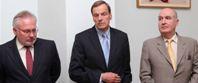
OSCE Minsk Group - Igor Popov of Russia, Bernard Fassier of France,
and Robert Bradtke of the United States.
In their meetings in both Yerevan and Baku, the co-chairs noted the
progress that has been made and the recognition by both sides that
the elements articulated by their three presidents in L'Aquila and
repeated in their June 26 statement must be the basis of a peaceful
settlement. They urged the parties, "in a spirit of constructive
compromise", to take the next step and move towards completing work
on the basic principles to enable the drafting of a peace agreement
to begin. They called upon the sides to strictly observe the 1994
ceasefire and exercise restraint along the line of contact.
The statement, issued by Presidents Dmitry Medvedev, Barack Obama
and Nicolas Sarkozy during a G8 summit in Canada, called on the
Armenian and Azerbaijani leaders to finalize the main principles of
Garabagh settlement in order to begin drafting a peace accord. The
statement referred to several key principles of the peace process,
including the return of the territories surrounding Nagorno
Garabagh to Azerbaijani control, an interim status for Nagorno
Garabagh providing guarantees of security and self-government, the
determination of the future legal status of the Azerbaijani region
through a legally binding expression of will and the right of
refugees and IDPs to return home, as well as international
guarantees of security, including peacekeeping operations.
During their visit, the co-chairs also presented to the parties
their plan to undertake a mission to the occupied territories this
fall, which was accepted in principle, the statement said.
The co-chairs expect that a meeting will take place between the
heads of their delegations and the foreign ministers of Armenia and
Azerbaijan on the margins of the OSCE informal ministerial in
Almaty July 16-17.
The three co-chairs visited Yerevan and Baku July 3-5. Bradtke and
Popov also visited the self-proclaimed Upper Garabagh republic July
2.
In Nagorno Garabagh, the US and Russian mediators briefed the
self-proclaimed republic’s leaders on the latest developments in
the peace process, including the June 26 statement of the mediating
countries’ presidents. They also discussed the June 18-19 incident
on the contact line of the two countries’ troops. They deplored
this incident as an unacceptable violation of the ceasefire, and
reiterated "their regret over the senseless loss of life and their
strong condemnation of the use of force".
In Baku and Yerevan, the three co-chairs met with the presidents,
foreign ministers and ministers of defense. In Baku, they also held
a meeting with representatives of Azerbaijani internally displaced
persons from the Nagorno Garabagh region.
Bayram Safarov, the leader of the region’s Azerbaijani community,
told a news conference following the meeting with the mediators
that Azerbaijanis were "binding great hopes" with the presidents’
latest statement. Speaking about the meeting, which lasted an hour
and a half, Safarov said the community members had said they hoped
to witness a positive outcome of the statement.
"We told them we want to return to our lands. We stated that the
enforcement of the presidents’ statement and Hillary Clinton’s
visit [to Baku] inspire great hopes in us," he said.
According to Safarov, discussions covered the status of Upper
Garabagh. "We stated that until the Azerbaijani population returns
to their homes, [determining] any status is out of the
question."
Azerbaijan and Armenia fought a lengthy war that ended with the
signing of a cease-fire in 1994, but Armenia continues to occupy
Upper Garabagh and seven other Azerbaijani districts in defiance of
international law. Despite numerous rounds of OSCE-brokered
negotiations, peace talks have been largely fruitless so far and
refugees remain stranded. Baku says the occupied districts must be
freed and Azerbaijani refugees displaced during the armed conflict
in the early 1990s returned home, and only after that could the
status of Nagorno Garabagh be determined within Azerbaijan’s
territorial integrity.
MP Elman Mammadov, a member of Nagorno Garabagh’s community, said
the Azerbaijani representatives had called upon the Minsk Group
co-chairs to put pressure on Armenia. The community members also
said they do not consider the conflict "frozen". It was also noted
that so long as occupation persists, Azerbaijan might launch
military action to liberate its territories.
According to Mammadov, in their reply, the co-chairs cited
Georgia’s experience.
"When we said this, the co-chairs reminded of Georgia and other
issues. The community members, for their part, explained to them
indirectly that Azerbaijan has no intention to wage a war with
Armenia. Azerbaijan will carry out military operations to free its
land from terrorists, the same way Russia is conducting anti-terror
operations in the northern Caucasus."
The co-chairs did not brief journalists following the discussions,
though this was previously planned, and confined to issuing a
written statement.
Here we are to serve you with news right now. It does not cost much, but worth your attention.
Choose to support open, independent, quality journalism and subscribe on a monthly basis.
By subscribing to our online newspaper, you can have full digital access to all news, analysis, and much more.
You can also follow AzerNEWS on Twitter @AzerNewsAz or Facebook @AzerNewsNewspaper
Thank you!