
Garabagh settlement outline covers Armenian pullout - minister
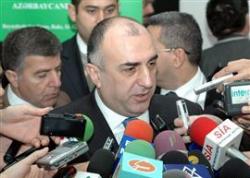
Armenia is to pull out from Azerbaijan’s five occupied regions
around Upper (Nagorno) Garabagh as well as thirteen villages of the
strategic Lachin district in the initial stage, according to the
updated conflict settlement outline dubbed the Madrid principles,
Azerbaijani Foreign Minister Elmar Mammadyarov has said.
Mammadyarov told a news conference Monday that during the ensuing stages, communications are to be restored, a donor conference held, the implementation of various programs launched in the region, and the safety of the persons displaced during the 1990s war returning to their homes ensured by international peacekeepers.
"Afterwards, Armenia is to withdraw its troops from Lachin and Kalbajar [another strategic district] and all roads are to open up. Once the Azerbaijani community has returned to Garabagh, an opportunity will emerge for launching the final stage, which is the process of determining the status of Garabagh.
Azerbaijan and Armenia fought a lengthy war that ended with the signing of a cease-fire in 1994, but Armenia continues to occupy Upper Garabagh and seven other Azerbaijani districts in defiance of international law. Peace talks have been largely fruitless so far and refugees remain stranded. The OSCE Minsk Group, co-chaired by the United States, Russia and France, is brokering peace talks, which are currently underway based on the Madrid principles, a peace outline on settling the conflict initially proposed by the OSCE mediators in the Spanish capital in November 2007. The updated version of the Madrid Document was submitted by the co-chairs to Azerbaijan and Armenia in Athens in November 2009 and is presently under discussion. Baku says the occupied districts must be freed and Azerbaijani refugees returned home, and only after that could the status of Upper Garabagh be determined within Azerbaijan’s territorial integrity.
Mammadyarov said the status determination is a pivotal issue for Azerbaijan.
"Upper Garabagh is Azerbaijani land. It would be wrong for a given territory of Azerbaijan to go beyond its administrative control. We are stating that all issues must be resolved within Azerbaijan’s territorial integrity."
The minister noted that self-determination is part of international law as well. "But this does not mean that territorial integrity can be violated. We have repeatedly stated that there are different autonomies and statuses in the world. For instance, in the Russian Federation, the Tatars, the Bashkirs have determined their fate, but they did so within the Russian Federation."
Mammadyarov reminded that Baku supports a stage-by-stage conflict resolution. "This is because we believe that all issues can’t be solved overnight. If Armenia pulls its troops from the occupied lands step by step, vast opportunities will open up for the region both from the economic and security viewpoints," Mammadyarov added.*
Here we are to serve you with news right now. It does not cost much, but worth your attention.
Choose to support open, independent, quality journalism and subscribe on a monthly basis.
By subscribing to our online newspaper, you can have full digital access to all news, analysis, and much more.
Subscribe
You can also follow AzerNEWS on Twitter @AzerNewsAz or Facebook @AzerNewsNewspaper
Thank you!