
Mediators see chances for Garabagh accord in 2008
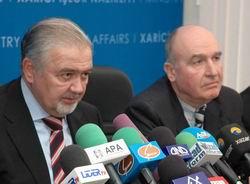
The OSCE mediators brokering settlement to the
Armenia-Azerbaijan Upper (Nagorno) Garabagh conflict have said 2008
could prove a successful year for the resolution of the
long-standing dispute.
"There is a chance that this year will see an agreement between the
sides," the co-chairmen of the Minsk Group told a news conference
in Baku on the outcomes of their visit to the region on Friday.
"We hope that the presidents of Azerbaijan and Armenia will avail
of all their chances this year and at least make a breakthrough in
the conflict settlement," French MG co-chair Bernard Fassier
said.
He emphasized that 2008 could be crucial for the peace process, as
new leaders will be elected in both countries. "In any country, the
newly-elected president strives to solve the most important issues
facing the country first."
The MG co-chairs from France, Russia and the United States arrived
in the Azerbaijani capital Sunday evening as part of their visit to
the region. After holding discussions in Baku they headed to
Yerevan late on Monday where they met with President Robert
Kocharian and Prime Minister Serzh Sarkisian. The co-chairs further
headed to Khankandi, an Azeri town turned by Armenians into the
center of the self-proclaimed republic, where they had discussions
with the separatist leader. On Thursday, the intermediaries paid
another visit to the Armenian capital for further talks. The
co-chairmen returned to Baku afterwards to complete their
visit.
The visit aimed to enquire about the positions of the two
countries' governments on the written proposals submitted by the
Minsk Group in Madrid late in November, but the mediators had to
provide explanations on the proposals instead.
The French co-chair said that considering the current positions of
the conflicting sides, a need has arisen for the mediators to
provide explanations concerning certain provisions of the document
submitted to the parties.
"We have explained to the sides that our proposals contain no trap
for anyone or ambiguity. These are the best proposals our countries
have made so far to reach a compromise on the Garabagh settlement,"
the diplomat said.
Fassier said the sides would be given time to work on the
proposals. He added that each party to the conflict was sincerely
trying to strike a compromise.
Russian co-chairman Yuri Merzlyakov said the mediators had received
new proposals during their talks in Baku and Yerevan that would
form the basis for a new version of basic principles on the
conflict settlement.
Merzlyakov said the status of Upper Garabagh was one of the
elements in negotiations currently under consideration but he did
not elaborate on progress in the discussions. The overall view of
the co-chairs is that there has been no precedent so far for the
balance of territorial integrity and self-determination of nations,
and that Upper Garabagh could be the first such precedent in
international experience.
Merzlyakov noted that one of the sides demands independence of the
self-proclaimed republic, while the other one is opposed to this.
"Each side interprets the important elements of the basic
settlement principles its own way."
The mediators did not agree with the assumptions that the 2008
presidential elections in both countries could hamper the peace
process. As an example of this, French co-chair Fassier cited
Armenia's elections due in February, pointing out that negotiations
have not been suspended although the vote is around the corner.
As for possible solution of the Garabagh problem through military
action, the mediators said this would not be a thought-through
option. The conflict will remain unresolved even if a fresh war
takes place, they said.
US co-chairman Matthew Bryza did not attend the news conference as
he left Baku earlier.
The intermediaries told the press after meeting Armenian Foreign
Minister Vardan Oskanian in Yerevan on Thursday that Azerbaijani
and Armenian Presidents Ilham Aliyev and Robert Kocharian adhere to
similar positions on basic principles of the conflict resolution.
At the same time, they declined to cite timing for a final
agreement between the conflicting sides.
"We don't want to set a precise timing for the signing of a peace
accord and prefer to give the presidents as much time as is needed
to thoroughly analyze each proposal, word or letter," Bryza said,
adding that "we should wait as both presidents are moving in the
right direction".
President Kocharian has said the Garabagh conflict may be settled
on the basis of the Madrid proposals.
He said it was possible to find a solution based on the logic of
the proposals, but added: "This document is not a final one and the
next president will continue talks on the conflict settlement."
Kocharian, who has served two presidential terms, will step down
after the election due in his country on February 19.
The Armenian leader was quoted by the Novosti Armenia news agency
as saying that both sides had accepted the content of the basic
principles but Armenia had divergent views on some provisions.
Azerbaijan and Armenia have been locked in conflict for over a
decade. Peace talks kicked off after a lengthy war that ended with
the signing of a cease-fire in 1994, but have brought little
tangible result so far. Armenia continues to occupy Upper Garabagh
and seven adjacent Azerbaijani districts.
False reports
US co-chairman, Deputy Assistant Secretary of State Matthew Bryza
said Friday that his earlier statement on the Azeri-Turkish
relations had been distorted.
Armenian media had quoted the diplomat as saying that he supported
altering the "one nation, two states" principle, which Bryza termed
as false.
"I never said that and have no right to say that. This is a policy
of Turkey and Azerbaijan," the mediator said.
Bryza had reportedly told a recent international conference in
Yerevan that Washington was working to normalize relations between
Yerevan and Ankara without the involvement of third states, which
means that Turkey should not put forth liberation of the occupied
Azerbaijani territories as a pre-condition for this. The reports
circulated that he backed changing the "one nation, two states"
notion that is in place between Turkey and Azerbaijan. He also said
that among tasks to be dealt with was opening the border between
Armenia and Turkey.
Ankara demands that Armenia relinquish its claims on the "genocide"
that allegedly happened in Ottoman Turkey during World War I.
Moreover, Ankara backs Azerbaijan on the Garabagh settlement
issue.
The Turkish-Armenian border has been closed since 1993 on Ankara's
insistence.
Here we are to serve you with news right now. It does not cost much, but worth your attention.
Choose to support open, independent, quality journalism and subscribe on a monthly basis.
By subscribing to our online newspaper, you can have full digital access to all news, analysis, and much more.
You can also follow AzerNEWS on Twitter @AzerNewsAz or Facebook @AzerNewsNewspaper
Thank you!