
Yen falls from four-week high before Fed as kiwi, krone slide
By Bloomberg
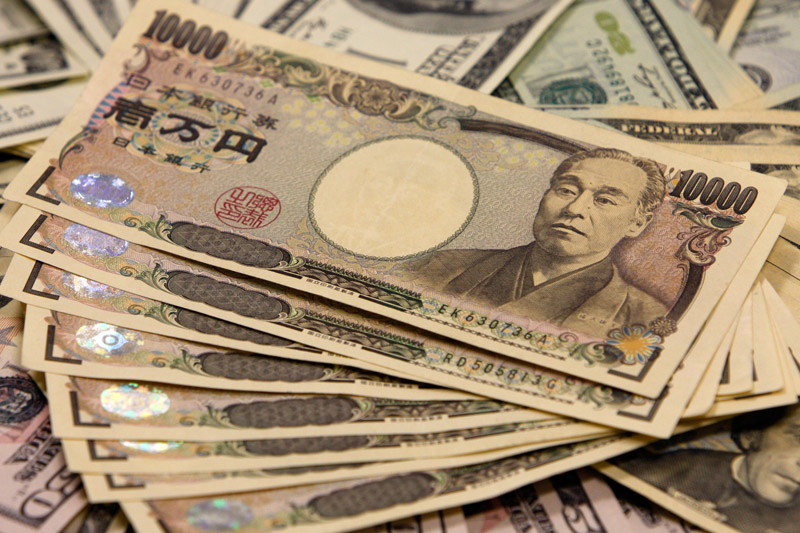
The yen retreated from the strongest level in four weeks against the dollar before the Federal Reserve ends a two-day policy meeting today.
Japan’s currency fell versus 12 of its 16 major counterparts. A gauge of the U.S. dollar rose amid speculation Fed policy makers will remove their pledge to keep borrowing costs low for a “considerable period” in their statement after today’s meeting. New Zealand’s dollar dropped the most in more than a week after a report showed the current-account deficit widened. Norway’s krone weakened. The ruble collapsed to a record yesterday even after Russia increased borrowing costs to the most since 1998.
“Looking toward the FOMC, it’s creating a bit of a cross current -- the market may be more reluctant to sell the dollar- yen now than it may have been yesterday,” said Greg Gibbs, the head of Asia-Pacific markets strategy at Royal Bank of Scotland Group Plc in Singapore, referring to the Federal Open Market Committee. The greenback “remains basically in a nervous state, caught somewhere between 115 and 119” yen.
The yen dropped 0.6 percent to 117.14 per dollar at 7:35 a.m. in London after appreciating to 115.57 yesterday, the strongest since Nov. 17. Japan’s currency fell 0.5 percent to 146.34 per euro after gaining 1.6 percent in the previous two days. The dollar strengthened 0.2 percent to $1.2487 per euro.
JPMorgan Chase & Co.’s Global FX Volatility Index rose to 10.04 percent yesterday, the highest level since September 2013. It has climbed from a record-low 5.28 percent set on July 4.
‘No End’
“The Fed is likely to get rid of the ‘considerable time’ phrase today,” said Shinji Kureda, head of foreign-exchange trading at Sumitomo Mitsui Banking Corp. in Tokyo. “But that could boost speculation of a rate hike in mid-2015, weighing on U.S. stocks and dollar-yen. There is no end in sight yet to declines in oil and commodity currencies.”
Crude oil futures fell as much as 2.4 percent after sliding below $54 a barrel yesterday for the first time since May 2009. The United Arab Emirates said the Organization of Petroleum Exporting Countries won’t cut production even if prices fall as low as $40 a barrel.
The Bloomberg Dollar Spot Index, which tracks the U.S. currency against 10 trading partners, gained 0.3 percent to 1,113.89. It closed at 1,122.34 on Dec. 5, the highest level since March 2009.
‘Considerable Time’
FOMC members conclude a two-day meeting today to discuss whether to retain a pledge to keep rates low for a “considerable time.” Signs of acceleration in the world’s biggest economy have contrasted with sluggish global growth. The key rate has remained at zero to 0.25 percent since 2008.
“Dollar-yen moves have been volatile,” said Kazuo Shirai, a trader at MUFG Union Bank NA in Los Angeles. “Where we go from here in dollar-yen depends on the Fed meeting.”
Norway’s krone slipped 0.7 percent to 7.4796 per dollar after declining to 7.8745 yesterday, the weakest since June 2002.
The kiwi dropped for the third time in four days after Statistics New Zealand said the current-account deficit expanded to NZ$5.01 billion ($3.87 billion) in the third quarter, the widest since 2008 and compared with NZ$1.08 billion in the previous three months.
The New Zealand currency fell 0.8 percent to 77.33 U.S. cents, the biggest decline since Dec. 5.
Australia’s dollar weakened 0.8 percent to 81.56 U.S. cents after dropping to 81.40, the lowest since June 2010.
The ruble lost as much as 19 percent yesterday in the biggest one-day drop in 16 years. Russia’s central bank unexpectedly raised its key interest rate to 17 percent from 10.5 percent, the largest increase since 1998.
“It’s a panic,” Greg Anderson, Bank of Montreal’s global head of foreign-exchange strategy in New York, said by phone. While the currencies of other oil-producing nations have fallen, “it’s just the magnitude in rubles that’s stunning,” reflecting the illiquidity of the market, he said.
The ruble was little changed today at 66.9785 per dollar after dropping to a record 80.10 yesterday.
Here we are to serve you with news right now. It does not cost much, but worth your attention.
Choose to support open, independent, quality journalism and subscribe on a monthly basis.
By subscribing to our online newspaper, you can have full digital access to all news, analysis, and much more.
You can also follow AzerNEWS on Twitter @AzerNewsAz or Facebook @AzerNewsNewspaper
Thank you!