
Green energy becomes new anchor of Baku-London ties

Ulviyya Poladova
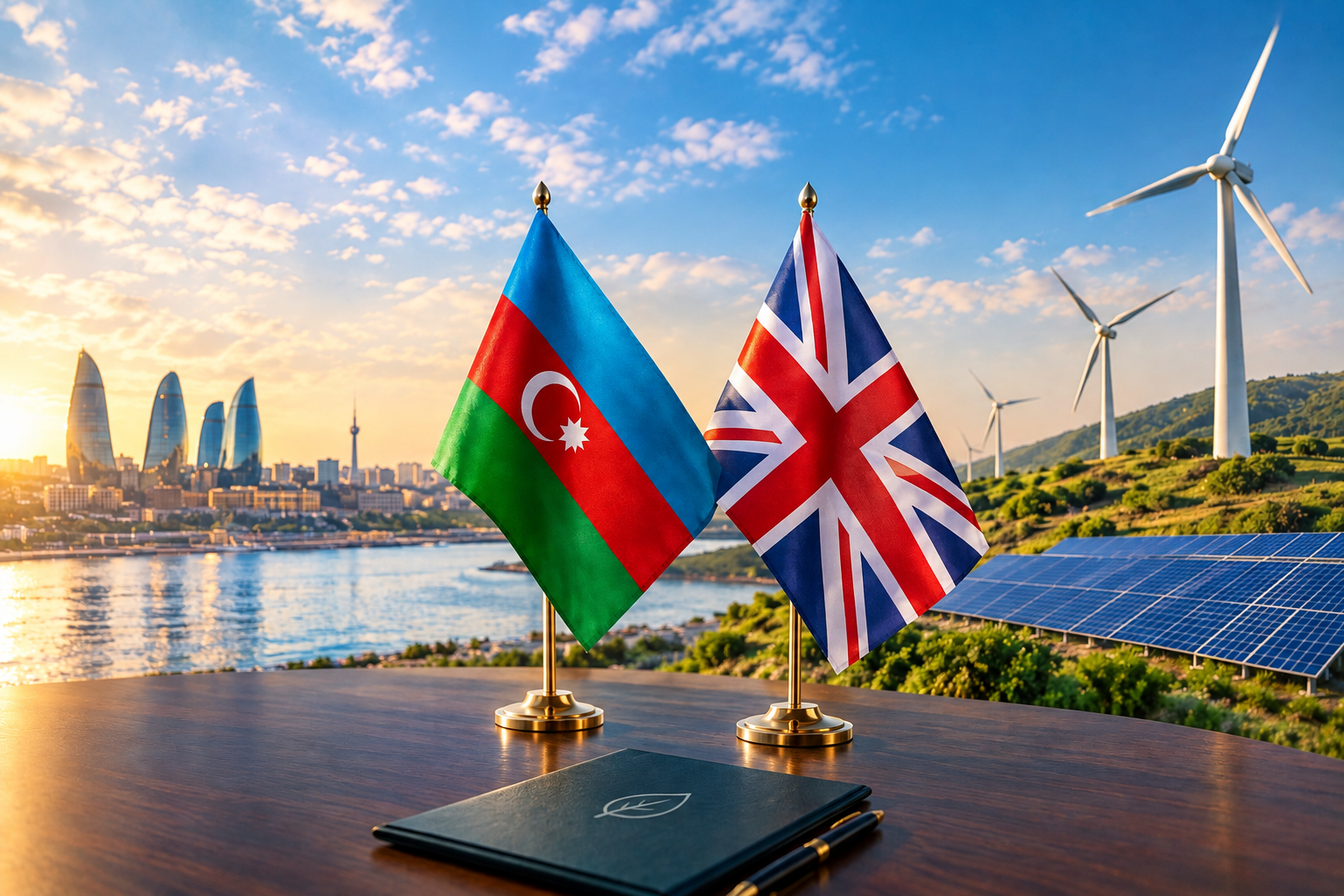
Read moreThe relationship between Baku and London moved beyond the familiar oil-and-gas script a long time ago, and the latest meeting at the Energy Ministry is a good case in point. Minister of Energy Parviz Shahbazov received Duncan Norman, Ambassador Extraordinary and Plenipotentiary of the United Kingdom of Great Britain and Northern Ireland to Azerbaijan. The conversation was a substantive one because the two sides, as the saying goes, compared notes across the whole span of their cooperation, from the traditional hydrocarbon sector to clean energy, decarbonization and electrical interconnections.
These days the spotlight has shifted to clean energy, decarbonization, electrification and the build-out of international energy corridors. One of the clearest markers of this new chapter is the solar power plant being developed together with bp in Jabrayil. The talks also singled out the electrification of oil and gas infrastructure that viewed as an important part of the energy transition. Pride of place on the agenda, however, went to the development of green energy corridors and interconnectors. In particular, the two sides discussed the "Caspian - Black Sea - Europe Green Energy Corridor." The Azerbaijani side laid out where the initiative stands, the findings of its feasibility study and the growing international appetite for the project.
It is worth recalling that Shahbazov has already set out some concrete milestones. In his words, Azerbaijan is counting on the launch of the "Central Asia - Azerbaijan" green energy corridor and the first phase of the Black Sea Energy corridor by 2032.
There is real groundwork behind those plans. In May 2024, the energy operators of Azerbaijan, Romania, Georgia and Hungary - Azerenerji, Transelectrica, the Georgian State Electrosystem and MVM - signed a memorandum on setting up a joint venture. That September the process went a step further, with a shareholders' agreement establishing Green Energy Corridor Power Company, the outfit tasked with laying the Black Sea Energy submarine power cable.
In effect, these are links in a single chain. The cable running along the bed of the Caspian and the Black Sea Energy cable are meant to become component parts of a sweeping energy bridge stretching from Central Asia, across the Caspian and Black seas, and straight into Europe. Black Sea Energy itself is seen as part of a broader infrastructure push aimed at knitting together the power grids of the Caspian region and Europe. Subsea interconnectors of this kind have already proven their worth. They are used to move electricity over long distances and to fold renewable sources into the wider grid.
Baku’s strategy here is clear. A country whose economy has long benefited from hydrocarbon revenues recognizes that it cannot rely on oil wealth indefinitely. Diversifying its energy portfolio is therefore not so much an environmental gesture as a matter of long-term economic resilience. For London, which has embarked on a path toward decarbonization, Azerbaijan is in turn an important partner in a region where European and Asian interests intersect.
The goal is to physically connect the power grids of the Caspian region and Europe. Projects of this scale, as history has shown, shape not only energy markets but also geopolitics. Every kilometer of subsea cable is more than an engineering achievement. Thus, it becomes a thread tying the region more closely to the European market and, more broadly, to the Western economic space. Baku’s readiness to involve British companies further suggests that it is seeking not one-off deals, but long-term cooperation with established and trusted partners.
In the modern world, geopolitical influence is no longer defined solely by military power or natural resources. Increasingly, it depends on a country’s ability to provide stable connectivity, facilitate economic integration, and ensure secure flows of energy, goods, and information.
At the heart of this strategy is the recognition that, in today’s geopolitical and geoeconomic environment, connectivity itself is strategic infrastructure. Pipelines, power interconnectors, fibre-optic routes, and multimodal transport corridors. For Azerbaijan, this translates into reinforcing the Middle Corridor (Trans-Caspian International Transport Route) with parallel "green energy corridors".
One of the most significant aspects of this strategy is the development of "green energy corridors" alongside the Middle Corridor transport route. The Middle Corridor, connecting China and Central Asia to Europe via the Caspian region and the South Caucasus, is rapidly gaining prominence as an alternative to traditional trade routes. Geopolitical instability in other regions has increased international interest in diversified logistics networks, giving Azerbaijan a unique opportunity to become a strategic transit hub for Eurasian commerce.
Through the "green" energy corridors Caspian-Black Sea-Europe, Azerbaijan-Türkiye-Europe, as well as through the Trans-Caspian and East-West, the renewable energy potential of Azerbaijan and Central Asia is integrated into a single system. Combined with fiber-optic components, these projects will create a long-term, diversified electrical and information bridge with Europe.
Earlier, President Ilham Aliyev stated that the goal of a clean environment and a "green growth" country has been identified as one of the five key national priorities for Azerbaijan’s socio-economic development through 2030.
Azerbaijan’s technical potential for renewable energy sources onshore is estimated at 135 GW. In Azerbaijan’s sector of the Caspian Sea, the technical potential for wind energy stands at 157 GW. Currently, renewable energy power plants with a total capacity of 2,070 MW are operating in the country. Of this, 1,443.5 MW comes from hydropower plants, 306.5 MW from wind power plants, 278.2 MW from solar power plants, 37 MW from bioenergy facilities, and 7.3 MW from hybrid power plants. The country’s targets for the coming years are even more ambitious. Based on signed projects, Azerbaijan plans to develop 6 GW of solar and wind power capacity by 2030 and 8 GW by 2032. By 2035, the country has also set a target of developing 8 GW of renewable energy capacity, which is expected to be used both to meet domestic demand and for export.
If Baku maintains its current pace, it could further expand and modernize its renewable energy sector, potentially enabling Azerbaijan in the future not only to meet a larger share of domestic electricity demand but also to export surplus green power to other countries.
Here we are to serve you with news right now. It does not cost much, but worth your attention.
Choose to support open, independent, quality journalism and subscribe on a monthly basis.
By subscribing to our online newspaper, you can have full digital access to all news, analysis, and much more.
You can also follow AzerNEWS on Twitter @AzerNewsAz or Facebook @AzerNewsNewspaper
Thank you!