
World blasts Russia over recognition of Georgian rebels
Russia has recognized the independence of the breakaway Georgian
regions of South Ossetia and Abkhazia, heightening tension in the
volatile Caucasus region and putting a further strain on Moscow's
relations with the West.
President Dmitry Medvedev approved the measure on Tuesday and called on other countries to follow suit.
"I have signed decrees on the recognition by the Russian Federation of the independence of South Ossetia and the independence of Abkhazia, considering the free will of the Ossetian and Abkhaz people," Medvedev declared in a meeting of the Security Council.
The move follows a vote in both houses of parliament on Monday, calling on the Russian government to recognize the two regions' independence.
Russia defied a plea from US President George Bush not to recognize the separatist regions.
Tensions escalated in Georgia's unrecognized republic of South Ossetia this month, sparking a brief war between Russia and Georgia. Russia sent troops to the region and pounded Georgian positions after Tbilisi launched an offensive to retake the pro-Russian, self-proclaimed region. A ceasefire agreement was reached with France's mediation on August 17.
Russia withdrew most of its forces from Georgia on Friday but built up its troops in and around the two separatist regions and left other military posts deep inside Georgia. The Pentagon said Russia was manning observation posts and checkpoints in Georgia's territory, violating the ceasefire.
The Russian leader blamed Georgian President Mikheil Saakashvili for what he said was "choosing genocide to solve his political tasks", saying Russia had prevented "the annihilation of the Ossetian and Abkhaz people".
"We had displayed tolerance and patience, and made repeated calls to return to the negotiating table," Medvedev said.
Medvedev said both NATO and the UN had ignored Russia's calls. He maintained that after the outbreak of hostilities in Georgia, South Ossetia and Abkhazia cannot remain within Georgia.
Medvedev vested the Russian Defense Ministry with the task of protecting law and order in the two regions pending signing of an agreement on friendship with the two republics. He also instructed the Foreign Ministry to forge diplomatic relations with Tskhinvali and Sukhumi, the capitals of South Ossetia and Abkhazia.
Russia's ambassador to NATO, Dmitry Rogozin, said while commenting on Medvedev's decision that his country had no intention to occupy Georgian territory. He cited as proof of that the fact that Moscow recognized the independence of South Ossetia and Abkhazia, instead of annexing the two regions.
Georgia's deputy foreign minister Giga Bokeria responded angrily, branding the move as "an unconcealed annexation" of the two Georgian regions.
The United States, NATO and European groups swiftly attacked Moscow's decision.
The Council of Europe Secretary General Terry Davis said in a statement that the unilateral recognition of the independence of Abkhazia and South Ossetia violates the territorial integrity of a fellow CE member state and jeopardizes prospects for a negotiated settlement of the dispute about the future status of the two regions.
"Russia cannot have it both ways. In the past, Russia has strongly supported the principle of territorial integrity. The decision to recognize Abkhazia and South Ossetia must strike any objective observer as being inconsistent with this principle. The ultimate victim of this decision is the international credibility of the Russian Federation. The Russians cannot invoke international law only when they feel like it."
NATO Secretary General, Jaap de Hoop Scheffer, said he rejected Moscow's decision. "This is in direct violation of numerous UN Security Council resolutions regarding Georgia's territorial integrity, resolutions that Russia itself has endorsed. Russia's actions in recent weeks call into question Russia's commitment to peace and security in the Caucasus."
Scheffer added that NATO firmly supports the sovereignty and territorial integrity of Georgia, and calls on Russia to respect these principles.
The OSCE chairman-in-office, Finnish Foreign Minister Alexander Stubb, condemned Russia's move as well. "The recognition of independence for South Ossetia and Abkhazia violates fundamental OSCE principles. As all OSCE participating states, Russia is committed to respecting the sovereignty and territorial integrity of others."
US Secretary of State Condoleezza Rice said Tuesday Russia's decision is "regrettable".
"I want to be very clear. Since the United States is a permanent member of the (UN) Security Council, this simply will be dead-on-arrival in the Security Council," Rice told a news conference in the West Bank city of Ramallah.
"And therefore, in accordance with other Security Council resolutions that are still in force, Abkhazia and South Ossetia are a part of the internationally-recognized borders of Georgia and it's going to remain so," she said.
State Department spokesman Robert Wood said the United States was considering steps for responding to Russia's "aggression." He did not elaborate, however, whether or not Washington would punish Moscow with sanctions.
"We can't allow what Russia has done to go without there being some consequences. We have not yet determined what those consequences will be from our standpoint but as I said, we are looking at a number of possibilities," Wood told reporters.
Western countries, including Germany, Britain and France, were quick to condemn Moscow's move. German Chancellor Angela Merkel termed it "absolutely unacceptable", while Britain "categorically rejected" the decision and France expressed dismay.
British Foreign Secretary David Miliband called for an international coalition to counter Russia's recognition of the two breakaway Georgian regions, regarding Tuesday's announcement by President Medvedev as "unjustifiable and unacceptable."
"I am holding talks today with international partners and will be visiting Ukraine tomorrow to ensure the widest possible coalition against Russian aggression in Georgia," Miliband said in a statement.
Russian Foreign Minister Sergei Lavrov countered that he was not concerned over Russia's potential isolation from the rest of the world after its recognition of South Ossetia and Abkhazia. "This course of developments is by far not the end of the world," he said.
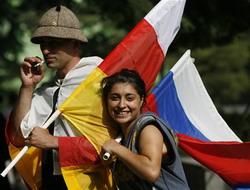
However, Moscow's move was warmly welcomed in the two breakaway regions.
Residents in Abkhazia took to the streets to celebrate the news, firing into the air, Reuters reports, and in the South Ossetian capital of Tskhinvali there were scenes of jubilation.
Here we are to serve you with news right now. It does not cost much, but worth your attention.
Choose to support open, independent, quality journalism and subscribe on a monthly basis.
By subscribing to our online newspaper, you can have full digital access to all news, analysis, and much more.
Subscribe
You can also follow AzerNEWS on Twitter @AzerNewsAz or Facebook @AzerNewsNewspaper
Thank you!