
Iran, major world powers make historic breakthrough with nuclear deal
By Sara Rajabova
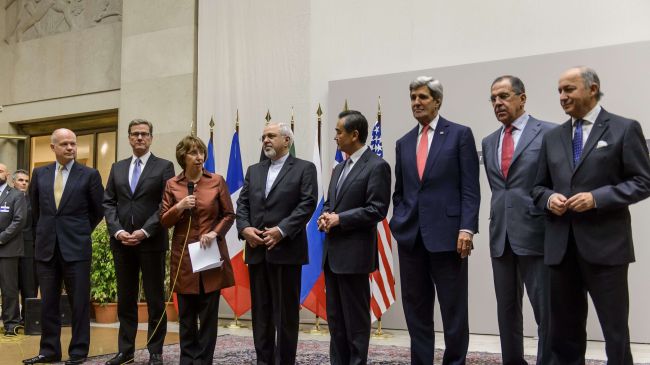
After the series of intensive talks, Iran and six world powers finally could reach an interim deal over Tehran's disputed nuclear program.
This deal could be considered as a historic turning point in the negotiation which has lasted over the last 10 years.
The agreement between world powers and Iran is also a sign of melting ice in the relations of major powers and Iran.
The world countries have hailed the agreement, reached on November 24 in Geneva between Iran and six major world powers over Tehran's civilian nuclear program as an important step toward.
The U.S. President Barack Obama said that the deal reached in Geneva is an important first step toward comprehensive solution to Iran's nuclear program.
Obama said the first step allows for "time and space" for more talks and the deal represents "a new path toward a world that is more secure."
According to him, Iran, like any nation, should be able to access peaceful nuclear energy, but it should prove to the world that its nuclear program will be exclusively for peaceful purposes.
Also, the high officials of the other six countries welcomed the deal calling it as a turning point and said the agreement with Tehran would "help safeguard peace and stability in the Middle East".
Iranian officials, in turn, assessed the initial deal with world powers as a victory, stressing that the agreement recognized Iran's nuclear enrichment right.
Iran's Foreign Minister Mohammad Javad Zarif described the country's new deal with the P5+1 as an important achievement. Based on the deal, Tehran's enrichment has been recognized.
Despite, Iranian officials pay special attention to the recognition of country's enrichment right, Western officials say it means no such thing and emphasize all the limits described in the text.
Under the six-month deal, Iran is allowed to continue enriching uranium to a level of 5 per cent, but will stop enriching at higher levels.
Iran has committed in nuclear deal to neutralize its stockpile of near-20 percent enriched uranium.
According to a fact sheet issued by the White House, uranium enriched to higher levels will be diluted in order to prevent its use in nuclear weapons.
Also, the stocks of lower-enriched uranium will be immediately converted into material that makes it more difficult to turn into weapons material.
Enrichment plants will not be expanded, and no new plants will be built.
The U.S. President Obama said Iran cannot use its next-generation centrifuges under nuclear deal.
Also, the construction will stop at the Arak reactor, which is of concern because it would produce plutonium as a side product.
Inspectors of the International Atomic Energy Agency (IAEA) will get access to additional sites to monitor implementation of the agreement.
Iran will grant daily access to its uranium-enrichment sites.
Sanctions relief
In exchange for Iran agreeing to limit certain aspects of its nuclear activities, the United States and its allies have agreed to lift some of the existing sanctions and offer access to a portion of the revenue that Tehran has been denied through these sanctions.
No new sanctions would be imposed on Iran for six months if the deal is honored.
According to the deal, embargoes will be suspended for the sectors of precious metals, car production, and petrochemical exports.
The group of six will also allow purchases of Iranian oil at low levels.
The six nations will also improve Iran's access to imports of food and medicines.
Also, Iran will get access to the assets in foreign exchange as part of an agreement under which it will curb its nuclear program in exchange for limited sanctions relief.
According to the reports, the U.S. has already released some $8 billion of Iran's assets.
Spokesman of Iran's administration, Mohammad-Baqer Nobakht said the mentioned assets are available for use, but Iran will not be converting that entire sum to national rial currency, IRNA news agency reported.
Nobakht also said that the nuclear deal will positively affect Iran's economy, and the sanctions will be decreasing as the time goes on.
There is no concrete figure about the amount of Iran's frozen assets abroad. Iran's former Deputy Commerce Minister for Economic Affairs, Hamid Safdel said in February that $100 billion worth of Iran's assets have been blocked overseas.
Earlier, AP reported that Iran's assets are estimated to be between $50 billion to $75 billion.
Besides, EU will likely lift some of the sanctions imposed against Iran in December following a deal between Tehran and the West.
French Foreign Minister Laurent Fabius said EU foreign ministers would meet in a few weeks to present a proposal to partially lift some sanctions imposed by the bloc against Iran as agreed in the recent deal.
EU sanctions on Iranian oil shipping insurance have already been lifted under the nuclear deal, member of Iran's Chamber of Commerce, Industry and Mines, Masoud Daneshmand said, IRNA reported.
Previously, Iranian and international shipping companies were unable to carry Iran's oil due to sanctions.
At the beginning of 2012, the European Union placed an embargo on Iranian oil and petrochemicals exports, banned the trade of precious metals as well as transactions with the Central Bank of Iran and froze its assets across the bloc. The measures came into effect as of July 1, 2012.
Iran and the six countries will hold another meeting in two weeks to decide about the date the document comes into effect.
The recent deal between Iran and six world powers was the consequence of some factors that urged the sides to come to agreement.
As for Iran, the election of moderate Hassan Rohani as Iranian president played important role in making breakthrough over the disputed nuclear program.
Rohani promised to warm up ties with the world and pull out of Iran from its hard economical situation.
After Rohani took the office, Iran and world powers held several rounds of talks to settle the nuclear dispute, which showed Tehran's strong commitment in this regard.
Finally, these efforts bear fruits and the sides could come to agreement over the dispute.
Besides, difficult economic situation in Iran because of sanctions compelled the country to take decisive actions to resolve dispute over its nuclear program.
On the other hand, the agreement with Iran was also very important for the West, as the nuclear conflict with Iran would threaten peace and security in the world.
The U.S. and its Western allies suspect Iran of developing nuclear weapons, something Iran denies. Iran has on numerous occasions stated that it does not seek to develop nuclear weapons but is using nuclear energy for medical research instead.
Here we are to serve you with news right now. It does not cost much, but worth your attention.
Choose to support open, independent, quality journalism and subscribe on a monthly basis.
By subscribing to our online newspaper, you can have full digital access to all news, analysis, and much more.
You can also follow AzerNEWS on Twitter @AzerNewsAz or Facebook @AzerNewsNewspaper
Thank you!