
Armenia ready for ‘normal ties’ with Turkey
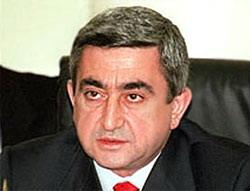
Armenian President Serzh Sarkisian has claimed forging normal
political relations between Armenia and Turkey would advance the
comprehensive solution of problems facing both countries.
"There is no real alternative to the establishment of normal relations between our countries," he said in an interview with The Wall Street Journal. "It is my hope that both of our governments can pass through the threshold of this new open door. Establishing normal political relations would enable us to create a commission to comprehensively discuss all of the complex issues affecting Armenia and Turkey. We cannot expect tangible progress without such structured relations. Only through them can we create an effective dialogue touching upon even the most contentious historical issues."
Sarkisian said that after his election in February, his Turkish counterpart, Abdullah Gul, was one of the first heads of state to congratulate him. Turkey's Prime Minister Recep Tayyip Erdogan suggested that the doors are open to new dialogue in this new period, he said.
Sarkisian said that during the Armenia-Azerbaijan Upper (Nagorno) Garabagh conflict, Turkey closed its border with Armenia as an expression of ethnic solidarity with Turkic Azerbaijan.
"The regrettable result is that for almost 15 years, the geopolitically vital border between Armenia and Turkey has become a barrier to diplomatic and economic cooperation. It is closed not only to Armenians and Turks who might want to visit their neighboring countries, but to trade, transport and energy flows from East to West."
Sarkisian said many Armenians and Turks have found ways to get around the closed border. They take advantage of regular charter flights from Yerevan to Istanbul and Anatolia. There are numerous bus and taxi routes through Georgia, and container trucks even make the long detour, enabling some trade between the two countries.
Sarkisian said that on Sept. 6 a World Cup qualifier match between the Armenian and Turkish national football teams will take place in Yerevan. "I hereby invite President Gül to visit Armenia to enjoy the match together with me in the stadium. Thus we will announce a new symbolic start in our relations."
Armenia and Turkey have been at odds and the border between the two countries has been closed since 1993 on Ankara’s insistence due to Armenia’s policy of occupation and the "Armenian genocide" claims.
Armenia has been occupying over 20% of Azerbaijani territory since the early 1990s in defiance of international law.
Armenians term the 1915 developments in the Ottoman Empire as genocide, a claim strenuously denied by the modern Turkish state.*
Here we are to serve you with news right now. It does not cost much, but worth your attention.
Choose to support open, independent, quality journalism and subscribe on a monthly basis.
By subscribing to our online newspaper, you can have full digital access to all news, analysis, and much more.
Subscribe
You can also follow AzerNEWS on Twitter @AzerNewsAz or Facebook @AzerNewsNewspaper
Thank you!