
Brahimi: Situation in Syria 'very grim'
By Sara Rajabova
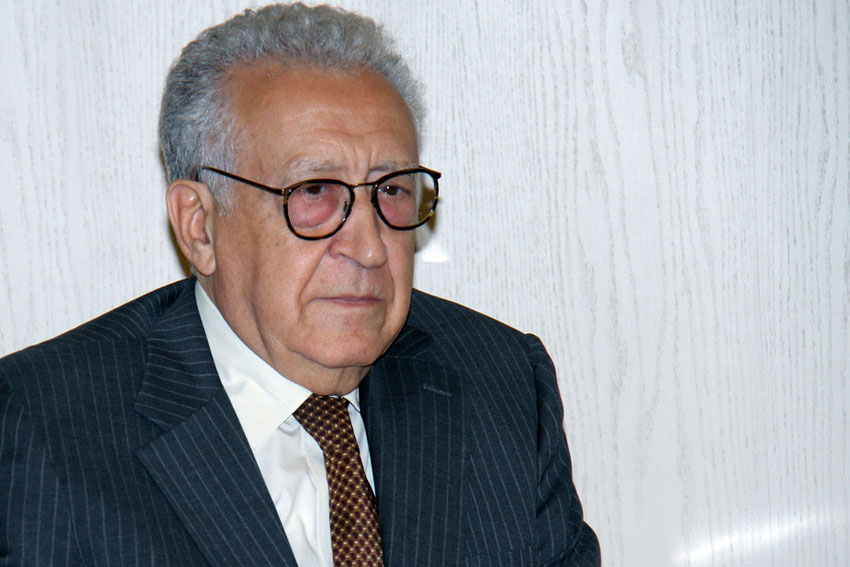
International envoy to Syria Lakhdar Brahimi announced on Monday that while the situation in Syria continues to be "very grim," a solution may be forthcoming.
Brahimi has briefed the UN Security Council about his visit to Syria last week and said the situation there is growing worse.
It was Brahimi's first briefing before the Security Council since he was appointed UN-Arab League envoy to Syria.
"There is no prospect for moving forward today or tomorrow," Brahimi told journalists following a briefing of the Security Council on the issue. "But I also told the Council that, paradoxically, now that I have found out a little more about what is happening in the country and the region, I think that we will find an opening in the not-to-distant future."
The envoy said the government in Damascus was "not serious about making reforms."
Speaking to reporters in New York, he highlighted Syria's need for transformation.
"I think I told everybody in Damascus and elsewhere that reform is not enough anymore; what is needed is change." he said.
More than 18,000 people, mostly civilians, have died since the uprising against President Bashar al-Assad began in March 2011. In addition, more than 260,000 Syrians have fled to neighbouring countries and an estimated 2.5 million are in urgent need of humanitarian assistance.
Brahimi recently returned from his trip to the Middle East where he met with President al-Assad to discuss the crisis. He then visited refugee camps in Turkey and Jordan, where he heard first-hand accounts of the struggles facing those who fled the conflict in their homeland.
Besides, the conference organized by the National Coordination Body for Democratic Change in Syria (NCB), an umbrella for 16 opposition groups with roots in the country, on September 23 requested Brahimi to call for an international conference about Syria where all concerned parties can play a part. The mission of that conference was to find the best political ways to start a transitional phase that guarantees the move toward a democratic regime.
On September 22, upon his return from the region, Brahimi met with Secretary-General Ban Ki-moon to address the violence in Syria and on how to progress towards an inclusive political solution that will address the legitimate demands of the Syrian people.
In his press encounter on Monday, Brahimi acknowledged that while he did not have "a full plan" as of yet on how to tackle the escalating conflict, he planned on returning to Syria soon.
"I'm returning to the region and I have agreed with the Council that I will come back here as soon as I can with more ideas on how we can move forward," Brahimi continued. "I refuse to believe that reasonable people do not see that you cannot go backward; that you cannot go back to the Syria of the past."
Turning his attention to the Security Council's ongoing deadlock - due to differences over how to proceed, the Council has so far been unable to unite and take collective action to put an end to the crisis - Brahimi said he was encouraged by the Council members' interest in the situation and their "generous support" to his mission. He also called on both the Council and the League of Arab States to remain united in their position.
Addressing the press stakeout, Ambassador of Germany Peter Wittig, which holds the Security Council's rotating presidency for this month, said the Council welcomed the opportunity to discuss the situation in Syria with Brahimi and that the Council members expressed grave concern about the ongoing violence in the country and its humanitarian impact. Furthermore, he reaffirmed the Council's "full and strong support" for the UN envoy's mission.
For his part, Brahimi noted that there was "no disagreement anywhere" that the situation in Syria was getting worse and that the violence had turned into a threat to regional peace and security. Nevertheless, he urged patience. "Please don't forget that I started just three weeks ago," he noted.
Brahimi has also told the council that the torture of detainees has become "routine" in Syria.
Brahimi said the Syrian people are also facing a growing food crisis. The envoy said harvests have been destroyed by the fighting between government forces and the rebels.
The head of the UN World Food Program, Ertharin Cousin, said on Monday that the number of people in Syria in need of aid has grown from 250,000 in April to some 1.5 million now.
According to activists, more than 29,000 people have died during the 18-month conflict in Syria.
Brahimi told the council that 1.5 million people are displaced and that 280,000 of them have fled to neighboring countries.
Here we are to serve you with news right now. It does not cost much, but worth your attention.
Choose to support open, independent, quality journalism and subscribe on a monthly basis.
By subscribing to our online newspaper, you can have full digital access to all news, analysis, and much more.
You can also follow AzerNEWS on Twitter @AzerNewsAz or Facebook @AzerNewsNewspaper
Thank you!