
Iran votes in parliamentary elections
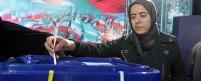
Polls opened Friday for Iran’s parliamentary elections, the country’s first major vote since the reelection of President Mahmoud Ahmadinejad in 2009 led to months of unprecedented anti-government protests, Washingtonpost.com reported.
No disturbances are expected this time around. The key question is turnout, as Iranians wait to see how many of the more than 48 million eligible voters go to the polls to elect 290 new members of parliament.
Iran’s supreme leader, Ayatollah Ali Khamenei, was one of the first to cast his ballot early Friday. State television quoted him as saying that a high turnout will "safeguard" Iran’s reputation and security.
In recent weeks, Iranian officials have increasingly linked the vote to Western sanctions and Israeli threats of war over the country’s controversial nuclear program. State-printed billboards quoted Western media organizations as allegedly saying that a high turnout would prove that sanctions and war threats are a "bluff."
The authorities initially warned that so-called Western enemies might plan fresh anti-government protests. When no protests materialized, they withdrew those warnings and lauded the "effectiveness" of the national security forces in stopping "Zionist paid spies" at the borders.
A security official told the semiofficial Mehr News Agency that 10 people arrested in recent days had been sent by Iran’s "enemies" to commit acts of sabotage during the elections.
"Threats like planting bombs have been prevented, but there might be more arrests before the end of the elections," said Mohammad Taqi Baqeri, the head of the Tehran province electoral security committee.
Friday’s vote could focus attention on Iran’s domestic infighting, which has turned the elections into an battle among conservatives who differ little ideologically but are split over whether to support Ahmadinejad.
One powerful group of hard-line clerics and Revolutionary Guard Corps commanders, united in a coalition called the Stability Front, is calling for more influence for those "elected by God."
In a sign of lingering discontent among officials purged after the 2009 disturbances, a former president of Iran urged fair elections after casting his ballot Friday.
"God willing, the results of the election will be what people have voted for and what they want. In that case, God willing, we will have a good Majlis [parliament]," said Ayatollah Ali Akbar Hashemi Rafsanjani, who has been sidelined by the Iranian leadership after he supported street protests against the 2009 presidential election.
Iranian authorities have predicted turnout of about 60 percent, even though others say that apathetic middle class voters might not go to the polls in large numbers.
At a polling station near the Enghelab (Revolution) Square, civil servant Mohammad Goudarzi said he had come to elect those who would solve problems such as high inflation, foreign currency prices and unemployment.
"If I don’t vote and others don’t, then who will decide for us?" he said.
Others said they were voting to make a statement to higher powers.
"I don’t know any candidate, but my goal is making God happy. The United States and Israel are God’s enemies, so by voting I’ll make them sad and God happy," said Zahra, 25, a university student, who did not give her last name.
Special correspondents Somaye Malekian and Ramtin Rastin contributed to this report.
Here we are to serve you with news right now. It does not cost much, but worth your attention.
Choose to support open, independent, quality journalism and subscribe on a monthly basis.
By subscribing to our online newspaper, you can have full digital access to all news, analysis, and much more.
You can also follow AzerNEWS on Twitter @AzerNewsAz or Facebook @AzerNewsNewspaper
Thank you!