
Regional leaders ink paper at anti-Russian energy summit
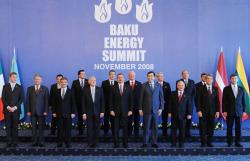
Leaders of former Soviet states gathered along with
European representatives in Baku on Friday for a key summit to
promote energy supply routes from the resource-rich Caspian region
to European markets that would bypass Russia. The event concluded
with the signing of a final declaration by the presidents of
Azerbaijan, Turkey, Georgia, Ukraine, Poland, and Lithuania.
During this fourth meeting of these countries, President Ilham Aliyev stressed the special importance that the agreement was co-signed by nine European Union states. "This is pivotal for the Caucasus region and the Caspian littoral states," he said.
Also joining in signing the declaration were Bulgaria, Hungary, Greece, Italy, Latvia, Romania, the United States, Switzerland, Estonia, and the European Commission. However, key Caspian energy producing states, Kazakhstan and Turkmenistan, declined to sign the declaration, which called for curtailing the Russian monopoly over export routes to the West. Currently, Kazakhstan and Turkmenistan sell most of their oil and gas to Russia or export it via Russian territory.
Azerbaijani Minister of Energy and Industry Natig Aliyev told reporters that the document covers the projects on transporting oil and gas through the East-West energy corridor, in particular, creating the NABUCCO gas pipeline system and building the Odessa-Brody-Plock-Gdansk oil pipeline.
"We have agreed to continue efforts... in the realization of joint projects aimed at the strengthening of Europe`s energy security, especially gas transit projects, including those across the territories of Georgia and Turkey," noted the declaration.
The first energy summit of Caspian, Black and Baltic Sea regional states was held in Krakow, Poland in May 2007, while the second summit met in Vilnius, Lithuania in October 2007. The third meeting was in the Ukrainian capital Kiev this past May. Participants focused on plans to extend the Odessa-Brody pipeline and to create transport corridors traveling through the Baltic states to deliver Caspian oil and gas to the Black and Baltic Sea regions.
President Aliyev told the Baku summit that there were realistic opportunities for the creation of the Odessa-Brody-Plock-Gdansk pipeline project. "I believe technical issues relating to this project will find their solution by year-end," he said.
The 674-km Odessa-Brody pipeline links the Ukrainian cities Odessa at the Black Sea with Brody near the Ukrainian-Polish border. The conduit is to be extended to the Polish towns of Plock and Gdansk. The EU-backed project is also expected to create a new market for Azeri oil.
President Aliyev emphasized that Azerbaijan has created, within the country, both energy security and economic stability. He noted that oil produced in the Caspian region is successfully being delivered to energy-thirsty world markets via existing pipelines.
"Energy security is important both for producers and consumers," he said.
Further, Aliyev stressed that Azerbaijan has already been transformed into a regional exporter of natural gas. By delivering gas to Turkey, Greece and Georgia, the resource-rich South Caucasus republic is developing future opportunities to export its gas to world markets.
"We possess tremendous gas reserves, which will suffice for at least another century," the Azerbaijani leader said.
During his remarks, Ukrainian President Viktor Yushchenko said new large-scale energy projects had been created due to the joint efforts of the heads of state. He noted that the feasibility study of the Odessa-Brody-Plock-Gdansk project is due to be completed in December.
Lithuanian President Valdas Adamkus, in his address at the summit, called on the EU countries to join the Odessa-Brody-Plock-Gdansk and NABUCCO projects, saying their involvement in these key regional initiatives was of great importance.
"If the EU states join these projects, their realization will further accelerate. This meets the interests of not only producers but also consumer nations," Adamkus said.
Further, the Lithuanian president said in a veiled hint about Russia, no country should be allowed to monopolize prices for energy resources.
To address the problem, he suggested calling a special meeting, during the Czech Republic`s EU chairmanship, to comprehensively discuss the issue. Adamkus added that such a discussion would allow European nations to bolster their cooperation in countering monopolistic practices and set up a body overseeing these efforts.
The EU is currently chaired by France. The chairmanship of the 27-member bloc is replaced every six months.
During the summit, the sharpest criticism of Russia`s energy policies came from Georgian President Mikheil Saakashvili. He accused Russia of seeking to maintain a tight grip on the regional energy resource corridor by sending troops to his country in August. Saakashvili said Moscow`s interference with the Georgian-Ossetian conflict actually targeted the South Caucasus republic, which is a transit state for key oil and gas pipelines.
"Russia is trying to impede the passage of large-scale energy projects through the Caucasus and is, therefore, seeking to boost its clout in the region," Saakashvili said.
The Georgian leader called on regional states to join efforts in countering what he described as forces hampering the creation of these projects.
On August 8, Georgia launched large-scale military operations against the breakaway region of South Ossetia. Moscow responded by sending troops to the pro-Russian region which struck at the Georgian armed forces using overwhelming force. A ceasefire was, subsequently, reached on August 17 to end the brief war, with the mediation of French President Nicolas Sarkozy.
Reviewing the past years, Polish President Lech Kaczynski highly praised Azerbaijan`s role in ensuring European energy security. "The country`s important role in this area is irrefutable."
Kaczynski emphasized that major energy projects, which seemed "a fairy tale" just a few years ago, have become a reality due to Azerbaijan`s initiative and direct involvement. Caspian oil is now being delivered to world markets through the Baku-Tbilisi-Ceyhan (BTC) pipeline, a major conduit that pumps crude from Azerbaijan`s Azeri-Chirag-Gunashli fields to the Turkish Mediterranean port of Ceyhan through Georgia.
"We believe that the NABUCCO gas project, which some believed was a fantasy, will soon materialize, as well. The hurdles that stand in the way of its realization will be eliminated in a short time," said Kaczynski.
The NABUCCO project, worth 8 billion euros, seeks to deliver 30 billion cubic meters of gas to European markets through a 3,300-kilometer pipeline traveling through Azerbaijan and Turkey to Romania, Bulgaria, Hungary and Austria. Transporting the first gas via the pipeline is expected in 2013. So far, only Azerbaijan has agreed to transport its gas via NABUCCO.
Turkish President Abdullah Gul said the South Ossetia crisis confirmed that unsolved conflicts pose a major threat to stability in the region.
"Our idea is to transform the South Caucasus from a region that is known for its conflicts to a region that would set an example for cooperation."
"The countries participating in large-scale energy projects should, first of all, stabilize the situation in the Caucasus, as this region`s security means the security of the energy corridor," Gul said.
He added that Ankara`s recent proposal to establish a regional platform sought to further that goal.
Following the brief Russia-Georgia war, Turkish Prime Minister Recep Tayyip Erdogan offered to establish a five-nation union, called the Caucasus Peace and Cooperation Platform, in an effort to bolster peace in the turbulent region.
Gul voiced confidence that the NABUCCO project would be completed. He said Ankara supported the efforts of Azerbaijan and Turkmenistan on gas exports and hoped that Uzbekistan would join in the proposal.
He also pointed out that Turkey was working hard to allow the delivery of gas from Iraq in a pipeline running through its territory, at the initial stage, and Iranian gas at a later time.
US Energy Secretary Samuel Bodman said the conflict in Georgia had shown "how important it is for Europe to diversify sources of supply" and predicted that Washington would remain engaged in the region under newly-elected President Barack Obama. "It is my firm belief that these efforts and this region of the world will also be a priority for the next administration," he said.
Here we are to serve you with news right now. It does not cost much, but worth your attention.
Choose to support open, independent, quality journalism and subscribe on a monthly basis.
By subscribing to our online newspaper, you can have full digital access to all news, analysis, and much more.
Subscribe
You can also follow AzerNEWS on Twitter @AzerNewsAz or Facebook @AzerNewsNewspaper
Thank you!