
SOCAR reveals Azerbaijan's energy figures
By Aynur Jafarova
Around 345 million metric tons of oil and 100 billion cubic meters of gas have been extracted from Azerbaijan's giant Azeri-Chirag-Gunashli block of oil and gas fields in the Caspian Sea since the beginning of development of the field.
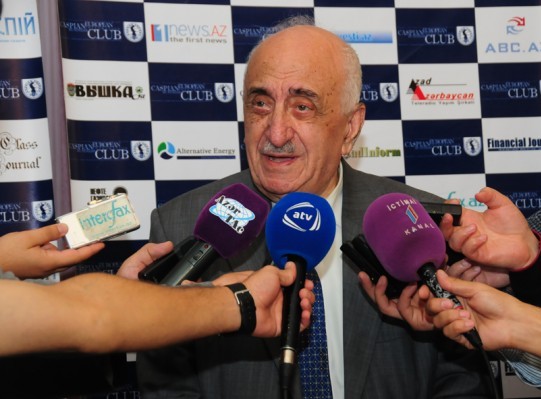
The news was announced by First Vice President of Azerbaijan's state energy company SOCAR Khoshbakht Yusifzade at an international conference titled 'Caspian shelf' held in Baku on September 10.
Around 185 million metric tons of Azerbaijan's profit oil was sold in the world markets as of September 1, 2014.
Yusifzade also noted some 22.3 million metric tons of 32.7 million metric tons of oil extracted from the ACG block accounted for Azerbaijan's profit oil in 2013.
"The average daily production volume at the field is 90,000 metric tons of oil and 35 million cubic meters of gas," he added.
The ACG block of fields has been active since 1997. The production started from the Chirag part of the field. It was followed successfully by Azeri Project; Central Azeri production in February 2005, West Azeri in December 2005, and East Azeri in October 2006.
The Deepwater Gunashli section launched production in April 2008.
ACG participating interests are BP (as operator, 35.8 percent), SOCAR (11.6 percent), Chevron (11.3 percent), INPEX (11 percent), Statoil (8.6 percent), ExxonMobil (8 percent), TPAO (6.8 percent), ITOCHU (4.3 percent), ONGC Videsh Limited (OVL) (2.7 percent).
Speaking about gas extraction from Azerbaijan's giant Shah Deniz
gas condensate field in the Caspian Sea, Yusifzade noted as of
September 1, around 55 billion cubic meters of gas were extracted
from this field since the beginning of development of the
field.
"Around 14 million metric tons of gas condensate was extracted from
the field since then," he said.
The Shah Deniz field, one of the world's largest gas-condensate fields, was discovered in 1999. Its reserves are estimated at 1.2 trillion cubic meters of gas. Overall, the field has proven to be a secure and reliable supplier of gas to Azerbaijan, Georgia, Turkey, and Europe.
The gas which will be produced at the second stage of Azerbaijan's Shah Deniz field development will be the main source of the Southern Gas Corridor, which is aimed at transportation of the Caspian gas to European markets.
Yusifzade also revealed the amount of Azerbaijan's proven gas reserves.
"The proven gas reserves hit 2.3 trillion cubic meters in Azerbaijan, but when it comes to the projected reserves, the figure can reach six trillion cubic meters," he said. "The projected reserves of only five perspective offshore blocks and structures - Babek, Nakhchivan, Zafar-Mashal, Araz-Alov-Sharg and Shafag-Asiman - make up 2.2 trillion cubic meters."
In his remarks about the Trans-Anatolian (TANAP) pipeline project, Yusifzade said this project will reach the maximum design capacity of 31 billion cubic meters per year by 2026.
TANAP, developed by SOCAR in collaboration with Turkish Botas and the energy company TPAO, will deliver Shah Deniz's gas to the Turkish-Greek border from eastern Turkey.
The initial capacity of the pipeline will be 16 billion cubic meters of gas a year. TANAP will link up with Trans-Adriatic (TAP) pipeline on the Turkish-Greek border.
About six billion cubic meters of gas will be delivered to Turkey and the rest to Europe. The costs of the TANAP project are estimated at $10 billion to $11 billion.
He also noted the Trans-Adriatic Pipeline (TAP) is planned to be commissioned in 2019.
The Shah Deniz consortium announced the selection of TAP as the main route for transporting its gas to Europe in late June. Another pipeline which was vying for Azerbaijan's gas transportation to Europe was Nabucco West.
Azerbaijan agreed to sell over 10 billion cubic meters of natural gas each year from the second phase of its Shah Deniz development to nine companies in the European Union in September 2013.
The contracts were signed for 25 years between SOCAR and the European utilities, including Axpo Trading AG, Bulgargaz EAD, Depa, Gas Natural Fenosa, Hera Trading Srl, Shell Energy Europe, Enel SpA, E.ON SE, and GDF Suez SA.
The initial capacity of TAP will amount to 10 billion cubic meters per annum with the possibility of expanding to 20 billion cubic meters per annum. The TAP's construction project is planned to start in 2015.
Later, he added that Azerbaijan exported 357 million metric tons
of oil as of September 1.
"Some 255 million metric tons of oil were shipped via the
Baku-Tbilisi-Ceyhan, 69 million metric tons via Baku-Supsa, and
11.3 million metric tons via the Baku-Novorossiysk pipeline of the
total volume of exported oil," SOCAR official noted.
In her remarks, Senior Adviser at Georgian National Oil and Gas
Corporation Liana Jervalidze said Caspian gas is one of the real
sources for diversification of routes of gas supplies to
Europe.
She said Caspian states - Azerbaijan, Kazakhstan, Turkmenistan and
Iran- have large natural gas reserves.
"There have long been international sanctions against Iran, and
development of large gas reserves in this country requires
substantial investments," Jervalidze said. "However, in this case
it will be easier to solve the gas transportation problem, as work
is underway to establish the TANAP."
Jervalidze said the situation is different with what is going on in
Turkmenistan.
"The country is ready to export up to 30 bcm of gas per year, but
this requires a corresponding infrastructure," she said.
"Turkmenistan is developing its gas transportation infrastructure
from the east to the west of the country, but at the same time
stands ready to sell gas on its own borders."
"This in turn requires establishing the Trans-Caspian Gas
Pipeline," the corporation's representative said.
The Trans-Caspian Gas Pipeline with a length of around 300
kilometers will stretch from the Turkmen coast of the Caspian Sea
to Azerbaijan, where it will be linked to the Southern Gas
Corridor. The pipeline's capacity is 30-40 billion cubic meters of
gas per year.
Talks on the construction of the Trans-Caspian Gas Pipeline between Turkmenistan, the EU, and other countries have been held since late 1990s. The negotiation process intensified after the EU issued a mandate to start negotiations on the preparation of an agreement between the EU, Azerbaijan, and Turkmenistan on the Trans-Caspian project in September 2011.
Here we are to serve you with news right now. It does not cost much, but worth your attention.
Choose to support open, independent, quality journalism and subscribe on a monthly basis.
By subscribing to our online newspaper, you can have full digital access to all news, analysis, and much more.
You can also follow AzerNEWS on Twitter @AzerNewsAz or Facebook @AzerNewsNewspaper
Thank you!