
Statoil to reprocess seismic data from Caspian prospective structures: SOCAR official
By Aynur Jafarova
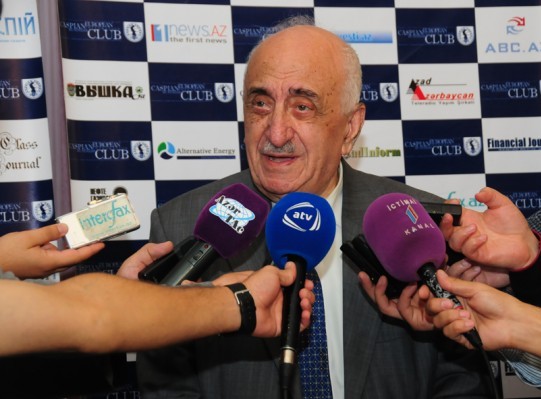
Norwegian energy giant Statoil intends to reprocess three-dimensional seismic data from the Zafar-Mashal prospective structures in the Azerbaijani sector of the Caspian Sea, Azerbaijani state energy company SOCAR's Vice President Khoshbakht Yusifzade said on October 30.
Yusifzade was speaking at a workshop organized as part of the Days of Norway in Azerbaijan.
According to him, reserves at the Zafar-Mashal block could reach 300 billion cubic meters of gas and 40 million tons of condensate.
SOCAR and Statoil signed a Memorandum of Understanding on these two prospective structures in April 2013. The memorandum was signed by SOCAR head Rovnag Abdullayev and Statoil CEO Helge Lund.
The document envisages negotiations and coordination of basic commercial principles and terms of a contract on development and conclusion of the contract within a year after its signing.
The first contract for the development of the Zafar and Mashal offshore structures was signed between SOCAR and U.S. company ExxonMobil on April 27, 1999. The state energy company had a 50 percent equity stake and ExxonMobil held 30 percent. In 2000, the remaining 20 percent was transferred to U.S. firm ConocoPhillips.
Yusifzade also cited production and export figures for Azeri-Chirag-Gunashli (ACG) oil and gas fields and the giant Shah Deniz gas condensate field in the Azerbaijani sector of the Caspian Sea.
According to him, to date 318 million tons of oil have been produced under the project on the development of the ACG fields.
Currently, the average daily production of oil at the block constitutes 90,000 tons of oil and 35 million cubic meters of gas.
The volume of profitable oil from the ACG block constitutes 165 million tons.
According to the SOCAR vice president, the proven oil reserves of Azerbaijan amount to 2 billion tons and estimated reserves stand at 4 billion tons.
The ACG block of fields has been producing since 1997. The production started from the Chirag part of the field and continues successfully. This was followed by the Azeri Project: Central Azeri production started in February 2005, West Azeri began producing in December 2005, and East Azeri came on stream in October 2006. The Deepwater Gunashli section launched production in April 2008.
Equity participation in the ACG contract is as follows: BP (operator) with 35.78 percent, Chevron with 11.27 percent, Inpex with 10.96 percent, AzACG with 11.65 percent, Statoil with 8.56 percent, Exxon with 8 percent, TPAO with 6.75 percent, Itochu with 4.3 percent; ONGC with 2.72 percent.
Around 29 billion cubic meters of gas have been exported since the start of development of the Shah Deniz field, Yusifzade said.
According to him, 25 billion cubic meters of the total gas volume exported from the field fell to Turkey and 3.4 billion cubic meters accounted for Georgia. Moreover, the gas is supplied to the pumping stations of the Baku-Tbilisi-Ceyhan oil pipeline.
In total, 46 billion cubic meters of gas and more than 12 million tons of condensate have been extracted since the beginning of the field development, the SOCAR vice president said.
According to Yusifzade, the potential daily flow-rate of the six wells at the Shah Deniz platform is 25-30 million cubic meters of gas and 7,000-8,000 tons of condensate.
The Shah Deniz field, which is one of the world's largest gas-condensate fields, was discovered in 1999. Its reserves are estimated at 1.2 trillion cubic meters of gas. Overall, the field has proved to be a secure and reliable supplier of gas to Azerbaijan, Georgia and Turkey as well as Europe.
Currently, the potential daily volume of production at Shah Deniz is 27.3 million cubic meters of gas (depending on demand) and 55,000 barrels of condensate.
Yusifzade went on to say that Azerbaijan has exported 328 million tons of oil and gas condensate via various routes since the beginning of development of the ACG and Shah Deniz fields.
According to him, 230 million tons of oil from the total volume was exported via Baku-Tbilisi-Ceyhan pipeline, 66 million-vial Baku-Supsa and 12 million-via Baku-Novorossiysk pipelines while some 20 million tons was exported via railway of the country.
Here we are to serve you with news right now. It does not cost much, but worth your attention.
Choose to support open, independent, quality journalism and subscribe on a monthly basis.
By subscribing to our online newspaper, you can have full digital access to all news, analysis, and much more.
You can also follow AzerNEWS on Twitter @AzerNewsAz or Facebook @AzerNewsNewspaper
Thank you!