
Aliyev criticizes BP over production falls (UPDATE)
By Nigar Orucova
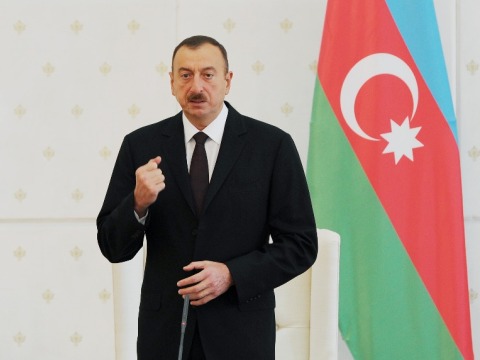
President Ilham Aliyev has criticized oil giant BP, saying crude mistakes of the international consortium that it operates have led to a sharp decline in oil production on Azerbaijan's two major offshore fields.
"Oil production began to decline sharply on the Azeri and Chirag fields due to serious mistakes made by the consortium over the past few years. This is not the first year when oil production decreases," President Aliyev told a cabinet meeting last week on the country's economic development in the first nine months of 2012.
The Azeri and Chirag fields are part of Azeri-Chirag-Gunashli (ACG), the largest oil fields in the Azerbaijan sector of the Caspian. The fields, located about 100 km east of the Azerbaijani capital Baku, are operated by BP on behalf of the Azerbaijan International Operating Company (AIOC). A landmark agreement on developing the ACG fields was signed with 13 energy majors from eight countries in Baku in September 1994.
President Aliyev noted that reaching the peak in oil production and its subsequent decline is a natural process, but the problem itself is the failure to fulfill the projections.
The president reminded that a production sharing agreement (PSA) was signed under the Azeri and Chirag development project. Huge investments were made during the first stage, and the share of foreign investors was initially much higher -- 75 percent. After the return on investments, the distribution of shares began to change and made up 50 to 50 percent, the president said.
President Aliyev noted that given the effectiveness of Azeri and Chirag and the terms of the contract, the share distribution changed in mid-2008 and since then it has comprised 75 to 25 percent in favor of Azerbaijan. That is, Azerbaijan receives 75 percent of the profit oil produced there.
Aliyev added, "I want to reiterate that oil production on the Azeri and Chirag fields for some reason began to decline after the share distribution was changed in accordance with the terms of the contract."
The president said the oil production forecast from the Azeri and Chirag fields presented to Azerbaijan was 46.8 million tons in 2009, with only 40.3 million tons of oil extracted.
In 2010, the forecast was 42.1 million tons, while actual production was 40.6 million tons.
In 2011, the output was projected at 40.2 million tons, but actual production was 36 million tons.
"The forecast for 2012 is 35.6 million tons," the president said. "Given current production, it can be assumed that BP will not be able to extract more than 33 million tons of oil from Azeri and Chirag by the end of the year."
According to President Aliyev, if all the figures are summed up based on the oil price of $100 per barrel -- considering that the price has been higher in past years -- it is obvious that Azerbaijan received $8.1 billion less in direct revenue.
"This is the reality behind the small statistical figures. Therefore, an annual, monthly, and quarterly decline in production in the oil industry is the logical result of this situation," the president said.
The president said, however, that hefty investments have been made in the Azeri and Chirag oil fields and Azerbaijan is grateful to all investors for this commitment.
"These investments have allowed the country to become one of the fastest growing countries in the world," he said.
"However, I want the public to know that the investments have no charity purposes. This is a specific business project. Until now, the BP-led consortium has invested $28.7 billion in the Azeri and Chirag oil fields and made revenues of $73 billion. So, quite a big profit has been made. Indeed, all of these profits became possible on the basis of contractual terms," Aliyev said, adding that Azerbaijan has also received considerable revenues.
Aliyev noted that most of the currency reserves, which total $45 billion, is the share of the Azerbaijani state oil fund SOFAZ. Much has been spent over the past 12 years since the establishment of SOFAZ.
The president said all pledges and forecasts made should be fulfilled.
"I should note that this unexpected drop occurred only due to crude mistakes by BP, which leads the consortium operating the Azeri and Chirag fields. We have cooperated with BP for many years. At all times we have supported their activity. We supported them in their hardest days. And we expected adequate treatment. These erroneous forecasts given to us are unacceptable. The false promises given to the state oil company [SOCAR] are unacceptable. In the business world, there is no place for such a relationship, it is impossible," the president said.
According to the Azerbaijani leader, last month BP officially promised to him that these shortfalls would be eliminated in a short time.
"All mistakes were admitted. It was admitted that the situation is not so encouraging. The promises given to me were that in a short period, significant changes would be made, the working program would be amended, specific measures would be taken to maintain production at a stable level, and, most importantly, the people who have made these mistakes would be replaced. Almost a month has passed since that time, but I do not see the implementation of these commitments.
"On the contrary, I believe, a process of dragging out time is ongoing. Therefore, I believe this is generally unacceptable. The State Oil Company has been instructed to raise the issue officially and to take the necessary measures. Investors who are unable to perform their duties and the terms of the contract should draw conclusions, strict measures should be and will be taken," Aliyev underscored.
BP Azerbaijan in response told the local press last Thursday that BP is fully committed to Azerbaijan and working with SOCAR to address the ACG production issues as quickly as possible.
A joint working group will determine the reason for the falls in ACG oil production, a senior SOCAR representative said last Friday. According to the SOCAR official, no one is protected against a reduction of production volumes regardless of a field's location.
"We are currently establishing a joint working group which will try to identify the reasons, find a solution to the situation and stabilize and increase production volumes," the SOCAR representative said.
He added that it is too early to make any statements on the reasons for the production decrease as the situation has to be thoroughly analyzed.
SOCAR has launched consultations with its partners after its formal accusation of BP of breach of the PSA contract on ACG development. The company's president, Rovnag Abdullayev, met Statoil's executive vice presidents Lars Christian Bacher and Eldar Saetre in Baku last Thursday. Details of the discussions were not disclosed.
Energy Minister Natig Aliyev said Monday that SOCAR should step up control over the operations on the ACG block of oil fields.
Aliyev told journalists that all the remarks regarding the project recently made by the Azerbaijani president are fair. Aliyev said that if the partners developing the fields are unable to match actual production with planned output volumes, "this indicates that there is a problem".
Specialists and scholars should jointly analyze the situation to determine the causes and solutions to the problem, Aliyev said.
He added that there is no threat to the activity of foreign companies in Azerbaijan.
A replacement has been made in the administration of BP Azerbaijan, spokesperson
Tamam Bayatli told the local press on Saturday.
"The company's vice-president on export pipeline operations, who had been planning to retire for a long time, stepped down," Bayatli said. "He planned to retire five to six months ago. BP Azerbaijan began selecting a new vice-president; there has already been an appointment to this post. The previous vice-president, who is not a citizen of Azerbaijan, worked in Azerbaijan for more than five years and made a contribution to the development of the oil industry. The new vice-president is not a citizen of Azerbaijan, either."
Bayatli named neither the previous nor the new vice-president, but according to the BP Azerbaijan website, the post is held by Kemp Copeland.
Operations at the ACG fields started in November 1997 with the start-up of production from the Chirag-1 platform, dubbed the Early Oil Project.
ACG participating interests are: BP (35.83%), SOCAR (11.65%), Chevron (11.27%), Inpex (10.96%), Statoil (8.56%), ExxonMobil (8%), TPAO (6.75%), Itochu (4.3%), and Hess (2.72%). Hess has sold its share in the project to India's ONGC, and the transaction will be completed in the first quarter of 2013.
Here we are to serve you with news right now. It does not cost much, but worth your attention.
Choose to support open, independent, quality journalism and subscribe on a monthly basis.
By subscribing to our online newspaper, you can have full digital access to all news, analysis, and much more.
You can also follow AzerNEWS on Twitter @AzerNewsAz or Facebook @AzerNewsNewspaper
Thank you!