
Nabucco support agreement to be signed in Ankara
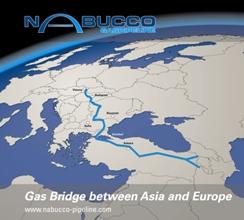
ANKARA – An agreement to support the realization of Nabucco gas pipeline project is expected to be signed this month by the pipeline's five transit countries - Turkey, Austria, Hungary, Romania and Bulgaria, Turkish newspapers report.
The details of the agreement, to be inked by the five countries’ ministers, are not yet known and need to be fine-tuned.
The signing ceremony was scheduled for July 30, but then the date was changed due to working schedules of the ministers.
The Turkish newspapers said outstanding supply problems were expected to be resolved this fall, while the financial issues - in the first months of 2011.
Nabucco shareholders are negotiating the gas supply issues with Azerbaijan, Iraq, Turkmenistan and Kazakhstan. If the talks succeed, then the pipeline extension will be enlarged from 3 300 km to 4 000 km, causing 10% boost in pipeline costs.
Nabucco is expected to carry the Caspian gas to the Central Europe via Turkey and Balkans. The shareholders of the company include Austria OMV, MOL of Hungary), Romanian Transgaz, Bulgarian Bulgargaz, Turkish BOTAS, as well as German RWE.
The shareholders, each of whom holds 16.67% of the shares, will meet 1/3 of the project expenses, while the remaining part will be funded by the international financial organizations.
The total cost of the project increased from €4.6bn to €7.9bn ($12.3bn).
The Nabucco pipeline is expected to come on-stream in 2013 and will carry 31 billion cubic meters of natural gas per year.
Background
The Nabucco pipeline project aims to decrease the EU's dependence
on Russian imports by bringing Caspian gas to a hub in Austria via
the Balkans.
Azerbaijan is seen as the project's most likely first gas supplier, while in future, it would also bring supplies from the Middle East. Supplies from Iraq are currently being considered, while in future Iran could also become an important supplier.
The gas would be shipped to Europe via Turkey, Bulgaria, Romania and Hungary. Construction of Nabucco will begin in 2011 (EurActiv 08/04/09), as the recent gas crisis between Russia and Ukraine has convinced decision-makers of the need to speed up the project.
Meanwhile, Russia is stepping up efforts to start implementing its rival 'South Stream' project (EurActiv 25/05/09). The country's Energy Minister Sergei Shmatko recently announced that South Stream would more than double its planned capacity from 31 billion cubic metres per year (bcm/y) to 63bcm.
The Nabucco consortium comprises leading European energy companies: OMV of Austria, MOL of Hungary, RWE of Germany, Bulgargaz of Bulgaria, Transgaz of Romania and Botas of Turkey. But three consortium members - OMV, MOL and Bulgargaz - have already signed up to Gazprom's South Stream pipeline, raising questions about conflicts of interest, or indeed their commitment to Nabucco.
Several EU governments, including Germany, France and Italy, which have close ties with the Kremlin as well as long-term gas contracts with Gazprom, are not convinced of the need for the new pipeline. Italy's ENI is Gazprom's main partner in 'South Stream'.
Turkey has used the Nabucco project as a bargaining chip with the EU. Also, Ankara seeks to use 15% of all natural gas flowing through the pipe as part of the deal for letting it pass through Turkish territory.
Here we are to serve you with news right now. It does not cost much, but worth your attention.
Choose to support open, independent, quality journalism and subscribe on a monthly basis.
By subscribing to our online newspaper, you can have full digital access to all news, analysis, and much more.
You can also follow AzerNEWS on Twitter @AzerNewsAz or Facebook @AzerNewsNewspaper
Thank you!