
SOCAR and Total to share production from Caspian block
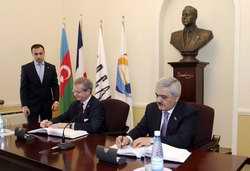
SOCAR, Azerbaijan`s state energy firm, signed an
agreement in Baku on Friday with French giant Total on production
sharing from the Absheron gas block in the Caspian Sea.
Under the contract, signed by SOCAR president Rovnag Abdullayev and Yves-Louis Darricarrere, president of exploration and production at Total, the Azerbaijani company will hold 40% interest while the French energy firm controls 60%.
Total will be the operator of the Absheron block during the exploration phase. For the development phase, Total and SOCAR will jointly form an operating company for the management of operations.
Under a previous Absheron development contract signed in 1997, Total had 20%, US oil giant Chevron had 30%, and SOCAR held 50%. But after exploration failed to produce significant findings, foreign partners withdrew from the project and the contract was invalidated. However, recent geological exploration data suggests that the field holds commercially viable reserves.
Total executive Yves-Louis Darricarrere said a repeated appraisal of the data acquired in the past, as well as increased demand for oil and gas, have sparked his company`s renewed interest in the project. He added that Total would give preference to highly-skilled Azerbaijani specialists in developing the field.
Darricarrere also said Total was holding talks with another French company on reorganizing its share in the project. "But I can`t elaborate on the details yet," he said, adding that the process had to be coordinated with SOCAR as well.
Abdullayev said that Total would be required to drill one well at the deposit during the three-year exploration period. "If the drilling is successful, it [Total] may drill two more wells over the following three years."
Investments during the exploration period are estimated at $100 million. The entire bulk of SOCAR`s exploration-related expenses will be incurred by Total. The amount spent will be further subtracted from the revenues received from the sale of the extracted hydrocarbons.
The Absheron block is located 100 km away from Baku, at a water depth of about 500 meters. According to SOCAR, the block holds 300 billion cubic meters of gas and 45 million tons of gas condensate.
Total is already participating in large-scale energy projects in Azerbaijan. The company holds a 10% stake in the development of the major Shahdaniz gas field in the Caspian and a 5% stake in the project on the Baku-Tbilisi-Ceyhan (BTC) main export pipeline that pumps Azerbaijan`s crude to world markets through Georgia and Turkey.
46 onshore and 25 offshore oil and gas fields are currently available in Azerbaijan, of which 54 are in operation. Foreign investments have been playing an important role in their development. 27 contracts in the oil and gas sector have been signed in the country to date, and work is underway on 13 of them - nine onshore and four at sea. A total of $30 billion has been invested in the Azerbaijani economy as a result of these operations. The resource-rich South Caucasus republic is presently cooperating with 30 energy companies from 20 countries, including the United States, Russia, China, Canada, Germany, the UAE and Ukraine. International consortiums tapping Azerbaijan`s energy fields are producing 80% of the extracted oil and 70% of gas.
Discovery of new reserves of natural gas may prove very beneficial for Azerbaijan. Azerbaijani gas is in high demand in European markets and it is not by mere chance that the number of countries expressing interest in buying more and more of it is increasing annually. For instance, Greece is looking to buy 3 billion cubic meters of gas per year from Azerbaijan, provided the latter can deliver this volume, the Greek ambassador in Baku, Ionis Metaksas, said last week. The statement follows Athens` announcement in 2008 that it was intent on purchasing 1bn cubic meters per year.
"But we understand that Azerbaijan has a lot of options in this regard," Metaksas said, adding that the Greek government hoped the issue would begin to be discussed soon and ultimately resolved.
Greece is already buying gas from Russia and Turkey. Turkey is selling fuel that it receives from Azerbaijan. Currently, Azerbaijani gas cannot be exported directly to Greece due to the lack of a transit agreement between Baku and Ankara as well as an inter-governmental agreement with Athens.
Here we are to serve you with news right now. It does not cost much, but worth your attention.
Choose to support open, independent, quality journalism and subscribe on a monthly basis.
By subscribing to our online newspaper, you can have full digital access to all news, analysis, and much more.
Subscribe
You can also follow AzerNEWS on Twitter @AzerNewsAz or Facebook @AzerNewsNewspaper
Thank you!