
Aliyev urges `courage` from NABUCCO players
The countries participating in the NABUCCO pipeline
project to transport Caspian gas to Europe should be more
courageous, Azerbaijani President Ilham Aliyev has said.
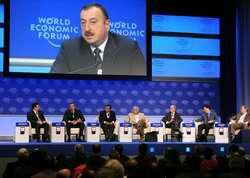
"NABUCCO has a number of problems: political backing, political will, financial commitment, the transit issue and drawing too many participants to this project," Aliyev told the "Energy Outlook 2009" session on the sidelines of the World Economic Forum in Davos, Switzerland on Thursday. "For this reason, I believe that joining efforts by the countries involved, and, at the same time providing strong financial support, could facilitate the course of the project."
President Aliyev emphasized that the NABUCCO initiative should not be viewed merely as a source of revenues. "This is a matter of energy security, which paves the way for overall security and, in the long run, energy independence."
The Western-backed project, worth 8 billion euros, envisions supplies of Azerbaijani and Turkmen gas begin delivered to energy-thirsty European markets through a 3,300-kilometer pipeline traveling through Azerbaijan and Turkey to Romania, Bulgaria, Hungary and Austria. It further seeks to ease the European countries` reliance on Russian gas.
Aliyev said Azerbaijan intended to ramp up production of gas in the coming years.
"We plan to at least double gas output in the next five years, therefore, existing markets are not enough. It is very important to have a precise understanding of what our potential markets are.
"Azerbaijan today has no problems with diversification. On the contrary, we have seven pipelines for the export of oil and gas that can transport our hydrocarbons in different directions. We are not dependent upon a single route or a single market. It may seem a little odd, but even the countries that are producing more oil and gas than Azerbaijan have offered to buy our oil and gas," the president said.
He emphasized that the proven reserves of gas in the South Caucasus republic amount to 2 trillion cubic meters, according to the most modest estimates, while the real volume could be several times higher. "The optimistic scenario of reserves puts the figure at 5-6 trillion cubic meters."
Meanwhile, Georgia leveled "transit claims" for the NABUCCO pipeline, which has yet to be built. Tbilisi has unequivocally stated the need for additional talks on the transit of Azerbaijani gas.
Georgia, which plans to participate in the project to construct the conduit, is counting on considerable dividends from the implementation of the project, Georgian Energy Minister Aleksandr Khetaguri told journalists in Budapest.
"Now everything depends upon what volume of gas will be left for Georgia [as payment] from its transit," he said, commenting on the declaration regarding the NABUCCO project adopted at the energy summit held in the Hungarian capital late in January.
According to Khetaguri, Georgia`s share in the overall volume of gas pumped through the South Caucasus Pipeline (SCP) has already been determined. "But if a third country`s gas is pumped into the pipeline, we will have to hold respective talks on transit."
SCP is the Azerbaijan-Georgia link to the Baku-Tbilisi-Erzurum (BTE) major gas pipeline which stretches to Turkey. On October 1, 2008, Georgia began to receive gas as a transit fee for the transporting of gas from Azerbaijan`s Shahdaniz Caspian field. The country receives 5% of the total volume of gas being transported.
Here we are to serve you with news right now. It does not cost much, but worth your attention.
Choose to support open, independent, quality journalism and subscribe on a monthly basis.
By subscribing to our online newspaper, you can have full digital access to all news, analysis, and much more.
Subscribe
You can also follow AzerNEWS on Twitter @AzerNewsAz or Facebook @AzerNewsNewspaper
Thank you!