
Jim Trengrove:
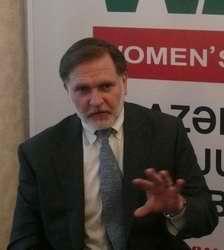
Jim Trengrove, former Senior Producer for American
PBS channel was the guest of the "Women`s Media Watch", the Union
of Women Journalists of Azerbaijan. Mr. Trengrove is one of the
architects of ADA Maclis, a newly-launched TV debate project on
Public Television of Azerbaijan. Sevinc Osmanqizi spoke to the
veteran TV producer upon completion of his three-months assignment
at the request of Azerbaijani Diplomatic Academy (ADA) at the
Ministry of Foreign Affairs.
- How did the ADA project find you?
- First of all, I quit my job. I worked for 21 years as Senior Producer for "Newshour with Jim Lehrer" show. And this was right during the presidential campaign. But I figured out that I have been doing this job for a long time and wanted to try something different. So I decided to quit without having another job. And within four days I heard from a friend at BBC in Washington that Azerbaijan Diplomatic Academy (ADA) was looking for a veteran television producer that would come to Baku and help start some programming. I was surprised. I knew Azerbaijan, I but wasn`t quite sure where it was. I looked up in Google and Wikipedia and became fascinated with what I read. It`s location next to Iran, Russia, Georgia and Caspian Sea, all the oil interests… I became very interested and started thinking about doing this. I never worked internationally. So I thought this is my opportunity to do something overseas.
- What was the purpose of the TV project?
- They were starting a new ADA University and one thing they wanted to do was to promote dialogue and debate among diplomats. As diplomats are been trained and sent around the world, one of the things they need to know is how to speak publicly, listen to other opinions, be open about them and know how to debate. At the same time, the idea was to open up the society here as well. I didn`t know how much has been done here, but gathered from my conversations at the ADA that there are not many debate programming on television. I was told that this will be on international relations and regional affairs, which I understood because of ADA. So it was meant to be the extension of ADA`s mission of developing debate discourse and to get people talking and exchanging ideas openly on issues that are important to Azerbaijan.
- You arrived in Azerbaijan right before the presidential elections and you have extensive experience in organizing presidential debates back at home. Was it one of the reasons why you were invited and were you in any way involved in setting up presidential debates here, in Azerbaijan?
- No, not at all. I knew that there were presidential elections coming up, because I did a lot of reading. And of course, our own presidential debates back in the United States were going on, so I thought I would experience different kind of presidential elections. But it came and went very quickly without much media coverage, I thought. I was at ITV and met several competing candidates. I watched their debate on Public Television. It was very different from what I experienced back in the United States.
- What was different?
- It was not a real debate. People were given certain amount of time to speak to the camera and to say anything they want. And from what I understood through translation, there were not quite on point. Often the candidates were all over the map. Instead of issues, there were a lot of personal attacks. Some were picking up silly, little things to argue about.
The moderator does not ask questions, which surprises me. He is a time keeper, that`s all. Whereas in the United States, the moderator prepares and asks questions. There might be one debate on foreign policy, one debate on domestic issues, etc. In the past they had a panel of journalists, asking questions as well. Here there were no questions. It was sort of free air time.
And the other thing that surprised me was that incumbent president did not participate at all. We had a history of that in the United States in the past. Lyndon Johnston, when he ran for presidency, after being Kennedy`s Vice-President, he was very popular and saw no reason to debate with his Republican challenger. When Richard Nixon ran for presidency twice and won, he had a bad experience in the first televised debates with Kennedy and he never wanted to do that again. So there has been a history of not participating in televised debates, but ever since 1976 there have been televised debates, where incumbent presidents have participated and debated against their challengers.
Of course, when you have so many challengers, as you have now, it is hard to do. So maybe the system needs to be looked at a little. I don`t think it would have changed many minds, I certainly understood that the President was going to win and he is very popular. But I think about five years from now. If there is a very serious presidential election, what would be the rule of the debate and what role the media will play. This was an easy one. You knew who was going to win and it didn`t matter if he had a lot of media attention, or there is legitimate debate or not. Five years from now, there might be some very good candidates opposing each other and my thinking is media and election system should be ready for something more important, than it was this year.
- Did you have a chance to share your experience with ITV management how the debates can be improved? Did you see willingness to improve, or is it something that is done because it has to?
- I think it is done because that`s what the Central Election Commission has set it to be. I understood that there had been some meetings in the past with OSCE and ITV and some other heads of the television stations, talking about how the media should cover the presidential elections. But you know, people have to want it. And right now it doesn`t matter if there is a lot of interest in making something like that happen, but again, in five years that might be a different story. When people are very interested in the debate and candidates and are not sure who will be the president, at that point there may be more public demand and outcry for debates and good, solid media coverage of campaign, that didn`t exist this time.
- What is the ultimate purpose of the ADA project? Why would be the Foreign Ministry interested in doing this?
- I think it is an experiment. Of course, it is an experiment. I think Azerbaijan is at a point now when it can play an important role in the regional affairs and certainly in world affairs as well. Its strategic location between the very hot flash points of world affairs, naturally, makes it an important player. Plus, its energy resources give it a lot of important standing. I think they want to improve their voice, to be heard outside of Azerbaijan. So I think one of the points of ADA Maclis and probably, number one, is to develop a voice, and number two, a dialogue and debate, and get it spread thorough Azerbaijan, and through television networking to other countries.
- You taped the very first show. What were the success and shortcomings of the first program?
- It was very ambitious first program. The fact that we were trying to do the programming around the schedule of the Baku Energy Summit, restricted us to certain extent. We had people in town for a very short period of time. It was very complicated, ambitious project. But I think it worked. Thanks to eleven-hours editing on Sunday. It looked very well, I thought.
Where I worked with Jim Lehrer, the interviewing became a science. Choosing right guests is a real technique, which I don`t think people here were realizing in the beginning. It is not just as easy, as to call people up, because you know that they are important and have opinions, or are very good speakers and invite them into the program and expect them to be good or brilliant. It is not that easy. Although I think our programming was very good and it is first program, it gave a lot of information. The ministers that we had, from countries of Greece, Ukraine, Georgia, Lituania and Azerbaijan were very good and natural. I don`t think they were too frightened by the cameras. But during the discussion, everybody seemed to agree and there was not a lot of debate.
- What do you think was missing to make debate happen?
- What we learned at the Newshour is the first thing you do, you sit down with the editorial staff, and decide what is the issue and what are the questions you want to ask and want to be answered. So you sit down with the moderator and with a group of research reporters and discuss the issue.. Then we come down to the list of questions. Then we come up with names of different people, who might fill in our roles. We don`t know at that point if we have room for two or three people. We don`t really know this until we talk to these people. If we think we want six or seven people in the program, we may call eight people.
When we have done that, we do pre-interviews. Now we know who is good, who is too general, who is specific, who has one point of view, who has another point of view. And then we start matching them up. So by the time you invite the people, you know how their answers are going to be and you can set up a debate even before the people have come.
- I understand that this wasn`t the case here. You invited and interviewed random people, who said random things…
- Right. But I have talked to several of them and had some idea. If we talked to them in advance, maybe we could have known better the questions we wanted to ask. But because of the frantic pace of what we were going through, finding the location, finding the furniture, finding the ministers and because it was our first program, we were just happy to get on the air and having it professional. And we got some good feedback on it too.
- How did you find [MFA Spokesman] Khazar Ibrahim and [Deputy Foreign Minister] Hafiz Pashayev as moderators?
- Khazar was good. My number one concern when I first considered this position was why is the Spokesperson from the Ministry of Foreign Affairs conducting open debate program? But when I met him, I felt much better. I think he is open-minded. And we say in the program that he is the Spokesperson from the MFA and here he is the host of the ADA Maclis. People recognize him. He was very good and natural. He was not nervous, even though he has done television on one side of the camera before, but has never been in the position of asking questions. He brought some of his own comments as well and added information which was very helpful.
Ambassador Pashayev was terrific. He was very natural. He is a very soft-spoken man. I met him several times and had very good conversations with him. But when the camera went on, he was like sitting at dinner table with friends and having discussion. He was very open, very easy and made the ministers relaxed as well. So I see a role for him in this program. Whether he wants to do it or not is a different story, but I think there is certainly a value of having him involved in the program.
- The moderator`s role is to challenge interviewees and air opposite views. Both of these moderators are high-ranking government officials. How far did they go in getting to the bottom of the issues?
- I have to go back and look at the translations of the discussion. But because we were dealing with something that maybe, there isn`t overall debate over. The issue was who Azerbaijan should sign up as transit and trading partners. I don`t think we got to a good discussion about the benefits of having new pipeline through Georgia, as opposed to going through Iran or Russia and foreign policy implications of that. And maybe in future we can do something a little hard-hitting. I think everybody was trying to feel comfortable with the first program. And what the Ambassador said, I agree with him, let`s get on the air, and see how it works. And as we move along, we can start get a focus on important things.
- Do you actually see the MFA Spokesman airing opposite views?
- O, yes, I do. Khazar can challenge. For instance, when he has his Foreign Minister on, he can challenge the Minister. He has to play the opposite role. I don`t expect that this will be his position, but he has to let people know that we are considering all positions. So if there are other opinions, he can challenge the Foreign Minister or someone else on that. He may say, someone say, or someone has this position, etc. So he can get the question on air and get the government`s side chance to respond. Whether or not the government people will come up with opposition people, I don`t know. That should be encouraged. I hope that when the Foreign Minister comes on, which I think he will, other people in the government will think it is ok to do this. There is nothing wrong with this. We can go on, listen to other people`s opinion and I think it can go a long way, opening up the debate. Because if the people in the government are willing to do it, then I think everybody will benefit from that.
- The ambition behind inviting you to Azerbaijan, apparently, was to create something along the principles of Newshour. Now that your assignment is over, how close is the program to what you had on mind?
- I think it is what it wants to be, as long as it sticks with core principles of debates and discussion. ADA Maclis can take different forms and shapes, as did our first program. But I think it will address its mission, which is to have people talking openly and not afraid to express their opinion.
- Based on your experience, how do you evaluate debating skills in Azerbaijan?
- It is hard to say. You have to match people better if you are to set up debate. My colleague Robert MacNeil used to say "don`t think that there are two sides of every issue, there are many sides of every issue".. So don`t think that you got to have a black and white debate. There are a lot of greys out there, which you need to expose as well. But I think it was a good beginning. I especially liked the idea that the audience participated as well. It shows that they are not afraid to speak on television.
"Women`s Media Watch" works to strengthen the role of women in the news media and increase women`s presence in the public debate; trains women`s groups to hold media outlets and decision-makers accountable to the public interest; advocates for ethical journalism and freedom of media, because free, professional and accountable media are essential to a vibrant democracy and an informed public.
Here we are to serve you with news right now. It does not cost much, but worth your attention.
Choose to support open, independent, quality journalism and subscribe on a monthly basis.
By subscribing to our online newspaper, you can have full digital access to all news, analysis, and much more.
Subscribe
You can also follow AzerNEWS on Twitter @AzerNewsAz or Facebook @AzerNewsNewspaper
Thank you!