
Justice for Khojaly seminar held in Indonesia
A seminar titled "Justice for Khojaly and Lessons for Future"
jointly organized by the International Youth Association for
Justice and Peace and Habib and Abdurrahman Wahid Centers has been
held at the University of Indonesia in Depok, West Java.
The one-day seminar was attended by human rights activists, think
tanks, religious leaders, scholars, diplomats and students, AzerTag
state news agency reported.
The event jointly organized by the International Youth Society
for Peace and Justice (IYSPJ),The Habibie Center, Abdurrahman Wahid
Center (AWC), and University of Indonesia’s vocational program to
commemorate the 23rd anniversary of the Khojaly genocide.
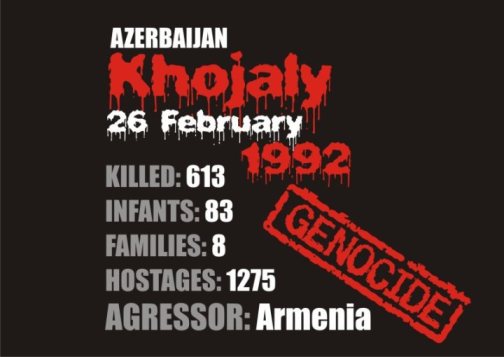
Tamerlan Garayev, Azerbaijani Ambassador to Indonesia, said 613
people were killed, including 106 women, 83 children and 70 elderly
persons during the course of a single day of violence in
Khojaly.
“It was a heinous crime committed not just against Muslims but
against humanity,” Garayev said.
“There is no doubt that what happened in Khojaly in 1992 was an act
of genocide. It was a crime against humanity and the perpetrators
must be brought to justice,” said Elfansuri Chairah, Head of Komnas
HAM's research and study wing.
While expressing his organization’s full support for Azerbaijan,
Elfansuri said that Komnas HAM was established mainly to deal with
human-rights issues in Indonesia. But he said it could not sit idly
by if crimes against humanity, especially at the level of genocide,
occurred outside Indonesia.
“As a human rights body, we are ready to raise the Khojaly genocide
issue at the regional and international level. We need more data
and information from Azerbaijan,” Elfansuri said.
Indonesia, which strongly supports Azerbaijan’s sovereignty and
territorial integrity, condemned Armenian aggression and asked both
Azerbaijan and Armenia to resolve the dispute through
negotiations.
“The conflict between Azerbaijan and Armenia should be resolved
through dialogue. We should make efforts not to allow this kind of
genocide in the future,” said Muhammad Syukron, vice director of
the Abdurrahman Wahid Center.
Most of the speakers asked the Indonesian government to put more
pressure on Armenia to withdraw its troops from Azerbaijan
territory. Indonesia, they said, must seek stern measures against
Armenia at the UN and the Organization of Islamic Cooperation
(OIC).
The conflict between the two South Caucasus countries began in 1988 when Armenia made territorial claims against Azerbaijan.
As a result of the ensuing war, in 1992 Armenian armed forces occupied 20 percent of Azerbaijan, including the Nagorno-Karabakh region and seven surrounding districts.
The two countries signed a ceasefire agreement in 1994. The co-chairs of the OSCE Minsk Group, Russia, France and the US are currently holding peace negotiations.
Armenia has not yet implemented four UN Security Council resolutions on the liberation of the Nagorno-Karabakh and the surrounding regions.
- - -
Follow us on Twitter @AzerNewsAz
Here we are to serve you with news right now. It does not cost much, but worth your attention.
Choose to support open, independent, quality journalism and subscribe on a monthly basis.
By subscribing to our online newspaper, you can have full digital access to all news, analysis, and much more.
You can also follow AzerNEWS on Twitter @AzerNewsAz or Facebook @AzerNewsNewspaper
Thank you!