
Humanism, dialogue main pillars of Azerbaijan’s foreign policy
By Aynur Jafarova
A high-ranking Azerbaijani official says the country's foreign policy is based on humanism and dialogue-oriented problem solving.
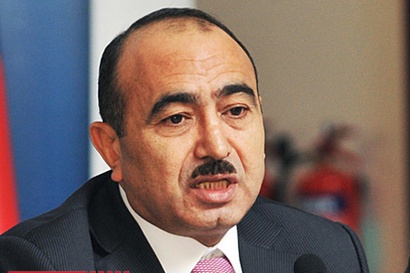
Head of the Public and Political Issues Department of Presidential Administration of Azerbaijan Ali Hasanov said Azerbaijan has not been involved in any conflict across the globe including Syria and does not plan to get involved either.
"Azerbaijan is itself a victim of regional conflicts," he said. "Some 20 percent of its territory has been occupied [by Armenia]. The country has done its best to find a fair solution to this problem with the principles of international laws. Thus, dispatching our forces to conflicts in other regions and sacrificing our forces for the interests of others is disgusting to us. They are our citizens and we cannot remain indifferent towards their fates."
He said Azerbaijan, using all available methods, tries to prevent its citizens from getting involved in any conflict.
"The security bodies, the foreign ministry and the embassies are closely working on this issue and taking appropriate measures. But it is necessary to take into account that this is a very complex issue, which at some point may require a systematic approach," he said.
"Azerbaijani citizens' participation in global conflicts is a two-folded issue. At personal level, this is their own fate and they can decide for themselves but if their decision pose a threat to the society, then we have to take systematic measures," Hasanov said.
The official also warned of some foreign media biased outlets about Azerbaijan.
"The internet and social networks are absolutely free, but sometimes the global network is used for carrying out campaigns against various individuals and countries to press on public opinion, to create artificially grudge in the society and to stimulate religious radicalism. Often the traces of certain external forces and international organizations can be seen behind these attempts," Hasanov underscored.
"Azerbaijan is a strong state capable of adequately preventing any threats or attempts aiming to harm its national security," he assured.
With regard to the Armenian-Azerbaijani Nagorno-Karabakh conflict, Hasanov noted that Armenia is not interested in a constructive dialogue and the peaceful settlement of the conflict. The Armenian leadership intends to maintain the status quo and prevents any peace initiatives by various means.
"Armenia did not fulfill its promise to respect the ceasefire for during the Olympic Games in Sochi and the tensions on the frontline are still rising," he underscored. "This provocation of Armenia should be an open message to the co-chairs of the OSCE Minsk Group - the co-chair from Russia, where the Olympic Games are being held, and the co-chair from the U.S., who wrote about it at the social network."
Armenia occupied over 20 percent of Azerbaijan's internationally recognized territory, including Nagorno-Karabakh and seven adjacent regions, after laying territorial claims against its South Caucasus neighbor that had caused a lengthy war in the early 1990s.
The UN Security Council has adopted four resolutions on Armenia's withdrawal from the Azerbaijani territory, but they have not been enforced to this day.
Here we are to serve you with news right now. It does not cost much, but worth your attention.
Choose to support open, independent, quality journalism and subscribe on a monthly basis.
By subscribing to our online newspaper, you can have full digital access to all news, analysis, and much more.
You can also follow AzerNEWS on Twitter @AzerNewsAz or Facebook @AzerNewsNewspaper
Thank you!