
Karabakh conflict is hindrance for European Neighborhood Policy in S.Caucasus- Romanian MP
By Sara Rajabova
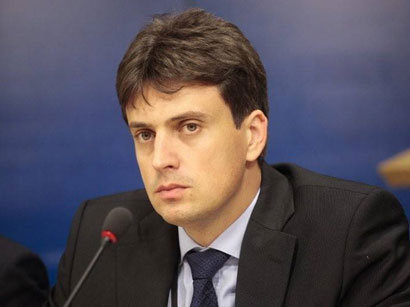
The Armenian-Azerbaijani Nagorno-Karabakh conflict is a great hindrance for the European Neighborhood Policy in the Southern Caucasus, Member of the European Parliament from Romania, Catalin Sorin Ivan said. He was answering to an inquiry of the European Azerbaijan Society (TEAS).
"The Eastern Partnership can only function if the partner states are peaceful and stable with each other," he emphasized.
In order to strengthen relations between the EU and six partner countries, the European Commission launched Eastern Partnership (EaP) initiative in 2009 and Azerbaijan became part of this initiative.
Ivan, who is also a member of the Group of the Progressive Alliance of Socialists and Democrats in the European Parliament, stressed that even the first Resolution adopted on Armenian-Azerbaijani conflict over Nagorno-Karabakh by the UN Security Council on April 30, 1993, demanded the withdrawal of the Armenian army from the occupied Azerbaijani territories.
He noted that the following resolutions have always renewed this request and therefore, the first step, which is the withdrawal of the army, must come from Armenia.
"The IDPs have the right to return to their homeland. The UN resolutions speak a clear language: Nagorno-Karabakh and the seven occupied regions belong to Azerbaijan. As soon as the resolutions are implemented, the IDPs can return," Ivan underscored.
According to Ivan, the Armenians should be interested in the soonest ending of the occupation policy. The willingness of the conflicting parties to negotiate is the most fundamental element, but mediators still play important role in every conflict.
"Armenia and Azerbaijan are both members of the OSCE, together with the Minsk Group they have deployed a board for the resolution of the dispute between the two states," he said.
He noted that the European Union is represented by a special representative in the Southern Caucasus.
"The most important stimulus for new peace negotiations would be Armenia's announcing its withdrawal from the occupied areas," Ivan stressed.
Armenia occupied over 20 percent of Azerbaijan's internationally recognized territory, including Nagorno-Karabakh and seven adjacent regions, after laying territorial claims against its South Caucasus neighbor that caused a brutal war in the early 1990s. Long-standing efforts by US, Russian and French mediators have been largely fruitless so far.
As a result of the military aggression of Armenia, over 20,000 Azerbaijanis were killed, 4,866 are reported missing and almost 100,000 were injured, and 50,000 were disabled.
The UNSC has passed four resolutions on Armenian withdrawal from the Azerbaijani territory, but they have not been enforced to this day.
Here we are to serve you with news right now. It does not cost much, but worth your attention.
Choose to support open, independent, quality journalism and subscribe on a monthly basis.
By subscribing to our online newspaper, you can have full digital access to all news, analysis, and much more.
You can also follow AzerNEWS on Twitter @AzerNewsAz or Facebook @AzerNewsNewspaper
Thank you!