
EU official urges Armenian efforts to agree on peace outline
By Nigar Orujova
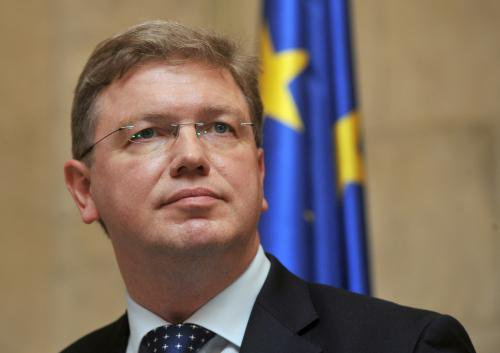
The European Union is ready to continue facilitating a settlement of the Armenia-Azerbaijan Nagorno-Karabakh conflict, EU Commissioner for Enlargement and Neighbourhood Policy Stefan Fule said in Yerevan July 10.
Fule arrived in Yerevan on July 9. According to the EU mission in Azerbaijan, he will not visit the Azerbaijani capital Baku.
Fule's meetings are planned with the Armenian leaders, including President Serzh Sargsyan, Prime Minister Tigran Sargsyan, as well as the leaders of pro-government and opposition parties and civil society representatives during the visit.
"We will continue to provide assistance to encourage progress in the conflict settlement and to support related peace-building activities," he said.
Fule urged Armenia to step up efforts with Azerbaijan to reach an agreement on the Madrid Principles, in accordance with the commitments made by the presidents of the two countries within the Minsk Group.
"I know this is a painful and difficult subject, but it is one that the European Union cannot hide from either in Baku or here, in Yerevan," Fule was quoted by Azerbaijan's state news agency AzerTac as saying.
Recently, a European Parliament delegation paid an official visit to Azerbaijan and met with Azerbaijani Foreign Minister Elmar Mammadyarov.
During the talks Mammadyarov expressed regret at the four relevant UN Security Council resolutions' being unenforced, and said the present status quo in the conflict is unacceptable.
Azerbaijan also urged OSCE Chairperson-in-Office Leonid Kozhara to intensify the efforts of the OSCE Minsk Group at a meeting of the Foreign Minister with the OSCE chief on July 8.
Kozhara in turn expressed concern over the problem of the Nagorno-Karabakh conflict settlement and voiced support for the Minsk Group's activity, adding that "we also consider it necessary to step up its activity."
The Minsk Group, co-chaired by France, the United States and Russia, has been mediating peace talks between Azerbaijan and Armenia since the two South Caucasus republics signed a precarious cease-fire in 1994 following a lengthy war.
The Karabakh conflict emerged in 1988 when Armenia made territorial claims against Azerbaijan. Armenia occupied over 20 percent of Azerbaijan's internationally recognized territory, including Nagorno-Karabakh and seven adjacent regions, after laying territorial claims against its South Caucasus neighbor that had caused a lengthy war in the early 1990s. The UN Security Council has adopted four resolutions on Armenia's withdrawal from the Azerbaijani territory, but they have not been enforced to this day.
Peace talks are underway on the basis of the peace outline dubbed the Madrid Principles, also known as Basic Principles. The document envisions a return of the territories surrounding Nagorno-Karabakh to Azerbaijani control; determining the final legal status of Nagorno-Karabakh; a corridor linking Armenia to the region; and the right of all internally displaced persons to return home.
Here we are to serve you with news right now. It does not cost much, but worth your attention.
Choose to support open, independent, quality journalism and subscribe on a monthly basis.
By subscribing to our online newspaper, you can have full digital access to all news, analysis, and much more.
You can also follow AzerNEWS on Twitter @AzerNewsAz or Facebook @AzerNewsNewspaper
Thank you!