
Mediators discuss Karabakh with OSCE chief after talks with foreign ministers
By Sara Rajabova
Progress in the settlement of the Armenia-Azerbaijan conflict over Nagorno-Karabakh was discussed on Tuesday at a meeting between the OSCE chief and the mediators brokering settlement of the long-standing dispute.
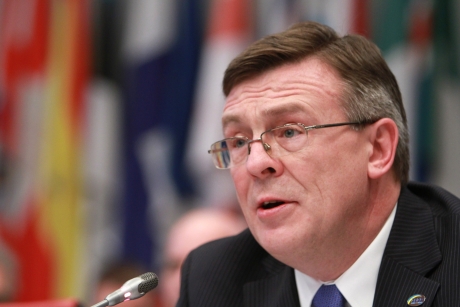
The talks between OSCE chairman, Ukrainian Foreign Minister Leonid Kozhara and the OSCE Minsk Group co-chairs - Igor Popov of Russia, Jacques Faure of France and Ian Kelly of the United States - as well as the OSCE chairperson's personal representative Andrzej Kasprzyk focused on the MG co-chairs' meeting last week in Paris with the foreign ministers of Azerbaijan and Armenia. During that meeting the mediators discussed a proposal to advance the peace process they had submitted to the sides late last year and views on possible confidence building measures.
Kozhara voiced full support to the efforts of the co-chairs aimed at strengthening the 1994 cease-fire -- which was signed following a brutal war between Armenia and Azerbaijan -- and helping the sides negotiate a peaceful settlement of the Nagorno-Karabakh conflict.
"It is a priority of Ukraine's OSCE chairmanship to work with the parties to advance this process to the extent possible, and I urge the sides to show the commitment and political will needed to finally bring peace to this region," Kozhara said.
Following the Paris meeting held on January 28, Azerbaijani Foreign Minister Elmar Mammadyarov and Armenia's Edward Nalbandian and the Minsk Group co-chairs stated their consent to a further discussion of the peace process in the coming weeks.
The OSCE mediators stated that the sides had reiterated their support for a peaceful settlement of the Nagorno-Karabakh conflict and their determination to continue the peace negotiations.
The ministers and the co-chairs also stressed the importance of the Minsk Group as the framework for negotiating a settlement of the conflict.
However, a senior Azerbaijani official recently said the results of the Paris meeting cannot be considered satisfactory.
'The results of this meeting do not differ from the outcomes of the previous meetings and didn't satisfy Baku," Deputy Foreign Minister Araz Azimov said.
Azimov stressed the importance of a new initiative in the negotiation process that has been put forward to the OSCE Minsk Group.
The deputy minister said the Minsk Group lacks new proposals, but is making an effort. "And the effort is that a push is needed for the movement of the process from the dead point," he said.
"Azerbaijan proposed the initiative, but, unfortunately, Armenia is not responding to it positively and still stands by its traditional position in the Nagorno-Karabakh conflict. This year, Armenia will hold presidential elections and possibly something might change after that. We should collaborate with the OSCE Minsk Group," Azimov said.
According to Azimov, Armenia is seeking to gain time, however, it does not understand that time is not in its favor.
"If they want to know who lost and who won in this matter, let them look at their own development and the development of Azerbaijan. Let no one doubt that Azerbaijan will return the occupied territories one way or the other. Therefore, I suggest undertaking practical steps," Azimov said.
The Nagorno-Karabakh conflict emerged in 1988 when Armenia made territorial claims against Azerbaijan. Since the lengthy war in the early 1990s that displaced over one million Azerbaijanis, Armenian armed forces have occupied over 20 percent of Azerbaijan's internationally recognized territory, including Nagorno-Karabakh and seven adjacent regions.
The UN Security Council has adopted four resolutions on Armenia's withdrawal from the Azerbaijani territory, but Armenia has not followed them to this day.
Peace negotiations are underway on the basis of a peace outline proposed by the Minsk Group co-chairs and dubbed the Madrid Principles, also known as Basic Principles. The document envisions a return of the territories surrounding Nagorno-Karabakh to Azerbaijani control; determining the final legal status of Nagorno-Karabakh; a corridor linking Armenia to the region; and the right of all internally displaced persons to return home.
Here we are to serve you with news right now. It does not cost much, but worth your attention.
Choose to support open, independent, quality journalism and subscribe on a monthly basis.
By subscribing to our online newspaper, you can have full digital access to all news, analysis, and much more.
You can also follow AzerNEWS on Twitter @AzerNewsAz or Facebook @AzerNewsNewspaper
Thank you!