
Think-tank: U.S. can't fully engage on Karabakh over Armenian lobby
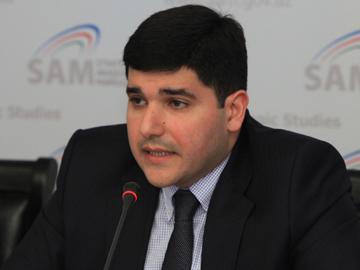
The United States cannot be closely involved in a fair resolution of the long-running Armenia-Azerbaijan conflict over Nagorno-Karabakh due to the influence of the Armenian lobby, the head of a leading Azerbaijani think-tank says.
"Over 20 years, the US policy in the region has been instrumental in strengthening the independence of Azerbaijan and Georgia and in the regional security process. However, due to the influence of the Armenian lobby, the U.S. cannot take an active part in an objective settlement of the Armenia-Azerbaijan Nagorno-Karabakh conflict -- the biggest threat to the security in the South Caucasus," Farhad Mammadov, director of the Center for Strategic Studies under the President of Azerbaijan.
Addressing the conference, "Role of Azerbaijani-American cooperation in regional peace and stability", on Friday, Mammadov said the situation in the region is volatile and it is impossible to create favorable conditions for a secure future without influence and even pressure from the outside.
"In our view, the U.S. is not active in this area. Statements that the resolution of the conflict depends on the free will of the parties are irresponsible to say the least. What will can we talk about when the aggressor state, Armenia, is putting forward unreasonable demands and trying to maintain the status quo by all means?" Mammadov queried.
The U.S., as the most powerful country in the world, can and should play a responsible role in the Karabakh settlement process, he believes.
Mammadov said "the beginning of a peace process advocated by Azerbaijan" will draw a new picture in the region.
"After the liberation of the occupied territories, the Armenian-Azerbaijani and Armenian-Turkish borders will be opened, and Armenia will be able to enjoy open borders, which promises a short-term 20% economic growth spurt," he said. "The status of Nagorno-Karabakh as part of Azerbaijan can be discussed for many years, because the new picture of the region will create a new reality and strengthen the independence of Armenia. Under no circumstances could resolution of the conflict pose a threat to US interests in the region. On the contrary, it will create [suitable] conditions for a safe and successful development of the region where all countries will enjoy partnership relations with the United States."
The Karabakh conflict emerged in 1988 when Armenia leveled territorial claims against its South Caucasus neighbor. Armenian armed forces have occupied 20 per cent of Azerbaijani territory, including Nagorno-Karabakh and seven surrounding regions, since a brutal war in the early 1990s.
Azerbaijan and Armenia signed a ceasefire agreement in 1994. Russia, France and the U.S., which co-chair the OSCE Minsk Group, are brokering peace talks. The negotiations have been largely fruitless so far.
Here we are to serve you with news right now. It does not cost much, but worth your attention.
Choose to support open, independent, quality journalism and subscribe on a monthly basis.
By subscribing to our online newspaper, you can have full digital access to all news, analysis, and much more.
You can also follow AzerNEWS on Twitter @AzerNewsAz or Facebook @AzerNewsNewspaper
Thank you!