
Regional leaders announce European transit area
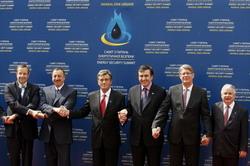
The leaders of seven countries convening for an energy summit in
Kyiv last week announced the establishment of a common European
transit area that will create a new route to take Caspian energy
resources to world markets.
A relevant declaration was signed by the presidents of Ukraine, Azerbaijan, Georgia, Latvia, Lithuania, Estonia, and Poland, as well as representatives of Bulgaria, Kazakhstan, Slovakia, the United States and the European Commission.
"The declaration was signed by the presidents of all countries represented. I believe this is a huge success," Ukrainian President Viktor Yushchenko said on Friday in conclusion of the two-day Energy Security Summit.
The document envisions setting up an energy transit area to link the Caspian, Black Sea and Baltic Sea regions. The key goal of the initiative is to build an oil pipeline stretching from Odessa, Ukraine to Gdansk, Poland to pave the way for Caspian crude exports to the European Union. This has become possible thanks to rapidly developing oil transport routes from Azerbaijan to Georgian maritime terminals. There, the oil can be shipped to Odessa by tankers for pumping to Poland through the Odessa-Brody-Plock-Gdansk pipeline. The pipeline is to be commissioned by 2010. This will be the second strategic export conduct bypassing Russia after the Baku-Tbilisi-Ceyhan (BTC) main export pipeline already pumping oil to energy-hungry Western markets through Azerbaijan, Georgia and Turkey.
The Ukrainian leader said the sides would set up a taskforce charged with developing the principles of the transit area. The first report of the working group will be heard at an energy summit in Baku in November.
Yushchenko expressed confidence that the Kyiv summit would go down in history. "Its key element is that today we started a formal dialog on creating a safe transit area."
Yushchenko noted that while discussing a common energy policy and matters concerning the transit area, the participants placed an emphasis on the development of the needed infrastructure.
The Ukrainian president reminded that initial results of the feasibility study on transporting Caspian oil to European markets through the Odessa-Brody-Plock-Gdansk pipeline were announced on the first day of the summit. "European energy security hinges on us," Yushchenko said, adding that he had talks with Azerbaijani President Ilham Aliyev on supplying oil for the pipeline.
Yushchenko further offered Kazakhstan and Azerbaijan, the two resource-rich countries that Kyiv sees as key suppliers for the new energy corridor, to build oil refineries in its territory. He suggested that the Central Asian state and the South Caucasus republic explore Ukraine's existing potential and build such facilities along the route of the Odessa-Gdansk pipeline. "The pipeline is very economically viable," Yushchenko added.
In conclusion of the summit, the participants signed the Kyiv Declaration on the principles of global energy security. A joint statement of the Azerbaijani, Georgian, Lithuanian, Polish, and Ukrainian leaders on the Eurasian oil transport corridor project was inked as well.
Azerbaijani President Ilham Aliyev positively assessed the outcomes of the summit. "The energy corridor being announced by our regions leads to further development of our cooperation. A transport corridor, a humanitarian corridor -all this will promote understanding among our countries and serve common interests."
Aliyev emphasized that the summit participants included producers, transit states and consumers of energy resources. "This is a very good example of how all these components of energy policy should be converged."
Aliyev said that Azerbaijan, as an oil and gas producer, has already surmounted the main challenges in the area of energy supplies and managed to diversify supplies of hydrocarbons to the markets of various countries.
"We are working very closely to support our partner friends - not only producers but also consumers, so that the latter can choose suppliers on the basis of competition," the president added.
The summit was attended by representatives of 30 states, along with those of the UN, OSCE and other international groups.
Here we are to serve you with news right now. It does not cost much, but worth your attention.
Choose to support open, independent, quality journalism and subscribe on a monthly basis.
By subscribing to our online newspaper, you can have full digital access to all news, analysis, and much more.
Subscribe
You can also follow AzerNEWS on Twitter @AzerNewsAz or Facebook @AzerNewsNewspaper
Thank you!