
Intellectual games encouraged in Azerbaijan
By Nigar Orujova, Azernews Staff Writer
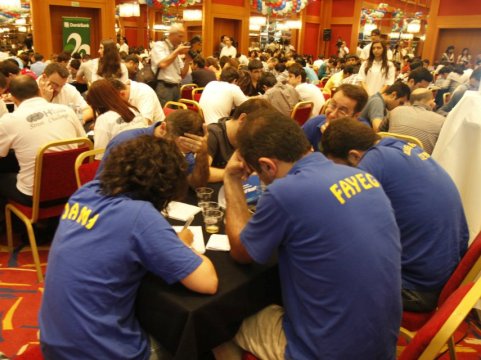
Seventeen Azerbaijani teams vied in the intellectual tournament traditionally held in Batumi, Georgia, on July 27-29. The Black Sea Open Cup 2012 brought together numerous clubs from four countries - Georgia, Azerbaijan, Russia and Armenia.
The "best brains" competed in different intellectual programs, such as What?Where?When?, Brain Ring, Texas Holdem Poker, Khamsa, and Your Own Game [Svoya Igra].
The tournament aimed to promote intellectual games in the regions and awarded winners of each game with cups, medals and diplomas.
The Azerbaijani team of Faig Huseynov and Balash Kasumov took third and fifth place respectively in What?Where?When? tournament, while in Khamsa the national team claimed bronze. Kasumov and Huseynov's teams came third and fourth in the Brain Ring tournament. The winner of all games was the Russian team of Maxim Potashev.
Fourteen teams from Georgia, 17 from Azerbaijan, four from Russia and four from Armenia participated in the tournament.
The intellectual games movement in Azerbaijan dates back to 1989, when the Ateshgah club was established; nowadays the club is co-founder of the "What? Where? When?" International Association. Games are played in the Russian language every weekend. The club has won the prestigious "Crystal owl" prize several times.
The Azerbaijan Intellectual Clubs Association and the Azerbaijan Federation of Intellectual Games (AIOF), which were founded in June 2012, are aimed to stimulate and oversee the intellectual games movement in the country. The federation provides every support to teams and clubs to ensure their participation in international tournaments.
"We have achieved our goal. Intellectual games are becoming very popular in Azerbaijan and the number of participants increases by the day," Seymur Teymurov, executive director of AIOF and chairman of Khazar club, told the local media.
Two more clubs, Khazar and Turan, were founded in 2001 and 2004 respectively.
Khazar has held intellectual games at the Baku State University, Azerbaijan Medical University, Azerbaijan Technical University, Azerbaijan University of Languages, and Baku Slavic University every weekend in Azerbaijani language.
Turan, in its turn, united 25 teams, which played in Russian language two days a week.
Popularity
Intellectual games are expanding throughout the country, involving more and more people.
Fuad Eminov has played What? Where? When? for 12 years now. "I was encouraged by Rufat Abdulla, a friend of mine, who is now one of the best game experts in Azerbaijan," he said.
"I have played in a number of teams. In some of them I was the strongest player, but I also enjoy being the weakest one to refine myself," Eminov said.
"The game is not just a game for me. I like the communication between the team experts, weak and strong members are important in the game. I have never heard about Doppler effect, for example, but each game gives me more knowledge," said Eminov.
"I absorb all the information possible; it helps me in my private life and profession. I'm a lawyer and I need to have analytical thinking. Detailed analysis ability is what I gained from this game," Eminov noted.
"Personal relationships is another advantage of the game, I get acquainted and make friends with a lot of interesting people. I appreciate it very much," he said.
Recent achievements
The Azerbaijan Association of Intellectual Games headed by well-known Azerbaijani expert Balash Kasumov was set up to promote the existing intellectual clubs and teams and to establish new ones in the country's regions. The Association comprises popular Azerbaijani clubs, including Diplomat, Azerbaijan and Igtisadchi (Economist), Kasumov said. He added that the Association is open to anyone who wants to encourage the intellectual games movement in Azerbaijan.
It is worthy of note that Balash Kasumov's team won the "What?Where?When?" 2012 games, defeating 40 top teams of the country, and gained the right to represent Azerbaijan at the 10th world "What?Where?When?" tournament due in Saransk, central Russia, on September 7-10.
According to the Governmental Youth Program for 2011-2015, more clubs are to be set up in Azerbaijani regions.
In this connection, the Association has contributed to opening an intellectual club in the northern Guba region on July 11.
Beylagan intellectual club was established in the Beylagan region of Azerbaijan on July 18 with the help of MIL and Khazar clubs. The Beylagan club plans to hold not only the traditional What?Where?When?, Brain Ring and Khamsa games, but also some other intellectual games.
Other intellectual clubs were opened in Sumgayit, Sabirabad, Ganja, Goygol, Ujar, Lankaran, Shabran, Qakh, Balakan and Nakhchivan regions and cities with the assistance of AIOF, Khazar club and other organizations.
According to Ramina Mahmudova, chairperson of the Public Association on Intellectual Youth Organization YURD, the clubs will promote public and intellectual activity of youths in the regions.
The capital Baku frequently hosts traditional intellectual games. For instance, the recent fifth Independence Cup tournament showed the high skills of Azerbaijani youths, who spent their spare time on self-development.
Another Azerbaijan Cup tournament will start in Nabran, north Azerbaijan, under the auspices of AIOF on August 18-19. The tournament, which comprises four stages, will further be held in the country's regions.
"The Azerbaijan Intellectual Overall Cup will promote and popularize the intellectual movement in the regions and attract more and more youths," said AIOF executive director Seymur Teymurov. Teymurov added that the tournament will support the governmental youth program.
Youths' choice
More and more youngsters in Azerbaijan, and particularly in Baku, are participating in the movement.
"Intellectual games are the best rest and work for your brain at the same time," said Sevil Gadirli, who joined the intellectual games movement in 2007.
"While discussing a new issue your mind is free from other problems, you just forget about them. That's why I enjoy the process more than the result," Sevil said.
"However, I'm more grateful to the game for the people I got acquainted with. The company of ambitious and intelligent young people is the only reason for me to come to the game each Sunday," she said.
Public support
Along with governmental programs, non-governmental clubs and organizations promote the intellectual movement by holding intellectual games and tournaments. Such entities as the National Assembly of Youth Organizations of the Republic of Azerbaijan (NAYORA) and its member organizations play a leading role in promoting intellectual programs in the country.
One of them, namely, Atasigorta insurance company, recently held a Brain Ring tournament for business sphere journalists on the occasion of the National Press Day. The main goal was to increase the intellectual knowledge of journalists, foster a link with mass media and arrange useful rest. The winning teams were awarded.
Here we are to serve you with news right now. It does not cost much, but worth your attention.
Choose to support open, independent, quality journalism and subscribe on a monthly basis.
By subscribing to our online newspaper, you can have full digital access to all news, analysis, and much more.
You can also follow AzerNEWS on Twitter @AzerNewsAz or Facebook @AzerNewsNewspaper
Thank you!