
Aliyev addresses UNSC, `decisively condemns` terror
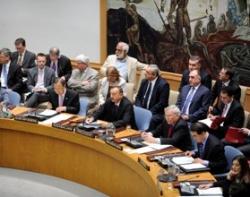
The United Nations Security Council discussed stepping up international efforts to combat terrorism at a high-level meeting in New York last Friday chaired by Azerbaijani President Ilham Aliyev.
President Aliyev told the UNSC that terrorism is a serious threat to international peace and security, as well as the protection of human rights and fundamental freedoms, democracy, political independence and territorial integrity of countries, and, finally, economic and social development of the UN member states.
``Azerbaijan decisively condemns all forms and manifestations of terrorism,`` Aliyev said at the meeting. ``We believe that all acts of terror are grave crimes, they must be condemned, and their perpetrators brought to book. Terrorists should never be allowed to substantiate their wrongdoing. No terror attack, regardless of its reasons, can ever be substantiated. Terrorism has changing essence and appearance, and in many cases it is linked to aggressive separatism, extremism and organized crime.``
Aliyev said that in the regions facing armed conflict, particularly, in the territories that are under foreign military occupation, as a rule, suitable conditions emerge for terrorists` bargaining with ``those who are in that area``.
Azerbaijan became a non-permanent member of the 15-seat UNSC from Eastern Europe for two years for the first time after a hard-won victory last October, achieving one of the most remarkable successes in its 20-year-long independence history. It was finally elected with 155 ballots after Slovenia withdrew its bid and the UN General Assembly picked Azerbaijan in a 17th round of balloting. The South Caucasus republic embarked on its duties on January 1, 2012. Azerbaijan`s representation in the most influential international organization alongside its powerful permanent members -- the U.S., China, Russia, Britain and France -- is a graphic example of the world community`s support and attaching importance to Baku`s policy and President Aliyev`s political course.
Azerbaijan assumed a month-long presidency at the UNSC from May 1.
Aliyev also spoke about terrorist acts perpetrated by Armenia against Azerbaijan.
``Azerbaijan has been a direct target of terrorist activity orchestrated from the outside. The Republic of Armenia has committed tens of terrorist attacks against the civilian population and infrastructure of Azerbaijan. As a result, over 2,000 Azerbaijanis were killed. Armenia committed these terror attacks, masterminded with direct involvement of its power-wielding agencies, using international terror groups. During the active phase of the Armenia-Azerbaijan Nagorno Karabakh conflict, along with a military aggression, Armenia widely used terror attacks against civilian population in order to carry out ethnic cleansing. These atrocious acts reached their culminating point in February 1992 with the annihilation of [unarmed civilian] population of Khojaly. 613 innocent people were killed then, including women, children and elderly. Over 100 women and 63 children were slain. Armenia also attacked civilian population by committing acts of terror in public transport and the locations of important infrastructure away from the conflict zone, such as the 1994 bomb blast in the Baku subway.``
A fragile ceasefire has been in place in the region since a brutal war between the two South Caucasus neighbors that claimed some 30,000 lives and displaced about one million Azerbaijanis from their homes. Armenia has since occupied 20 percent of Azerbaijan`s territory, despite four UN resolutions on an unconditional pullout of its armed forces and condemnation by a number of other international groups. Peace talks, brokered by the United States, Russia and France through the OSCE Minsk Group, have been largely fruitless so far.
Aliyev said that though Azerbaijan has largely fenced off the threat of terrorism posed by arch-foe Armenia, these risks remain high.
``We are still witnessing frank statements and opinions that a number of terror attacks, including such acts as attacks on Azerbaijan`s civilian infrastructure, particularly, water reservoirs and dams and the pipeline network, are a legitimate military tactics,`` the Azerbaijani leader said. ``This definitely may cause deaths of hundreds of thousands of civilians. Pockets of international terror cells are integrated into Armenia`s defense and security sector. When you see that a country trying to display its adherence to European and universal values presents members of international terror groups as heroes and erects monuments to honor them, you feel regret.``
Aliyev called for a ``comprehensive convention`` on international terrorism, saying it would be ``an effective tool`` in anti-terror efforts. He said such an agreement could effectively prevent states from organizing, financing, and providing training for terrorist activities.
He also emphasized that the international community needed to prevent states from promoting terrorism, in addition to terrorist groups.
President Aliyev was congratulated at the Council`s meeting on Azerbaijan`s UNSC presidency by a number of senior officials, including the foreign ministers of Germany, Togo and Morocco, Guido Westerwelle, Elliott Ohin and Youssef Amrani, US Ambassador to the U.N. Susan Rice, Russian special representative for the fight against terrorism and organized crime, Alexander Zmeyevskiy, Colombia`s Deputy Minister of Multilateral Affairs Patti Londono, as well as representatives of China, Pakistan, UK, India, South Africa, Guatemala, France and Portugal. They noted that terrorism is the biggest threat for the world and expressed their support for the UN measures taken in this area.
Azerbaijan, which took over UNSC chairmanship from the United States, will chair the organization in May 2012 before handing it over to China, and will also preside it in September 2013. The UNSC`s agenda in May includes the situation in the Middle East, nuclear non-proliferation, the Syria crisis, developments ongoing in Africa and the Balkans, as well as other key issues such as anti-terror combat and international security.
Analysts say UNSC presidency grants Azerbaijan a number of advantages. But this does not mean its long-standing conflict with Armenia will be put on discussion. However, presidency at the U.N. council will allow Baku to bolster its clout on the world stage and to play a key role in issues of concern for the UNSC`s permanent members, which could foster a change in the superpowers` stance on the Karabakh conflict.
Here we are to serve you with news right now. It does not cost much, but worth your attention.
Choose to support open, independent, quality journalism and subscribe on a monthly basis.
By subscribing to our online newspaper, you can have full digital access to all news, analysis, and much more.
You can also follow AzerNEWS on Twitter @AzerNewsAz or Facebook @AzerNewsNewspaper
Thank you!